
Political leaders such as Canadian Prime Minister Mark Carney have urged the world’s “middle powers” to unite in defense of democracy and the liberal rules-based order. While laudable, such appeals rest on an outdated conception of middle powers as largely benign democratic actors committed to providing global public goods. In reality, many middle powers are authoritarian and are more likely to contribute to the erosion of global norms and institutions than to efforts to sustain them. Drawing on evidence from cases including the United Arab Emirates, Saudi Arabia, and Turkey, this essay presents a new framework to understand how authoritarian middle powers use alliances with their democratic counterparts to hedge their bets while simultaneously undermining liberal multilateral institutions, promoting autocratic ideals, and engaging in cross-border repression. These practices merit greater attention because they serve to dilute global human-rights commitments, normalize authoritarian governance, and accelerate the unravelling of the international rules-based order.
The current worldwide wave of autocratization poses one of the most serious tests to the global architecture long thought to structure international politics: the liberal rules-based international order that, since 1945, helped coordinate cooperation on everything from trade to climate to security. Concerns about the erosion — and potential collapse — of this framework have intensified in recent years in response to the increasingly unilateral and coercive conduct of powerful states. Actions such as Russia’s unprovoked invasion of Ukraine, U.S. president Donald Trump’s public threats to assert control over Greenland, alongside China’s growing use of economic coercion and territorial pressure in regions such as the South China Sea, have alarmed Western allies and raised questions about the durability of established norms of cooperation and sovereignty.
Against this backdrop, Canadian prime minister Mark Carney used his address at the January 2026 World Economic Forum in Davos, Switzerland, to issue a stark assessment of the global situation and to call on “middle powers” to step up. Carney declared that the post–Cold War rules-based international order had experienced “a rupture, not a transition,” and warned that powerful states were increasingly using economic integration, tariffs, and supply chains as instruments of coercion rather than cooperation. In blunt terms that resonated across international audiences, he argued that “middle powers must act together, because if we’re not at the table, we’re on the menu,” and that genuine cooperation among states of intermediate capacity offered one of the few viable paths for sustaining a more resilient, values-based world order.
While this call for collective action is understandable, it rests on an assumption about the nature of middle powerdom that no longer holds. Classic middle powers such as Australia, Canada, and Norway were once seen as consensus-oriented states committed to providing global public goods and strengthening the rules-based international order — in part because they were democratic states committed to liberal ideals. In recent years, a new kind of authoritarian middle power has emerged with very different foundations and goals, epitomized by the growing assertiveness in global politics of states such as the United Arab Emirates (UAE) and, until recently, Venezuela. The global impact of these states has tended to be overlooked in favor of a focus on China, Russia, and, of late, the United States, but this is a major oversight because authoritarian middle powers have, in their own right, played an important role in weakening the foundation of the rules-based order: by promoting authoritarian norms and practices, weakening the capacity of multilateral institutions to uphold democratic and human-rights standards, and sustaining some of the world’s deadliest civil conflicts. In other words, many middle powers cannot be part of the solution because they are part of the very problem that leaders such as Carney hope to address.
The behavior of these authoritarian midlevel states is motivated by strategies of regime survival. Because foreign policy is systematically subordinated to shoring up regimes against regional rivals and domestic challenges, it is often self-serving, short-termist, and volatile. We therefore need to leave behind existing understandings of middle-power behavior based on democratic exemplars in order to understand how their authoritarian counterparts are reshaping world politics. Drawing on a thorough review of authoritarian middle-power behavior across five continents, we demonstrate that the distinctive combination of midsized power and undemocratic governance produces a form of international behavior marked by three core features. First, authoritarian middle powers routinely combine hard and soft power to pursue their goals. This includes collaborating with other governments to target dissidents abroad, arming allied governments and proxy actors in neighboring states, and deploying cross-border disinformation campaigns and cyber operations that weaken democratic debate and electoral integrity.
Second, their midlevel power heightens their awareness of the risks of acting alone. Democratic middle powers historically responded to this constraint by promoting multilateralism and coalitions designed to strengthen democratic cooperation. Authoritarian middle powers adopt a similar logic, remaining deeply engaged in regional and international forums through a strategy of hedging, which involves maintaining ties with a wide range of partners to blunt external threats and enhance regime durability. States that fail to hedge effectively risk coercion, isolation, or even regime-threatening intervention — a dynamic illustrated starkly by the overthrow of Venezuelan president Nicolás Maduro by U.S. forces in January 2026. As a result, authoritarian middle powers often remain embedded in democratic institutions and alliances, even as they work from within to weaken democratic safeguards and make multilateral arenas more supportive of their politics and strategies. Their engagement with multilateralism thus becomes a vehicle for democratic erosion rather than democratic cooperation.
This dynamic feeds into a third key feature: Many authoritarian middle powers actively work to weaken global commitments to democratic norms and human rights. States such as Egypt and Turkey, for example, have emphasized alternative principles — such as state sovereignty or the right to development — while diluting protections for freedom of expression, electoral integrity, and political accountability. When coordinated with authoritarian great powers, including China, these efforts undermine democratic norms at the global level and make it harder for democratic institutions to respond effectively to backsliding, reducing democratic resilience.1
None of these strategies is unique to authoritarian middle powers individually. What is distinctive is their combination and the consequences it generates. Great powers also deploy hard power, but do so under conditions that reduce reliance on hedging and reputational management. Small states, by contrast, depend heavily on hedging, diplomacy, and international branding, but generally lack the capacity to deploy hard power beyond their borders. Authoritarian middle powers sit between these poles, combining coercion, hedging, and legitimation in ways that allow them to manage vulnerability, project influence, and secure regime survival simultaneously.
The role of middle powers is therefore of profound and growing importance for the future of democracy, but not quite in the way that the likes of Carney imagine. At a moment when democratic norms are increasingly contested, midsized authoritarian states are practicing a markedly different form of global citizenship from that associated with their democratic forebears. While they do not seek to overthrow the liberal international order outright, by selectively working within and against it — disrupting its operation while undermining the appeal and practice of democracy and liberal internationalism — they make a powerful contribution to the global autocratic wave. In doing so, they are reshaping the rules of the rules-based order in ways that weaken democratic accountability and entrench authoritarian advantage.
The Growing Influence of Authoritarian Middle Powers
Countries such as the UAE, Saudi Arabia, and Turkey qualify as middle powers because they “make no claim to the title of great power, but have been shown to be capable of exerting a degree of strength and influence not found in the small powers.”2 Like the democratic middle powers that attracted attention in the late 1940s and again in the 1990s, these states lack the capacity to compete directly with great powers. Yet their midlevel military and economic resources enable them to exert substantial influence over their own neighborhoods and — when acting in concert — over multilateral institutions that shape democratic norms and practices.
Despite their growing import, research on these authoritarian middle powers remains fragmented. Along with the absence of a common definition, this has limited systematic comparison and obscured their broader patterns of influence. To move toward a new framework of middle-power behavior, we anchor our analysis in states’ relative military and economic capacity. On this basis, a middle power is defined as a country that ranks below tenth and above fifty-sixth globally on both dimensions, placing them beneath great powers but well above the average “small” power.
As the Table shows, on this basis the number of middle powers has remained relatively stable since 2000. There were 39 middle powers in 2000 and 44 in 2023. With the exception of India, which crossed the threshold into great-power status, most states that were midsized two decades ago remain so today, joined by a small number of new entrants. What has changed far more dramatically is the political composition of this group. In 2000, nine middle powers were governed by authoritarian regimes. By 2023, that number had risen to fifteen. This increase is partly due to the accession of new middle powers that are not democratic, such as Bangladesh, Iraq, Nigeria, and Qatar — though Bangladesh’s future trajectory remains uncertain following the ouster of Sheikh Hasina and the February 2026 elections. The shift becomes even more striking when autocratizing states are included. Among today’s middle powers, six — Greece, Indonesia, Mexico, Peru, Romania, and South Korea — have recently experienced episodes of democratic erosion.
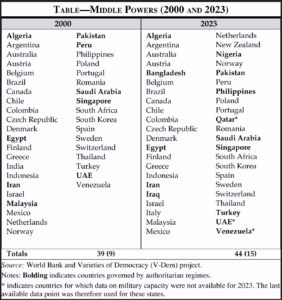
These figures point to a clear trend: Nondemocratic middle powers are becoming more prevalent. States that are either authoritarian or moving away from democratic politics now account for close to a third of all middle powers, compared with roughly a quarter in 2000. This represents a significant rebalancing of influence between democratic and nondemocratic middle powers. Just as important, authoritarian middle powers are now found across all major regions. While they have sometimes been described as “Southern” or “emerging” powers, neither label adequately captures the phenomenon. Authoritarian middle powers are not confined to the Global South — especially once autocratizing cases are included — and many were already firmly midsized a quarter-century ago. Rather than newly emergent actors, several have long exercised regional influence, consistent with established understandings of middle-power behavior. But the global wave of autocratization is amplifying their influence and impact.
Understanding the politics of authoritarian middle powers should therefore be a priority. Like their democratic counterparts, their conduct remains shaped by their midlevel material capabilities. But unlike countries such as Canada and Norway, this is increasingly filtered through authoritarian political logics. Above all, the foreign policy of authoritarian middle powers is driven by regime survival, with international engagement deployed to preempt external pressure, divert attention from domestic repression, and construct coalitions that help incumbents to retain power.
These survival-oriented strategies are not deployed in isolation, but rather through a variety of interconnected policies and approaches. Typical authoritarian middle powers combine coercive tools with softer forms of engagement, including diplomacy, mediation, and selective alliance-building, often within multilateral settings that provide political cover from external pressure. Hedging across overlapping networks — including those led by democratic states — allows regimes to diversify sources of support, reduce dependence on any single patron, and limit exposure to sanctions or isolation. The constraints of midsized power also heighten reliance on ideas, identity, and claims to legitimacy as instruments of international influence. We examine how these dynamics play out across three key domains: foreign policy and power projection, engagement with multilateral institutions, and efforts to legitimize authoritarian governance by reshaping norms and narratives. Taken together, these different dimensions reveal how authoritarian middle powers convert midsized capabilities into durable influence while systematically weakening democratic constraints at home and abroad.
Projecting Power, Protecting Authoritarian Rule
Foreign policy is typically understood as a means through which states pursue influence and security beyond their borders. For authoritarian middle powers, however, external engagement is shaped less by abstract strategic goals than by the imperative of regime survival. While they invest heavily in prestige diplomacy designed to position themselves as actors of international importance — often described as soft power — authoritarian middle powers have also shown a readiness to deploy coercive hard power when it serves domestic political ends. These strategies are not incidental. They are designed to deter external threats, preempt internal challenges, and reshape international environments in ways that reduce pressure for democratic reform.
Taken together, these efforts generate concrete benefits for regime stability. Transnational repression — including surveillance, intimidation, and the targeting of dissidents abroad — undermines the confidence and capacity of critical voices while preventing the consolidation of organized opposition, a pattern which Nate Schenkkan describes as a defining feature of a new “golden age” of authoritarian cross-border coercion.3 Securing regional dominance can bolster domestic support by fostering national pride, intimidating neighboring governments, and insulating regimes from future threats posed by rival states. Prestige diplomacy, for its part, can enhance a state’s international profile, increasing its influence within multilateral forums and bilateral relationships. Under favorable conditions, this influence can translate into greater access to resources and diplomatic cover for both domestic and international objectives, including tolerance of human-rights abuses and democratic backsliding.
Projecting military force abroad has long been recognized as a means of signaling resolve, influence, and power. For authoritarian middle powers, it also functions as a tool of internal control, demonstrating strength to domestic audiences while neutralizing perceived external and internal challengers. In recent years, states including Turkey, Saudi Arabia, Iran, and the UAE have deployed hard power in ways that increasingly resemble the strategies of larger powers. Turkey’s military interventions in Syria, for example, have weakened Kurdish groups regarded as threats to the regime, expanded Ankara’s regional influence, and enabled the forging of new alliances. Iran and Saudi Arabia, meanwhile, have engaged in proxy warfare in Yemen not only as part of an ideological rivalry, but to prevent the consolidation of regional dominance by a rival in a strategically important space.
What distinguishes authoritarian middle powers is not simply their willingness to use force, however, but the ambition and calculation behind it. Some states, such as Iran and Saudi Arabia, pursue overt regional hegemonic goals, while others — including Turkey and the UAE — seek to punch above their geographic and demographic weight. The Horn of Africa has emerged as a key arena for these ambitions.4 The UAE, in particular, has used military assistance, arms transfers, and security partnerships to extend its influence in Somalia and Sudan. In the former, it backed the government against al-Shabab. In the latter, it has fueled conflict through its support for the rebel paramilitary group Rapid Support Forces, which stands accused of crimes against humanity. These cases illustrate how military diplomacy and arms provision can create long-term political leverage, extending influence well beyond immediate neighborhoods.
Authoritarian middle powers have also innovated in the forms of hard power they deploy. Investment in domestic arms industries has become a means of enhancing international standing, while creating dependencies abroad. Turkey’s defense sector provides a clear example. Ankara has transformed itself into a significant arms exporter, particularly through its drone program. As a rising “drone power,”5 Turkey has reshaped battlefield dynamics in multiple conflicts, locked in security relationships with recipient states, and raised its international profile. Domestically, President Recep Tayyip Erdo¢gan has explicitly tied advances in defense production to national pride and regime competence, seeking to convert military innovation into political support.
These assertive strategies contrast sharply with the largely status quo–oriented regional approaches pursued by democratic middle powers in previous decades and more closely resemble the tactics associated with great powers. Such strategies are also inherently destabilizing. The decline of U.S. global hegemony, combined with the ability of authoritarian middle powers to offset the risks of crossing international red lines by cultivating ties with China and Russia, has reduced the costs of coercive behavior. This has further emboldened the use of hard power, even as it deepens regional instability and erodes democratic norms.
Authoritarian middle powers have therefore sought to offset coercion with softer forms of power that carry lower risks and reputational costs. Soft-power diplomacy is used to signal responsibility and international relevance, often mirroring the practices of democratic states. Prestige diplomacy and transactional development assistance have become central tools in this effort. High-profile mediation has been particularly important. States such as Qatar, Turkey, and Saudi Arabia have positioned themselves as indispensable intermediaries in regional and global conflicts. Qatar, for example, has leveraged its diverse network of relationships — including ties to the United States, Hamas, and a range of regional actors — to mediate conflicts from Gaza to Venezuela. Such efforts raise international standing while reinforcing an image of constructive global citizenship, even as domestic political space remains tightly controlled.
Other forms of prestige diplomacy focus on symbolic and cultural arenas. Sport has proven especially attractive. Qatar’s hosting of the 2022 World Cup and Azerbaijan’s staging of the 2015 European Games exemplify the use of mega-events to deflect attention from repression and rights abuses. Ownership of major sports teams, such as Emirati vice-president Sheikh Mansour’s investment in the Manchester City Football Club, serves a similar function, embedding authoritarian elites within globally admired institutions and normalizing their political authority.
Development assistance has also become an important tool of influence. Authoritarian middle powers deploy aid to cultivate a reputation for generosity while deepening political leverage over recipient states.6 Most notably, Saudi Arabia, the UAE, and Turkey have expanded their aid footprints precisely as Western engagement has receded. In addition, “emerging donors have stepped in to aid countries not serviced by the Western-led aid community.”7 Unlike Western donors, these emerging donors rarely attach conditions related to democratic reform or human rights, which makes them attractive partners for autocratic and autocratizing regimes. The result is a parallel aid ecosystem that sustains authoritarian governance and weakens democratic conditionality. In Sheikh Hasina’s increasingly authoritarian Bangladesh, for instance, reductions in Western assistance, in part linked to democratic concerns, were offset by increased support from authoritarian and autocratizing donors — most notably India, but also China, Saudi Arabia, and the UAE — enabling her government to maintain capacity without meaningful reform.
The combined use of hard and soft power highlights the breadth and flexibility of authoritarian middle-power foreign policy. It also exposes its contradictions. States that portray themselves as peace brokers while fueling proxy conflicts, or as generous donors while repressing dissent, operate within a strategy of deliberate ambiguity. Hedging is central to this approach: Authoritarian middle powers seek influence while minimizing exposure to retaliation.
Yet this ambiguity carries risks. As ambitions expand, so too does the potential for miscalculation. While authoritarian middle powers have developed innovative ways to project influence, they remain vulnerable to the volatility they help to generate. Overestimating the protection afforded by alliances or misjudging the tolerance of major powers can trigger instability or escalation. Moreover, their calculated use of hard and soft power — working simultaneously within and against the liberal international order — contributes to a more unstable international environment, particularly in the regions closest to their reach.
Working Within and Against the Rules-Based Order
Democratic middle powers have long been cast as guardians of multilateralism and liberal internationalism. Contrary to widespread assumptions, however, their nondemocratic counterparts have neither ignored nor rejected multilateralism. What is distinctive is the way they engage strategically to advance regime survival and blunt democratic pressure. In global organizations such as the United Nations, middle powers have worked to dilute liberal commitments by reshaping agendas, language, and voting coalitions. Such states have also used regional organizations, old and new, to advance authoritarian counternorms and counterpractices.8 Formal multilateralism is not the only arena in which this occurs. Authoritarian middle powers also operate through less formal networks and ad hoc coalitions among states with shared interests. What emerges is a sophisticated strategy of authoritarian multilateralism — one that seeks not to dismantle international institutions, but to make them safer for authoritarian rule by reshaping them from within.
This strategy is particularly visible in coordinated voting and sponsorship patterns at the United Nations. Counties such as Egypt, Pakistan, Saudi Arabia, the UAE, and Indonesia have repeatedly worked together in the UN General Assembly and the UN Human Rights Council (UNHRC) to block country-specific scrutiny, weaken investigative mandates, and dilute resolutions addressing democratic erosion. Rather than rejecting human-rights language outright, these states have focused on procedural obstruction and textual revision, substituting references to democracy and civil and political rights with appeals to dialogue, technical cooperation, and national ownership. Acting collectively, they have been able to exert influence disproportionate to their individual power, reshaping outcomes through coalition-building rather than vetoes.
Recent empirical evidence underscores the cumulative impact of these practices. Using systematic text analysis of UN resolutions and debates, Jennie Barker shows that references to democracy and political rights have declined across key forums such as the General Assembly, while language emphasizing sovereignty, development, and noninterference has become more prominent.9 These shifts are not driven solely by authoritarian great powers. Instead, they reflect the sustained efforts of voting coalitions in which authoritarian middle powers play a central coordinating role. Over time, this incremental recalibration has reduced the visibility and salience of democracy within the UN system itself, weakening a key normative environment in which democratic accountability is meant to operate.
Important multilateral bodies, most notably the UNHRC, have therefore become sites of sustained contestation in which authoritarian middle powers coordinate to weaken democratic scrutiny.10 Spearheaded by China and Russia but actively supported by states such as Egypt and Venezuela, these efforts have recast human rights through a developmental and sovereignty-first lens. The shift away from civil and political rights toward the “right to development” blunts external criticism while legitimizing repressive domestic practices.11
The Like-Minded Group (LMG), a loosely coordinated bloc of nearly thirty states, has notably played a central role in advancing claims of civilizational pluralism. Comprising core authoritarian and autocratizing powers — including Indonesia, Egypt, and Venezuela — the LMG has worked to resist democratic oversight at the UN by emphasizing noninterference, cultural relativism, and the primacy of state sovereignty. A 2014 Egyptian statement illustrates this approach, calling for respect for sovereignty alongside a greater focus on the “right to development.”12 While recognition of global diversity corrects Western dominance, these claims have also been used to delegitimize scrutiny and insulate governments from accountability for democratic backsliding and rights abuses.
While global institutions remain important, regional arenas often provide greater room to maneuver. Across Latin America, Southeast Asia, and Central Asia, authoritarian middle powers have promoted what has been termed “authoritarian regionalism”:13 the creation and manipulation of regional bodies to legitimize autocracy and facilitate regime survival. These organizations provide financial and diplomatic support to friendly regimes, coordinate repressive practices such as surveillance and extradition, and enshrine authoritarian norms through public endorsement.14 The Association of Southeast Asian Nations (ASEAN) illustrates this dynamic. Beyond economic integration, ASEAN has served as a platform through which authoritarian middle powers resist democratic openings and, at times, facilitate cross-border repression.
To secure these advantages, leaders have gone beyond subverting existing bodies and have revitalized moribund organizations or created new ones. The Organization of Turkic States (OTS) and the Bolivarian Alliance for the Peoples of Our America (ALBA) exemplify this trend.15 Established by Cuba and Venezuela — and later joined by Bolivia, Ecuador (until 2018), and Nicaragua — ALBA was explicitly intended as an alternative to institutions such as the Organization of American States (OAS), viewed as U.S.-dominated, overly critical of authoritarian practices, or insufficiently aligned with anti-imperial and socialist goals.
Another telling example is the Gulf Cooperation Council (GCC), established in 1981 by Arab Gulf monarchies in the wake of the Iranian revolution and regional tensions. Since then, the GCC has evolved into a platform for military and political cooperation, including mutual support in managing domestic opposition — notably contributing to the suppression of popular protest in Bahrain in 2011. The GCC has also evolved into a platform through which member states coordinate activities and narratives to buffer themselves against external pressures from great powers.
In this way, authoritarian regional bodies function as both strategically useful alternatives to their democratic counterparts and insurance mechanisms against pressure to democratize. Unsurprisingly, the number of authoritarian-dominated regional organizations has grown and now outnumbers democratic regional bodies.16 In doing so, they have become key vectors through which authoritarian middle powers cultivate regions that tolerate, and sometimes actively endorse, their politics.
Authoritarian internationalism also extends beyond formal institutions. Increasingly, middle powers build looser networks and minilaterals around infrastructure, security, or trade in order to sidestep normative scrutiny. Turkey’s promotion of the Trans-Caspian International Transport Route — the Middle Corridor — illustrates this approach. Linking Turkey to Central Asia and China, the initiative enhances Ankara’s leverage while reducing dependence on Western partners and projecting entrepreneurial competence.
Yet authoritarian middle powers rarely abandon engagement with democratic states or institutions. Most are omnibalancers, hedging across blocs to preserve autonomy and minimize risk. While Iran and Venezuela have pursued more confrontational strategies, they remain exceptions, and their recent experiences demonstrate the risks of this approach. More commonly, authoritarian middle powers maintain ties to democratic powers and ostensibly prodemocratic institutions. Turkey’s ambivalence toward Europe and the West exemplifies this pattern: strong enough to deploy antagonism strategically, such as delaying Sweden’s accession to NATO, but insufficiently powerful to jeopardize core economic and security relationships, particularly with the West.
The rise of authoritarian middle powers poses a profound challenge to liberal institutions. By weaponizing multilateralism, these governments transform forums designed to uphold democratic norms into instruments of regime legitimation. At the regional level, the proliferation of authoritarian organizations has dampened prospects for political liberalization among member states.17 This internationalism is fragmented and opportunistic, yet increasingly effective. By coopting institutions, creating parallel bodies, and assembling ad hoc coalitions, authoritarian middle powers work simultaneously within and against the rules-based order, reshaping it in ways that narrow the space for liberal values and democratic accountability.
Legitimizing Authoritarian Governance
Authoritarian middle powers are also adept at using political ideas and ideologies to tout their regime’s performance, manufacture legitimacy, and manage their global reputation, allowing them to shape how they are perceived both domestically and internationally. For the leaders of authoritarian middle powers, these tools are key to sanitizing their image and reshaping international norms in ways that favor the nondemocratic values underpinning their rule. In some cases, those political ideas and ideologies reflect leaders’ core beliefs — for example, when they appeal to religious identity to build ties with likeminded states and publics. More often, however, narratives are carefully crafted and projected abroad to serve strategic ends, above all regime survival. Whether framed as technocratic and apolitical or grounded in more explicit worldviews such as traditionalism, these efforts are frequently antidemocratic in effect and are reshaping global norms.
Nation-branding plays a key role in this process by managing how regimes are seen internationally.18 Projected outward, nation-branding can make “achieving foreign policy goals easier and helps marginalise foreign critics. It also makes it tougher for exiles and domestic activists to work together.”19 Unlike liberal democracies, whose branding typically invokes democratic values — often selectively — authoritarian middle powers emphasize service delivery, economic performance, and political stability. When linked to global benchmarks such as the UN Sustainable Development Goals, such narratives can position authoritarian regimes as models to emulate. Ethiopia, a borderline middle power but the third-largest economy in sub-Saharan Africa, successfully marketed its poverty-reduction and reform agenda under Prime Minister Meles Zenawi (1995–2012), securing donor support despite electoral manipulation and human-rights abuses.20 Appeals to regional stability reinforced this narrative, helping to justify continued international backing. Similar logics are evident in Saudi Arabia’s Vision 2030, which recasts authoritarian governance as technocratic and reformist, aiming to soften international criticism while political repression continues.
Other branding strategies rely more heavily on ideological imagery. Prior to Maduro’s removal by the United States, Venezuela offered a prominent example. Its leaders consistently portrayed the country as a symbol of global resistance, justifying authoritarian policies through appeals to domestic equality and Southern solidarity. This anti-imperialist framing has helped to bind new international alliances, including within the BRICS grouping of emerging economies — now expanded to include Ethiopia, Iran, Saudi Arabia, and the UAE, all authoritarian.
In contrast, Gulf states have largely pursued ostensibly apolitical branding. The UAE provides the clearest case, deploying logos, websites, and press kits that emphasize diversity, happiness, and generosity. These narratives bolster its economic reputation while also helping to “crowd-out, delegitimize and ultimately deter political dissidents.”21 Comparable dynamics can be seen in Turkey’s global export of historical television dramas, which promote conservative nationalism and strong leadership while reinforcing civilizational narratives aligned with the government’s domestic political project.
The appeal of nation-branding is unlikely to fade. Though costly, it allows authoritarian leaders to humanize and legitimize regimes that are often corrupt or repressive. By emphasizing development and stability, they present themselves as effective and progressive, contributing to the global normalization of authoritarian practices. As ideas about “effective” or “well-performing” authoritarianism gain traction, such narratives make authoritarian rule appear both viable and desirable, while obscuring its coercive foundations.
Authoritarian middle powers also deploy ideas and ideologies more directly to contest democratic norms. Two strands have been especially influential. The first emphasizes civilizational plurality, challenging universal claims associated with democracy and human rights. The second promotes traditional or conservative values. Together, these narratives are used to justify repression and resist international scrutiny.22
While China has been central to advancing civilizational arguments, including through its Global Civilization Initiative (GCI), similar language has been adopted elsewhere. Venezuelan leaders have previously called for alternatives to “barbaric capitalism” and external political conditionality, while a number of other middle powers including Egypt, Pakistan, and the UAE have used language consistent with China’s GCI. Although the recognition of global diversity is an important corrective to the historical dominance of Western ideas, this ideology has also been used to delegitimize external scrutiny and insulate authoritarian governments from accountability for democratic backsliding and rights abuses. These ideological salvos also come in more populist versions, as in Poland under the Law and Justice Party, where socially conservative rhetoric accompanied restrictions on media freedom and civil society, and a backlash against women’s and LGBTQ+ rights.
A second strategy has focused instead on identity, emphasizing shared religion or ethnicity to build loyalty at home and solidarity abroad. Iran provides the most far-reaching example. Drawing on Shia Islam and the legacy of the 1979 revolution, the ideology of the Islamic Republic blends self-sufficiency with anti-Westernism, presenting the regime as a defender of Muslims worldwide. Cultural diplomacy — through education, film, and sport — supports this projection and complements military and financial interventions, including backing for Hezbollah. Elsewhere, states such as Saudi Arabia and Indonesia have used religion more softly to enhance regional influence. Indonesia’s promotion of “moderate Islam” and Islamic diplomacy illustrates how identity can be mobilized without overt confrontation.23
The projection of ideas, ideologies, and identities by authoritarian middle powers serves dual purposes. Domestically, it resonates with citizens drawn to identity-based narratives, reinforcing regime legitimacy. Internationally, it builds external support and shapes how authoritarian regimes are understood globally. While much attention focuses on China and Russia, the influence of authoritarian middle powers often travels farther than expected, in part because their apparent success feels more attainable to many states in the Global South than that of great powers. Consequently, as the pro-authoritarian narratives of states such as Turkey and the UAE circulate, they weaken the appeal of democratic norms and help recast authoritarianism as a legitimate — sometimes even attractive — alternative.
Public-opinion data demonstrate why such narratives are so damaging. Across regions, satisfaction with democracy is falling while tolerance for nondemocratic alternatives has grown.24 These trends are driven by a number of factors, including democracy’s own shortcomings, but they are reinforced by the efforts of authoritarian middle powers to normalize repression and present authoritarian governance as effective and legitimate, making it harder for democratic values to thrive.
Middle Powers and the Authoritarian Turn
As the liberal rules-based international order enters a period of profound crisis, it cannot be assumed that middle powers will act collectively to defend it. On the contrary, authoritarian midsized states have been central to the erosion of the liberal rules-based order, pushing international red lines, facilitating cross-border repression, weakening multilateral commitments to human rights, and normalizing authoritarian governance. Rather than withdrawing from international institutions, authoritarian middle powers have remained deeply engaged, using them selectively to reshape rules and norms in ways that protect regime interests, including by elevating principles such as sovereignty and noninterference and by exploiting regional organizations and informal forums to shield allies from scrutiny.
Taken together, these practices have gradually hollowed out the norms and institutional commitments that have sustained rules-based, democracy-supporting multilateralism. As authoritarian forms of power become more entrenched internationally, the political and normative costs of illiberal behavior continue to fall, creating greater scope for authoritarian middle powers to pursue these strategies with confidence. This, in turn, will make it increasingly difficult for democratic middle-power governments, such as Canada and its like-minded allies, to forge common ground with their nondemocratic counterparts to prevent the collapse of the rules-based order.
To date, the distinctive impact of authoritarian middle powers has often been underestimated due to an — often unspoken — assumption that they are effectively proxies of other states. Yet, while they often align with authoritarian great powers, particularly within forums such as the UN General Assembly and UNHRC, it would be a mistake to view authoritarian middle powers simply as extensions of China and Russia. In reality, these midsized countries retain considerable autonomy and pursue strategies that at times diverge from the preferences of Beijing or Moscow. Indeed, their preference for hedging and maintaining relationships across competing blocs means that they rarely bind themselves fully to any single patron or alliance. Despite having close ties with Moscow, for example, President Erdo¢gan has repeatedly supported Azerbaijan militarily against Armenia, supplying Azerbaijan with drones and military advisors. These moves effectively challenge Russia’s role as the primary security arbiter in the South Caucasus, weakening Moscow’s leverage over a region it views as part of its privileged sphere of influence.
This strategic ambivalence and independence points to another important conclusion. The foreign policies of authoritarian middle powers are likely to remain pragmatic and fragmented. Cooperation will coexist with rivalry, producing fluid alignments and persistent uncertainty. Conflicts such as the war in Yemen, which by proxy has pitted Iran against Saudi Arabia, and the UAE’s involvement in Sudan illustrate how these dynamics unfold in practice. The future may well be more authoritarian, but the challenge posed by authoritarian middle powers is unlikely to take the form of a coherent or coordinated assault on the liberal international order. Instead, it will be uneven, unpredictable, and deeply shaped by the incentives of middle-power politics — making it harder to anticipate, and more difficult for democracies to counter.
NOTES
1.Matías Bianchi, Nic Cheeseman, and Jennifer Cyr, “The Myth of Democratic Resilience,” Journal of Democracy 36 (July 2025): 33–46.
2.George de T. Glazebrook, “The Middle-Powers in the United Nations System,” International Organization 1, no. 2 (1947): 307–15.
3.Nate Schenkkan, “The Golden Age of Transnational Repression,” Journal of Democracy 36 (October 2025): 36–50.
4.Harry Verhoeven, “The Gulf and the Horn: Changing Geographies of Security Interdependence and Competing Visions of Regional Order,” Civil Wars 20, no. 3 (2018): 333–57.
5.Ash Rossiter and Brendon J. Cannon, “Turkey’s Rise as a Drone Power: Trial by Fire,” Defense and Security Analysis 38, no. 2 (2022): 210–29.
6.Samiratou Dipama and Emel Parlar, “Assessing Turkey–Africa Engagements,” APRI Policy Brief no. 2/2023 (Berlin, 2023); Yasmine Farouk, “Saudi Arabia: Aid as a Primary Foreign Policy Tool,” Carnegie Endowment for International Peace, 9 June 2020, https://carnegieendowment.org/2020/06/09/saudi-arabia-aid-as-primary-foreign-policy-tool-pub-82003.
7.Alexander Cooley, “Authoritarianism Goes Global: Countering Democratic Norms,” Journal of Democracy 26 (July 2015): 49–63, 59.
8.Cooley, “Authoritarianism Goes Global,” 49.
9.Jennie Barker, “The Changing Geopolitical Landscape for Support for Democracy,” American Political Science Association Convention, 6 September 2024.
10.Tom Ginsburg, “How Authoritarians Use International Law,” Journal of Democracy 31 (October 2020): 44–58.
11.Ted Piccone, “China’s Long Game on Human Rights at the United Nations,” Brookings Institution (September 2018), 4, https://www.brookings.edu/articles/chinas-long-game-on-human-rights-at-the-united-nations/.
12.Rana Siu Inboden, “Authoritarian States: Blocking Civil Society Participation in the United Nations,” Robert Strauss Center for International Security and Law, University of Texas at Austin (February 2019), 4.
13.Alexander Libman and Anastassia V. Obydenkova, “Understanding Authoritarian Regionalism,” Journal of Democracy 29 (October 2018): 151–65.
14.Christina Cottiero and Stephan Haggard, “Stabilizing Authoritarian Rule: The Role of International Organizations,” International Studies Quarterly 67, no. 2 (2023).
15.Marianne Kneuer et al., “Playing the Regional Card: Why and How Authoritarian Gravity Centres Exploit Regional Organisations,” Third World Quarterly 40, no. 3 (2019): 451–70.
16.Cottiero and Haggard, “Stabilizing Authoritarian Rule,” 2.
17.Cottiero and Haggard, “Stabilizing Authoritarian Rule,” 12.
18.Petra Alderman, Branding Authoritarian Nations: Political Legitimation and Strategic National Myths in Military-Ruled Thailand (London: Routledge, 2023).
19.Alexander Dukalskis, “How Authoritarian Rulers Manage Their International Image,” The Conversation, 31 August 2021, https://theconversation.com/how-authoritarian-rulers-manage-their-international-image-166778.
20.Stephen Brown and Jonathan Fisher, “Aid Donors, Democracy, and the Developmental State in Ethiopia,” Democratization 27, no. 2 (2020): 185–203.
21.Robert Uniacke, “Authoritarianism in the Information Age,” British Journal of Middle Eastern Studies 48, no. 5 (2021): 979–99.
22.Thomas Ambrosio, “Catching the ‘Shanghai Spirit,’” Europe-Asia Studies 60, no. 8 (2008): 1321–44.
23.Amanda tho Seeth, “Indonesia’s Islamic Peace Diplomacy,” GIGA Focus Asia, no. 2 (2023), https://www.giga-hamburg.de/en/publications/giga-focus/indonesia-s-islamic-peace-diplomacy-crafting-role-model-for-moderate-islam.
24.Afrobarometer, “African Insights 2025: Flagship Report,” Afrobarometer, https://www.afrobarometer.org/wp-content/uploads/2025/05/Citizen-engagement-Afrobarometer-flagship-report-ENG-4july25.pdf; Pew Research Center, “Representative Democracy Remains a Popular Ideal,” 28 February 2024, https://www.pewresearch.org/global/2024/02/28/representative-democracy-remains-a-popular-ideal-but-people-around-the-world-are-critical-of-how-its-working/.
Copyright © 2026 National Endowment for Democracy and Johns Hopkins University Press
Image credit: Mikhail Svetlov/Getty Images