
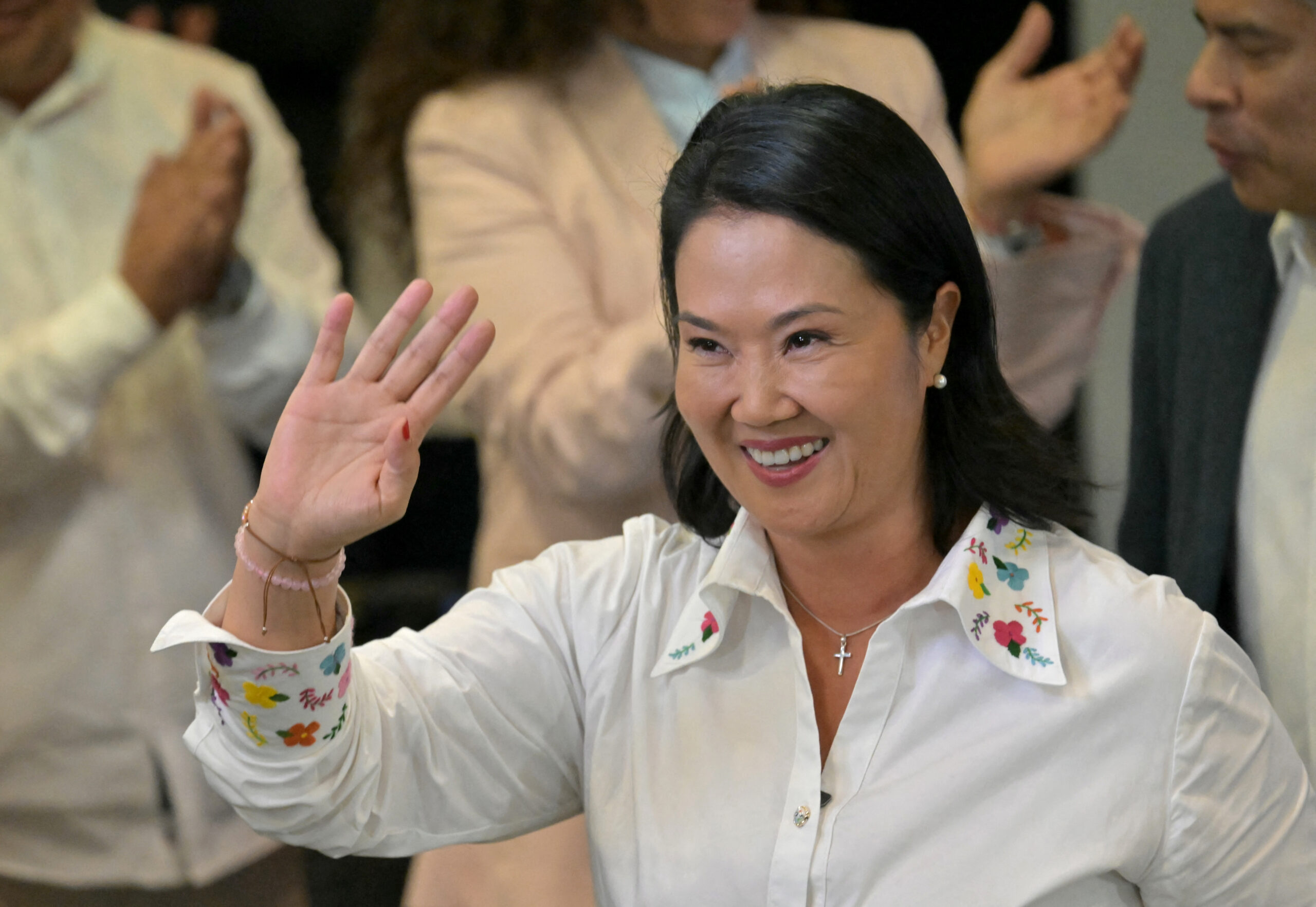
Peruvians just narrowly elected Keiko Fujimori their next president. But the country’s political fragmentation combined with the manipulation of illiberal incumbents has left the majority of the country feeling unrepresented.
July 2026
On June 7, Peruvian voters went to the polls to choose their president in a runoff between fourth-time candidate Keiko Fujimori of the conservative Popular Force (FP) party and left-wing congressman Roberto Sánchez of the Together for Peru coalition. In the first-round field of 35 candidates, Fujimori and Sánchez had been the top vote-getters on April 12, winning just 17 and 12 percent, respectively. The runoff race was extremely tight, and it was not until July 3 that Fujimori was declared the winner with 50.135 percent of the vote.
Peruvians favor democracy; they want political representation. But they doubt that they have it — in part because the outcomes of recent elections have not reflected their will. In Peru, as in many other countries, illiberal incumbent leaders have learned how to skew election outcomes in their favor without fraud. When these leaders’ machinations are combined with razor-thin vote margins and administrative blunders — as happened in Peru this year — the unsurprising result is a crisis of democratic legitimacy.
In 2012, 46 percent of Peruvians had faith in their elections, a figure that was slightly above the Latin American average. But after a problematic general election in 2021, trust in elections fell to 33 percent, well below the Latin American average. By early 2026, it had plummeted to 17 percent. Already near rock-bottom, this number will surely continue to fall.
The key catalyst of political misrepresentation is not political polarization. Peru’s 2021 and 2026 presidential runoffs both pitted a far-left candidate (Pedro Castillo in 2021 and Roberto Sánchez in 2026) against a right-wing one (Keiko Fujimori, daughter of former authoritarian president Alberto Fujimori, both times). Although in both contests the left- and right-wing candidates had political bases, they were small. In this year’s contest, Fujimori and Sánchez commanded just 29 percent of the first-round vote between them, and Fujimori now has the distinction of having won the lowest first-round vote share of any elected president in Latin America since 1989, save Bernardo Arévalo in Guatemala’s 2023 election. As Alberto Vergara put it, “This is a choice between two unpopular candidates. Neither with democratic credentials.”
Rather than polarization, the key catalyst of misrepresentation was political fragmentation: There were eighteen presidential contenders in the 2021 election and an unprecedented 35 in the 2026 contest. In both cases, relatively moderate candidates with stronger democratic credentials together claimed the majority of the vote, but none could win because the votes were divided among so many. And there were additional deficiencies in the 2026 election — most of which could be blamed on illiberal incumbent leadership.
There are good reasons for Peruvians’ mistrust of their country’s elections.
Illiberal Incumbents Chose the Candidates
It is not uncommon in Latin America for viable presidential candidates — for example, Brazil’s Luiz Inácio Lula da Silva (Lula) in 2018 or Venezuela’s María Corina Machado in 2024 — to be barred from competing for having allegedly committed some offense. Yet if other contenders were held to the same standard as the banned candidates, they too would be disqualified.
In Peru, the first disqualification that likely altered an election outcome was that of Julio Guzmán in 2016. About two months before the first round that year, Guzmán, a development economist whose parents hailed from Peru’s mountains, surged to 20 percent in opinion polls, behind only Fujimori. He was then disqualified on grounds that his party had not followed its stipulated procedure in nominating him.
Popular former president Martín Vizcarra (2018–20) could not run in 2026 after being banned by Congress in 2021 from holding office for ten years for having secretly received the coronavirus shot before vaccinations were made available to the public. Francisco Sagasti, the country’s only other popular former president (2020–21), had considered a run in 2026 but decided against it, in part because the majority of the Congressional Subcommittee for Constitutional Accusations had already voted to disqualify him. And Vizcarra’s prime minister, Salvador del Solar, who had also remained popular, had similar reasons to believe that he too faced the same fate.
The irony is that Keiko Fujimori was competing despite Peruvian prosecutors’ well-documented charges of irregular contributions from the Brazilian conglomerate Odebrecht and other large corporations to her 2011 and 2016 presidential campaigns. Former president Ollanta Humala (2011–16) was disqualified from running for reelection in 2016 for the same offense.
Illiberal Incumbents Made the Rules
Since 2021, Peru’s Congress has made several consequential institutional reforms. These changes were often driven by Fujimori’s FP party — with an eye to growing its power.
In 2024, the FP-dominated unicameral Congress approved the creation of a Senate with exceptionally large powers. Although bicameralism is Peru’s historical norm, the Senate was eliminated in 1993 under Alberto Fujimori, and a proposal for its reestablishment was resoundingly defeated in a 2018 referendum. The newly restored upper house appoints — and can oust — a spectrum of Peru’s highest-level officials in both the judicial and economic sectors. In addition, Congress also curtailed the conditions under which Peru’s president can dissolve the body. At the same time, a ban against the reelection of legislators, introduced in the 2018 referendum, was eliminated.
FP was expecting to have a quota of power in Peru’s Congress beyond its vote share — in part because it was also expecting a fragmented field of parties. As of the 2016 elections, for a party to qualify for a legislative seat it had to meet a threshold of 5 percent of the valid nationwide vote. While such a threshold is common in Latin America with the laudable goal of encouraging party alliances, 5 percent was already exceptionally high. The newly restored Senate then raised it even higher: In the 2026 legislative elections, not only did parties have to secure 5 percent of the overall vote to enter Congress, but at least seven of their lower-house candidates and three of their Senate candidates also had to win election (approximately 5 percent of the legislators in these bodies).
The result has been a disproportionate number of seats occupied by parties with bases and a large number of citizens whose votes did not count. In 2026, 31 of the 37 parties competing for seats in the Chamber of Deputies and the Senate did not reach the threshold. Yet FP, with just 15 percent of the vote in both the Chamber and Senate elections (averaging the national constituency and district constituencies in the latter), gained 32 and 37 percent of the respective seats.
In 2019, amid a political reform promoted by the Vizcarra government, Peru’s Congress approved a rule requiring parties to hold “open, simultaneous, and obligatory primaries,” known as the PASO. This could have mitigated some of problems of having so many contenders in the first round. The PASO required all parties to compete in a nationwide primary in which voters were to choose one slate of candidates from one party. To advance to the first round, a party had to secure at least 1.5 percent of the total valid vote in the primary. Here, Peru was following the lead of Argentina, where the PASO had been established in 2009 and seemed to have improved party organization and reduced fragmentation.
But Peru’s illiberal incumbent parties voted to suspend it in 2021, as coronavirus was spreading and vaccination rates were low at the time the PASO would have been held, and eliminated it altogether in 2023.
Moderate Voters Could Not Vote Strategically
Despite the pattern of disqualifying potentially strong moderate candidates, a number of relative moderates with previous political experience and some name recognition did compete: Former culture and defense minister Jorge Nieto, television-network owner and former Lima mayor Ricardo Belmont, and university rector and former Central Reserve Bank director Alfonso López Chao finished fourth, fifth, and seventh, respectively. To this set could be added Carlos Álvarez, an outsider but very well-known former comedian with right- and left-wing positions, who came in sixth. They fared quite well, but also split the vote.
Together, the three relatively moderate, experienced candidates tallied 29 percent of the first-round vote; with Álvarez added to the group, it won 37 percent. By contrast, the two markedly rightist candidates among the top-ten finishers—Fujimori and far-right populist businessman Rafael López Aliaga—together tallied only 28 percent.
How could moderate voters decide whom to support? With 35 total candidates, media coverage of each one was limited and debates were crowded: There were two rounds of two-and-a-half hour debates, each with three groups of eleven or twelve candidates. Moreover, it would have been nearly impossible to calculate which of the moderates had the best chance of reaching the runoff. Opinion polls closest to the first-round vote gave the edge to Belmont; Nieto, who ultimately topped the group with 11 percent, was at only 4 percent in the opinion polls.
With the moderate base divided among the different contenders, it was likely more difficult for each candidate to recruit poll watchers—yet another disadvantage. The leftist Sánchez, by contrast, could easily recruit teachers from the mountains who had been the political base of his former party’s leftist president, Pedro Castillo, who himself had been a schoolteacher before entering politics.
Administrative Failures Were Unprecedented
Peru’s electoral authorities have rarely been questioned in recent years. Although Fujimori alleged fraud in 2021, her accusations were only against particular sets of tally sheets and without evidence. By contrast, in 2026, administrative failure in the first round was egregious. While there is no evidence that this was intentional, there were suspicions and accusations. Piero Corvetto, the head of the National Electoral Processes Office, quickly resigned in the wake.
On the day of the first-round vote, April 12, materials for many polling stations were delivered five hours late in Lima (and only Lima), and thirteen stations could not be set up at all, affecting more than 60,000 voters in the capital city. The National Elections Board eventually extended the voting period at these sites to the following day, but by one estimate some 27,000 voters nevertheless did not cast ballots as a result.
These missing votes may have changed the results. In the first-round count for the berth in the runoff against Fujimori, Sánchez edged out López Aliaga by fewer than 25,000 votes. López Aliaga had been Lima’s mayor from 2023 to 2025 and his political base was in the capital, where Sánchez had almost no support. This likely helped Fujimori in the runoff: Pollsters had forecast either a tie or a narrow loss for Sánchez in a runoff with Fujimori while predicting a slight advantage for López Aliaga over the strongman’s daughter.
Problematically, too, it was overseas voters who finally gave Fujimori her victory in the runoff. She led the overseas vote by just over 80,000 ballots, almost twice the size of her total margin over Sánchez. Fujimori will become the first president of Peru who lost the popular vote within the country. Not surprisingly, this anomaly gave Sánchez an opening, and he charged a violation in the method for the transfer of tally sheets from overseas to Peru.
What Is Peru to Do?
If any of the moderates had reached Peru’s runoff, that candidate would almost certainly have won. When such outcomes happen, they must be analyzed in depth both by the international community and within the country. Moreover, as has often been said, international election monitors must assess more than election-day events. In particular, more attention should be paid to the field of candidates. The international community should ask: When a viable presidential candidate is disqualified, are there consistent standards for all candidates? And, if there is a very large number of presidential candidates, what are the reasons? Can the plethora be explained in part by illiberal incumbents’ strategic calculations?
Just as illiberal incumbent leaders have become savvier about skewing elections in their favor, democratic societies must become savvier about these manipulations. In Peru, as in many countries where illiberal forces are powerful, countering their narratives requires bravery, and many journalists, civil society activists, and political leaders have shown just that. We must hope that their numbers will yet grow. Voters must be told the real reasons why an election does not reflect their preferences — that the problem is not democracy per se but the distortion of democracy by nondemocrats.
Cynthia McClintock is professor of political science and international affairs at George Washington University.
Copyright © 2026 JoD Productions
Image credit: MARTIN BERNETTI / AFP via Getty Images)
|
FURTHER READING |
||
Latin America Erupts: Peru Goes Populist
|
Peru: The Danger of Powerless DemocracyComplaining about parties and politicians is common everywhere, but troubled Peru has devolved into a cautionary tale for what a democracy without established parties and professional politicians can look like. |
How Covid Changed Latin AmericaCovid-19 swept across Latin America with devastating effects. But it had unexpected positive consequences too, as citizens ousted inept politicians and pushed back against the inequities laid bare by the pandemic. |