
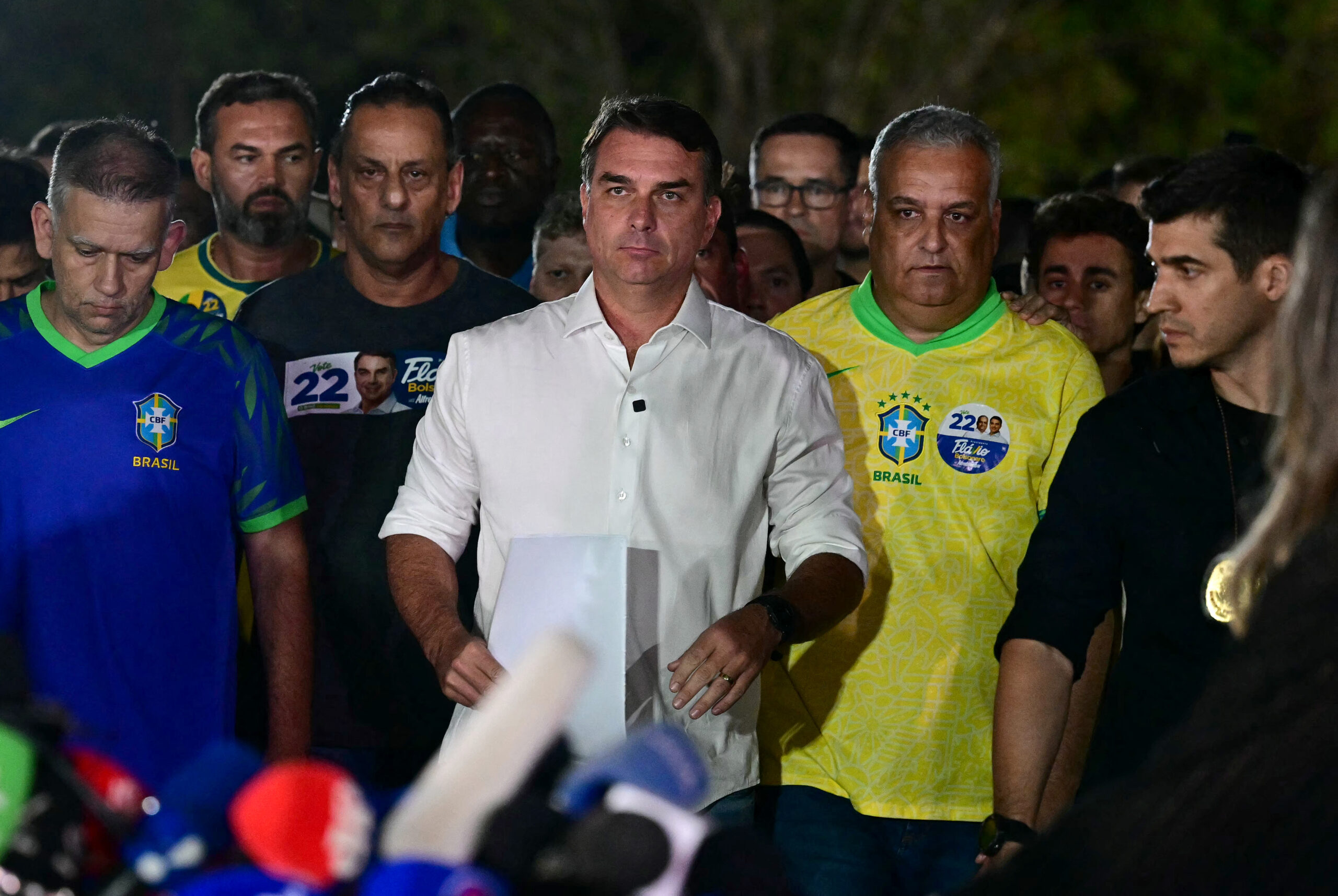
Flávio Bolsonaro lost Brazil’s presidential election and then did a predictable thing: He claimed it was stolen. Why are the region’s runners-up constantly crying foul when they lose free and fair elections?
October 2026
“It is impossible to recognize the result of this election in the context in which these things happened. We will ask for the annulment of these elections.” With these words, spoken on the night of 25 October 2026, Flávio Bolsonaro refused to accept his defeat in Brazil’s presidential runoff. Luiz Inácio Lula da Silva had won a new term with 51.8 percent of the valid vote, a margin of more than four-million votes, according to official results from Brazil’s Superior Electoral Court. Three days later, writing from the United States, Bolsonaro doubled down, proclaiming himself Brazil’s “true president-elect.”
Brazil has been here before. In 2022, Jair Bolsonaro lost by 1.8 points after months of attacks on the electronic voting system, and his refusal to accept the outcome culminated in the 8 January 2023 assault on the seat of government in Brasília. Barred from the 2026 race and sentenced to 27 years in prison for plotting a coup, he passed the movement, and its fraud narrative, to his son.
Earlier this year, the losing candidate in Peru’s presidential runoff refused to accept a narrow defeat, and in Colombia’s presidential contest the runner-up initially rejected the preliminary count. Last year, losing candidates in Ecuador and Honduras also claimed fraud. Disputes over election results are not new to Latin America. In the 1980s and 1990s, contested elections in Mexico (1988), Panama (1989), and the Dominican Republic (1994) mostly followed overt manipulation, where electoral institutions remained fragile or democratic transitions were incomplete. What stands out in recent years is how often the problem recurs. Yet most of these elections met at least minimum standards of electoral integrity, with results that electoral authorities certified and international observers judged broadly credible.
None of this means that challenging an election is inherently illegitimate. Candidates must be able to request recounts, present evidence, and go to court, and sometimes their complaints are fully justified. In Honduras in 2017, irregularities in the count led the Organization of American States (OAS) to call for a new election. In Bolivia in 2019, an OAS audit and an EU expert mission found serious problems with the count, and the election was annulled. And in Venezuela in 2024, Nicolás Maduro was proclaimed the winner without published results, while opposition tally sheets, deemed credible by the Carter Center, showed a decisive victory for Edmundo González. In such cases, rejecting the official result is an effort to enforce democratic rules, not to undermine them. But we are witnessing a different phenomenon across Latin America: losers who reject results that electoral authorities, courts, and observers have found credible.
Latin America spent four decades building electoral-management bodies that, in many countries, rank among the most professional and autonomous institutions of the state. It did so precisely because of the constant accusations of fraud that had marred its elections in the past. So why do losers increasingly disown clean elections, and what do they gain from it? The answer lies in the combination of three developments: Close results make claims of fraud easier to believe. Social media have given losing candidates a way to spread those claims directly to their supporters and keep them alive long after the count is over. And many of the candidates who lose today lead movements built around themselves, for whom conceding defeat can mean losing everything.
When Every Vote Matters
For much of the twentieth century, Latin American elections were instruments of authoritarian control. Military dictator Alfredo Stroessner’s Paraguay and the Somoza family’s Nicaragua held regular but tightly controlled votes. Brazil’s military regime allowed legislative elections while choosing presidents through an electoral college it dominated. And in Mexico, the PRI held the presidency for 71 uninterrupted years, in elections organized for most of that period by the interior ministry. Democratization therefore required taking election administration out of the government’s hands. Many new democracies built powerful, permanent, and autonomous electoral bodies, cleaner voter registries, and specialized procedures for challenging results. The goal was to settle disputes through institutional channels rather than in the streets, and for a time it worked. The memory of those decades, however, did not disappear with them. In many countries, the suspicion that elections can be stolen remains part of the political culture. A losing candidate who cries fraud is rarely inventing a story from scratch. More often, he is drawing on one that many voters already know.
Yet the professionalization and autonomy of election administration also made elections genuinely competitive, and competitive elections can produce very close results. A narrow margin changes the political meaning of ordinary flaws. Reporting delays, technological glitches, and irregularities at individual polling stations can be serious problems in any election, but in a landslide they are unlikely to change the winner. In a close race, they can be portrayed as decisive.
Mexico’s 2006 election illustrates the logic. Andrés Manuel López Obrador lost by 0.56 percentage points, demanded a full recount, and mobilized supporters around the claim that fraud, and the authorities’ refusal to reopen all the ballot packages, had denied him victory, rallying them behind the slogan “voto por voto, casilla por casilla.” In Peru in 2021, Keiko Fujimori lost the runoff by about 0.25 points, sought to annul hundreds of tally sheets, and denounced what she called “fraude en mesa.” In both cases, electoral and judicial authorities upheld the result. Strong institutions reduce uncertainty about how votes are counted, but they cannot reduce uncertainty about who will win, and they cannot stop a loser from refusing to accept it.
Expectations also play a role. A candidate who has spent the campaign telling supporters that only fraud could defeat him finds a narrow loss especially costly to accept. In Brazil in 2022, Bolsonaro’s narrow defeat came after months of insisting that the electronic voting system could not be trusted. Yet that system had long been a source of national pride, delivering fast and reliable results in a country of continental size where counting paper ballots had once been slow and vulnerable to fraud.
A Playbook That Travels
Digital platforms have changed how such claims circulate and how long they last. They allow candidates to bypass the filters of traditional media and reach supporters directly with messages that confirm what those supporters already believe. A familiar repertoire has emerged. Candidates question the reliability of the election before the vote, inflate isolated errors into claims of systematic fraud, attack the electoral authority whenever its decisions go against them, and keep denying the winner’s legitimacy after every formal remedy is exhausted. Tellingly, they do so in the name of democracy, casting themselves as defenders of the popular will against a captured referee. Polarization makes this repertoire more effective. When political identities are emotionally charged, supporters judge an allegation by who makes it rather than by the evidence behind it. A court ruling can end a legal challenge, but it rarely ends an online narrative, which can recast the ruling itself as proof of institutional complicity.
This repertoire also travels across borders. Jair Bolsonaro openly embraced the claim that the 2020 U.S. election had been stolen and then built a similar anticipatory narrative about Brazil’s voting machines. In Colombia this year, outgoing president Gustavo Petro questioned the voter registry and electoral software before the count and later alleged manipulation of tally sheets when his preferred successor lost.
That a right-wing populist and a former leftist guerrilla should rely on the same playbook is telling. Rejecting an unfavorable result belongs to no ideology. Opposition candidates have used it against incumbent parties, and incumbents have used it against the very systems that brought them to power.
Losing Without Conceding
A third factor is who loses. A challenge can fail as a legal strategy and still succeed as a survival strategy. By blaming the referee, a losing candidate deflects responsibility, keeps supporters mobilized, and turns the next campaign into the continuation of an unfinished fight. Leaders whose movements depend on them personally face especially high costs from conceding. An established party can absorb a defeat and replace its candidate. A movement built around its leader finds this much harder. For such a leader, conceding can open a succession struggle, cost the visibility that sustains the movement, and, for incumbents and their heirs, expose them to prosecution once out of power.
For these leaders, rejection often begins before election day. Attacks on the electoral authority during the campaign work as political insurance. They identify in advance an institution to blame, prepare supporters to read a defeat as theft, and leave the candidate an exit that does not require admitting that voters chose someone else.
Nor does rejecting defeat necessarily carry the reputational cost that democratic theory would predict. López Obrador rejected the results of 2006 and 2012 and won the presidency in 2018. Keiko Fujimori remained the dominant figure of the Peruvian right after 2021 and won the presidency this year. Donald Trump never accepted his 2020 defeat and returned to the White House in 2024. In Brazil, Jair Bolsonaro’s ineligibility did not dismantle his movement; it simply passed to his son. None of these comebacks was caused by the fraud claims, but together they show that denial can coexist with political survival. For this kind of politician, “the election was stolen” can work less as a claim about the past than as an investment in the future.
What Contestation Costs Democracy
The refusal to accept electoral defeat has consequences that extend well beyond the losing campaign. When losers insist without evidence that an election was stolen, some of their followers will act accordingly. The January 8 assault in Brasília, which echoed the 6 January 2021 attack on the U.S. Capitol, showed how far a stolen-election narrative can go. The damage also outlasts the crisis. Electoral authorities that for years enjoyed more prestige than most other state institutions can lose public confidence, as Mexico’s electoral institute did after 2006 and as Brazil’s electronic voting system did among Bolsonaro’s supporters after 2022. Democracy does not require citizens to like every result. It does require broad agreement about which institutions get to determine winners, and in much of the region that agreement is now fragmenting along partisan lines.
Better election administration and dispute-resolution mechanisms will not, by themselves, solve this problem. In most of the region, electoral authorities already count votes accurately. What they cannot do on their own is make losers accept the count. Social-media platforms need clearer rules on electoral disinformation, although sanctions must be designed with care, since such tools can easily become weapons for incumbents against their opponents. Political actors need to recommit to democratic values, beginning with the recognition that the opposition has the same right to win as one’s own candidate. Electoral institutions, finally, must respond quickly and transparently, because a fraud narrative fills any vacuum left by delay. That means monitoring digital media and answering false claims in real time but also engaging political actors in dialogue rather than reacting to provocations, so that tensions can be defused before they escalate.
Above all, the broader system that protects electoral integrity needs reinforcement. Electoral authorities were not designed to withstand the combined pressures of polarization, the digital era, and candidates unwilling to accept defeat, and they cannot withstand them alone. They need stronger support from civil society, the media, universities, the private sector, international organizations, and religious institutions committed to democracy. Broad civic efforts have already made a difference in the region. In Brazil, the Pacto pela Democracia built a cross-partisan coalition to defend the electronic voting system and has worked to keep the memory of the dictatorship alive among younger generations. In Bolivia, the Alianza Observación Ciudadana de la Democracia (OCD Bolivia) united civic actors to expand election observation and monitor disinformation, complementing the electoral authority’s work.
These dynamics are not unique to Latin America, as the United States in 2020 made clear. But the region is especially revealing, because these disputes keep recurring after decades of investment in credible election administration.
Counting every vote accurately remains indispensable. But governing democratically requires knowing how to win, and sustaining democracy requires learning how to lose. As Adam Przeworski observed more than three decades ago, democracy is a system in which parties lose elections.
Alejandro González Ruiz is pursuing a PhD in political science at the University of Notre Dame, where he is affiliated with the Kellogg Institute.
Copyright © 2026 JoD Productions Inc
Image Credit: Pablo PORCIUNCULA / AFP via Getty Images
|
FURTHER READING |
||

How to Build the Right Coalition |

How to Defeat the Authoritarian Message
|

The Election Fraud Epidemic |