
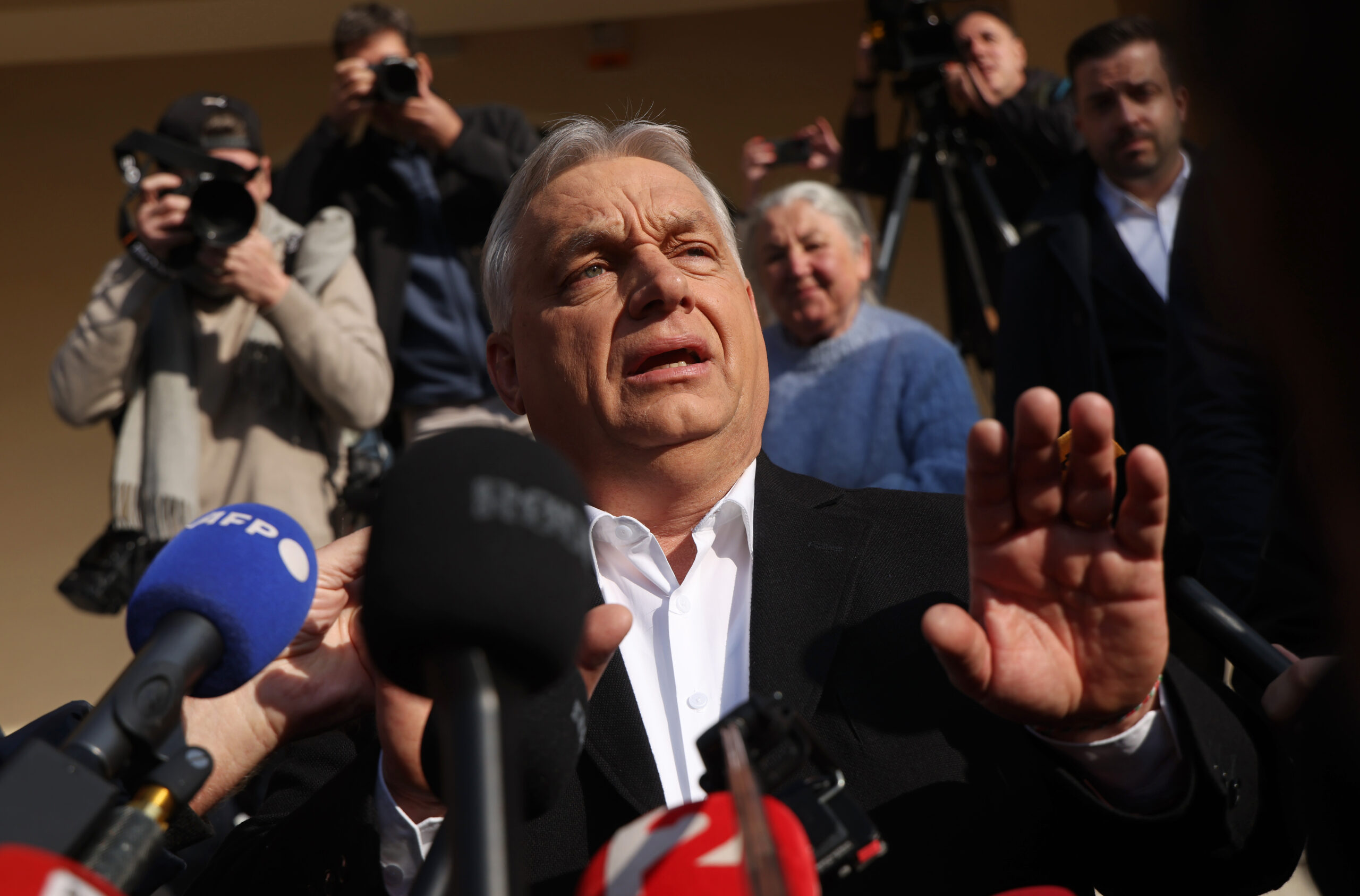
If democracy’s defenders want to push back against authoritarianism, they must learn to tap into patriotic language and a sense of national identity. Such emotional appeals shouldn’t be left to autocrats and demagogues.
April 2026
When in 1929 Walter Lippmann assessed the likelihood of fascism spreading to Western countries, he categorically ruled out its reaching Germany. In his view, modern industrial societies were too complex and contained too many diverse interests to be subsumed into one fascist direction. A few years later, when the Nazis did come to power in Germany, many observers were surprised at how easily Germans gave up their recently won civil liberties for the sake of national interests. Like Lippmann before them, these observers had underestimated the power of nationalism.
Nearly a century later, something similar has unfolded in many countries worldwide. From established democracies such as India, Israel, and the United States to democracies that were once seen as regional success stories such as Brazil, Hungary, Poland, and Turkey, voters have elected and sometimes reelected, undemocratic politicians who promise to protect the allegedly threatened nation. Many scholars and friends of democracy have found this puzzling, and often attribute it to a “crisis of democracy.” It is likely, however, that the words of the distinguished political scientist E.E. Schattschneider (1892–1971) are more applicable: “The crisis here is not a crisis in democracy but a crisis in theory.”
One of the key reasons why liberals, broadly speaking, have failed to comprehend the recent trend of democratic backsliding is that their theory of human nature is wrong, or at least incomplete. Liberals view individuals as rational beings primarily concerned with maximizing their economic benefits. However, this is only partly true. Long before modern economic theory came into being, Plato had Socrates observe to his interlocutors in The Republic that besides “the desiring and calculating parts of the soul,” there is also a third, separate part which he called “the spirited.” In other words, people act not only for material gain but also because they desire recognition from others, or in a word, dignity. Liberal-democratic principles of liberty, government by consent, and respect for “equal laws, equally applied” are meant to ensure dignity for members of the political community—a type of dignity that absolutist and totalitarian regimes abhor and violently reject.
The rub is that liberal-democratic dignity and the regime that undergirds it are not the only sources of personal dignity. As social psychology teaches us, individuals draw much of their self-esteem and dignity from the groups to which they belong. Among the most important of these collectives is the nation.
“Nation” is a word that comes from Latin terms such as natio, meaning children of a common parental stock, and natus meaning to be born. We see it in other modern words such as “natal,” “native,” and “nativity.” It describes a form of belonging that even if not always literally by birth (though it often is), is nonetheless profound and gives many individuals a sense of meaning and a longed-for chance to be part of something greater than themselves. It provides them with a cognitive map of where they come from and guidance for where they are heading, thus helping them to navigate the world. In other words, the nation gives people a sense that they have a shared past and a linked fate, providing a sense of certainty and stability that is especially important during times of rapid change. This is why the concept of the nation is important to many people across the political spectrum.
If a nation seems to be under threat, then membership in that nation can become highly consequential for political behavior. Political psychology teaches us that a threat, whether real or imagined (or perhaps real but exaggerated), to a group that undergirds social identity will shape many group members’ behavior and color their views. Group members can fall victim to bias and faulty decisionmaking when they are acting out of fear for the group’s welfare and a desire to defend it. This fear is precisely what many authoritarian incumbents have deliberately tried to create.
Authoritarian incumbents in Hungary, Israel, Poland, Serbia, and Turkey paint national identity and sovereignty as threatened by enemies foreign and domestic. The foreign threats may come from entities such as the West or immigrants from Muslim countries. The domestic threats can come from secular elites or communities seen as “not fitting in” such as Kurds, Israeli Arabs, or sexual minorities. As I was told in many interviews with political actors and civil society activists, developing such portraits of “the nation besieged” was a strategic move by authoritarians because in each case it made easier to subvert democracy to one degree or another.
If voters become convinced that national identity and sovereignty are at stake, this appears to make them more willing to accept the undermining of liberal democracy for the urgent purpose of protecting these cherished national patrimonies. A widespread sense of “la patrie en danger” can make the curtailing of civil liberties seem more palatable and the concentration of power in the chief executive’s hands more reasonable.
If the subversion of democracy in the name of the nation is to succeed, the rhetoric of threat must resonate with the public. Authoritarian incumbents find it easier to deploy such rhetoric when preexisting historical and structural factors work in its favor. Such factors include collective memories of lost national territory or sovereignty, disputed borders, shrinking populations, rival national narratives challenging that of the cherished nation, and ideas concerning national exceptionalism or victimization.
But none of these factors, or even all of them, is a fate. Rather, political agency must intervene. Threat sources must be aptly chosen. Viktor Orbán’s notable success, until recently, at presenting Muslim immigrants and sexual minorities as threats to the Hungarian nation is well known. More obscure are his earlier failed efforts to cast the Roma and homeless people in this role. His narrative for the recent parliamentary election campaign – painting Ukraine as an external threat that was eager to pull Hungary into the war – did not resonate either, helping to usher in his defeat. In 2023, the ruling PiS party in Poland campaigned in that year’s election by claiming that Germany was threatening Poland’s existence. This claim failed to resonate with most Poles, contributing to PiS’s defeat.
The most common type of democratic backsliding involves power grabs by the executive. This frequency has led scholars to dwell on institutional strategies for resisting such gambits. The importance of threat narratives to attacks on democracy suggests that opposition approaches to the discursive contest also merit attention. When autocratic incumbents assert “safeguarding the nation” as grounds for subverting democracy, oppositionists have three options: 1) Ignore the threat narrative and the topic of the nation altogether; 2) try to rhetorically outbid the autocrat by posturing as even more ethno-nationalist; or 3) develop a nation-related counternarrative into which the split between autocratic and democratic forces can be integrated.
The last option is the most promising. In Brazil, Israel, and Poland, compelling counternarratives aided democratic resistance. Interviews that I conducted in the latter two countries reveal that the cultivation of such counternarratives was a conscious strategic choice. In both cases, the counternarrative helped to bring democracy-supporting citizens into the streets and to the polls. Similarly, Péter Magyar and his Tisza party recently got Orbán voted out while they leaned heavily on patriotic language and appeals to Hungarian national identity that previous opposition parties had eschewed. By contrast, oppositionists who ignored the issue of the nation or tried to outbid on it met with less success in India, Serbia, Turkey, and the United States.
My interviews from the less successful cases revealed that many saw the need to counter the incumbent’s nationalist appeals but failed to develop a compelling narrative. Lessons from more successful cases could be useful. These cases teach us that the counternarrative should focus on a topic salient to the local political dynamic and that can be directly linked to the concept of the nation. In Poland, the opponents of PiS adopted a counternarrative centered on the country’s EU membership as an integral part of Poland’s identity as a Western nation, with PiS cast as threat to that identity for provoking a so-called “PolExit.” Opponents of President Jair Bolsonaro (2019–23) in Brazil charged him with excessive deference to Trump and U.S. interests. Israeli protesters in 2023 cast themselves as the true guardians of the democratic and Jewish country that Israel was founded to be, citing the Israeli Declaration of Independence, while accusing Prime Minister Benjamin Netanyahu’s government of promoting a most un-Israeli authoritarianism.
When deciding on the counternarrative, democrats should always take into account structural factors. Disputed national boundaries often give authoritarian incumbents a chance to foster an ethnonationalist narrative: Consider the role of the Kosovo issue in Aleksandar Vučić’s nationalist appeals in Serbia, or that of the Kurdish issue in Recep Tayyip Erdoğan’s nationalist appeals in Turkey. Democrats must recognize that such an issue is too salient to ignore. In an ethnically and religiously diverse country, they will often have to decide whether they want to appeal mainly to minority voters, or to focus on voters within the authoritarian coalition who are “soft supporters” with moderate leanings, and who might be drawn away. Local context—and above all, the intensity of the majority-versus-minority conflict—must shape this decision. While in Turkey the main opposition party became more inclusive of Kurds, the Israeli protest movement largely ignored Israeli Arabs and was more inclusive of conservative Jews instead.
In sum, the battle for democracy must be waged not only through institutions but through words. To successfully resist attacks on democracy in the name of the nation, democrats need their own patriotic counternarratives. The sovereignty and dignity of the nation are topics that cannot be left to authoritarians with designs to dilute, degrade, or subvert democracy.
Filip Milačić is senior researcher at the “Democracy of the Future” office of the Friedrich Ebert Foundation, visiting professor at the Central European University (CEU), and research affiliate at the CEU’s Democracy Institute. He is the author of Abandoning Democracy for the Nation (2026).
Copyright © 2026 National Endowment for Democracy
Image credit: Sean Gallup/Getty Images
|
FURTHER READING |
||
The Future of Nonviolent Resistance
|

How to Compete in Unfair Elections |

How Oppositions Fight Back |