
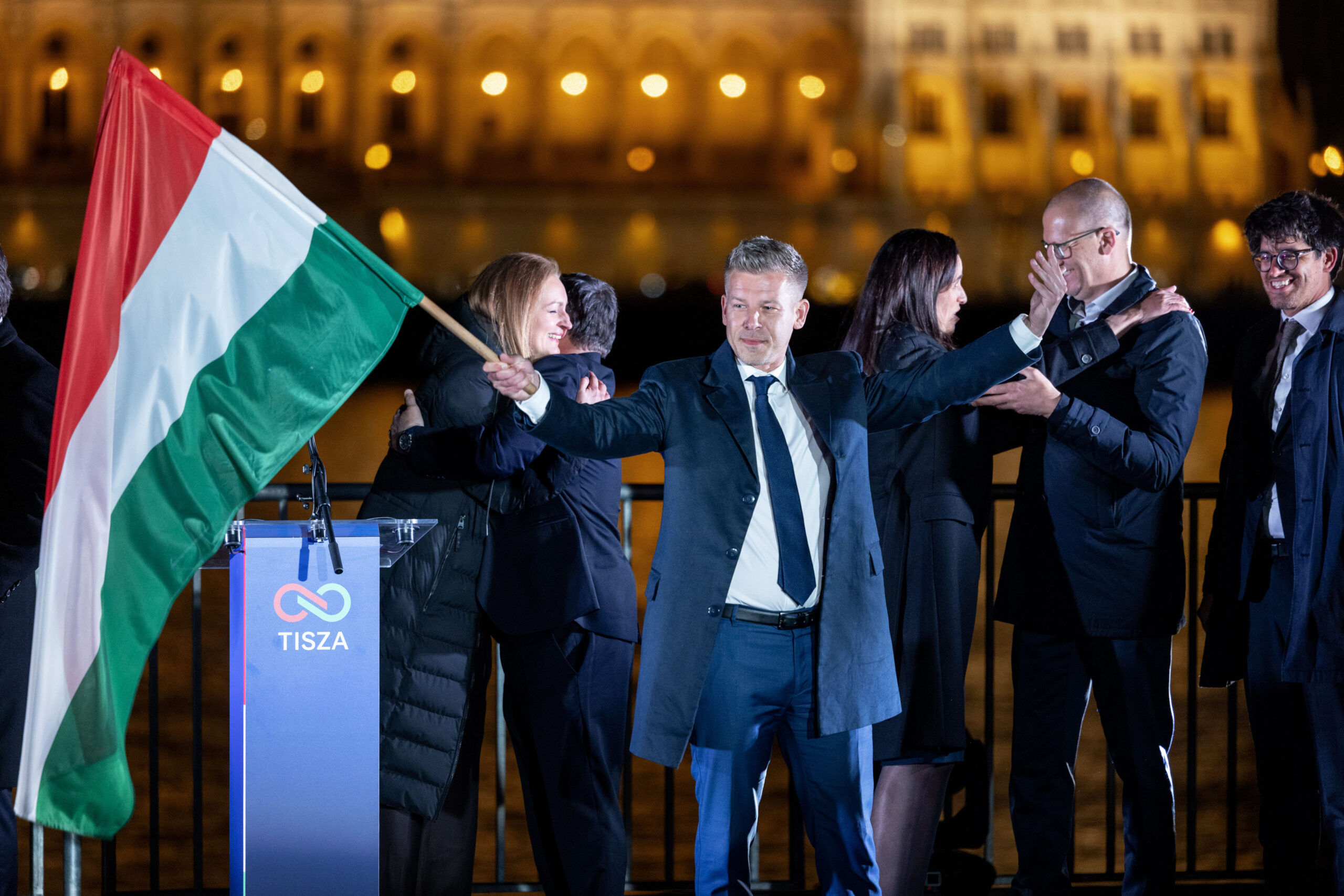
The opposition party leader pulled off the most stunning election upset in modern Hungarian history. Magyar did it by taking the fight to the countryside and winning over Orbán voters who were tired of corruption and poor results.
By Sándor Ésik
April 2026
The air in Budapest’s metro stations was electric on election night, April 12, vibrating with a chant that had not been heard in more than a decade: “Vége van.” It’s over. The streets of the capital and major provincial cities across Hungary were filled with tens of thousands of young people celebrating the defeat of Viktor Orbán and his Fidesz party after sixteen years in power. Many of these revelers have never known any other government.
At the center of this political earthquake — whose shockwaves are rippling far beyond Hungary — stood Péter Magyar, leader of the Tisza party. Addressing the jubilant crowds, his victory speech was an exercise in careful calibration: optimistic and triumphant, yet distinctly sober about the monumental task ahead.
Magyar had just orchestrated the most stunning electoral upset in modern Hungarian history, winning a two-thirds majority in parliament with a massive voter turnout (77 percent), despite the deck being heavily stacked in favor of the ruling party. But this election was about far more than a charismatic challenger: It is a case study in democratic resilience, the limits of patronage networks, and the sudden, cascading collapse of a geography of fear.
Magyar’s New Playbook
A key component of Orbán’s rule has been the careful positioning of his party on the political playing field. Fidesz has long claimed positions from the political center (and even some from left-populism, such as “13th-month” and “14th-month” pensions) all the way to the far right, stopping just shy of fascism and neo-Nazism, leaving those to the far-right satellite party Mi Hazánk (Our Homeland).
Before Magyar assumed leadership of the previously dormant Tisza in 2024, Fidesz’s political opposition had always come from the left. But the Hungarian left is extremely fragmented, still largely occupied by politicians who began their careers in the old Communist Party, and has failed to win even when trying to band together as in 2022. Moreover, Hungarian voters, especially rural ones, prefer a patriotic center-right party.
Magyar, himself a former Fidesz official, scrapped the traditional opposition playbook. Instead of campaigning to the left, he laid claim to the same political space as Orbán and Fidesz. The theme behind Tisza’s messaging was that Fidesz was no longer the true patriotic party — the one that had come to power in a 2010 landslide victory promising a “Hungary First” program — and that Magyar and Tisza would assume that mantle. One of Magyar’s slogans was “Take back our country step by step and rebuild it brick by brick.”
To understand the magnitude of this democratic resurgence, one must look past the euphoria of the capital and examine the underlying mechanics of the victory. Fidesz has long maintained its grip on power through a well-oiled mobilization machine. Operating off localized lists of loyal voters (the “Kubatov lists,” named after Fidesz’s mobilization chief, Gábor Kubatov), clientelist networks, and immense pressure on voters from party-dependent rural mayors, Fidesz’s get-out-the-vote operation is formidable.
And that machine did not break down; it merely reached its limits. Fidesz’s mobilization peaked with party’s overwhelming 2022 victory, when it mobilized 2.8 million voters (Hungary’s population is just 9.5 million). The party underperformed this year, but not by much. Orbán did not lose his base; rather, his base was submerged under a tidal wave of citizens once thought to be eternally passive.
For months, independent polling firms such as Medián had forecast this very scenario, tracking a steady, undeniable surge in support for Tisza. Many Hungarian observers, including myself, didn’t dare believe it. The trauma of past electoral disappointments, coupled with the sheer white noise of Fidesz’s multibillion-forint media monopoly, had conditioned Hungary’s intelligentsia to assume that the regime was undefeatable.
The ruling camp, meanwhile, openly ridiculed pollsters, convinced that its mastery of the electoral map would bring victory once again. Conventional political wisdom in Hungary has long relied on a strict geographical hierarchy, dividing the country’s 106 individual voting districts into four distinct tiers: Budapest urban, Budapest suburban, county seats, and rural districts. The rule of thumb was simple: The smaller the settlement, the stronger Orbán’s rule.
Going into the election, most analysts assumed that Magyar would sweep the urban center of Budapest, perform well in the suburbs and county seats, but ultimately falter in the deep countryside. In these rural boroughs, Orbán’s regime enjoys an informational hegemony that is virtually unimaginable to Western observers. Local radio stations broadcast uninterrupted government propaganda masquerading as news, and local Fidesz party bosses wield immense power over public-works jobs and local businesses. In such environments, voting for the opposition is not just a political choice; it is an act of courage.
Political views in such places, especially opposition views, are discussed only in the tightest of personal circles. Well-mannered conversation carefully steers clear of politics. Voters keep carefully blank faces to avoid intrusive questions, just as one might when entering a hospital or courtroom, and speak in semiformal phrases tailored to the perceived political affiliation of their interlocutors (and often baffling to foreign reporters).
Yet it was exactly in these rural boroughs that the regime suffered its most humiliating defeats. Tisza breached Fidesz’s rural firewall even in Hungary’s northeastern corner — historically Orbán’s most impenetrable stronghold — winning districts that were thought to be unwinnable. In Szabolcs-Szatmár-Bereg (known as Szabolcs) and Borsod-Abaúj-Zemplén (Borsod), Tisza nearly swept the entire counties even though some districts had been considered toss-ups.
Those studiously blank faces had reached critical mass. Magyar’s most important achievement in this campaign was perhaps to have created a feeling among voters that he and his party were close to them. Tisza signs urging “Most vagy soha” (It’s now or never) could be seen hanging from the windows of ordinary homes; the spell of isolation had been broken. Once voters realized they were not alone — that the person standing next to them in line with a similarly expressionless gaze was also holding a grudge against the system — the regime’s psychological grip evaporated. By ten o’clock on election night, Viktor Orbán was forced to concede.
Fidesz’s Flailing Campaign and Unending Scandals
In the desperate final weeks of the campaign, Fidesz sought to project an aura of global conservative dominance, culminating in the highly publicized visit by U.S. vice-president J.D. Vance. The intended message was clear: Orbán is not alone; he is at the vanguard of a triumphant international conservative movement. Vance’s speech was professional, but for the average Hungarian voter grappling with domestic realities the visit was entirely irrelevant. In retrospect, by the time the vice-president arrived, it was already too late for Fidesz.
Just ahead Vance’s arrival, a former police captain with the National Bureau of Investigation named Bence Szabó sat down in front of a camera with the investigative news site Direkt36. For ninety minutes, he calmly provided a detailed account of how the Hungarian domestic-intelligence service had attempted to recruit moles within Magyar’s party. To cover its tracks, Szabó explained, the service used the police’s elite anti-child-pornography unit to investigate two of the Tisza targets, both IT specialists for the party, on spurious grounds. Two days later, one of the men targeted in the operation described in an interview how he had managed to lead his interrogators by the nose.
Shortly after that, Szilveszter Pálinkás, a young military captain who had been a classmate of Viktor Orbán’s son, Gáspár, at the United Kingdom’s Royal Military Academy Sandhurst, spoke to the press about a highly controversial plan to launch Hungarian military operation in Chad. Pálinkás revealed that the younger Orbán had proposed the operation, viewing it as a crusade to protect Christians in Chad. He even suggested that a 50 percent casualty rate would be “acceptable.”
In a country stunned by the confirmation of longstanding rumors of corruption and abuse of power, the visit by the U.S. vice-president held little significance.
What the New Government Faces
Péter Magyar and Tisza are inheriting a nation in a dire state. The Hungarian economy has been severely battered. For the last two years, Hungary’s inflation rates have been the highest in the European Union, growth has stagnated, and billions in EU development funds have been frozen due to rule-of-law violations committed by the outgoing government.
Throughout the campaign, and even in the immediate aftermath of his victory, Magyar has kept his cards close to his vest. He successfully united a fractured electorate by focusing on national renewal and fighting corruption, and on reclaiming the national symbols from Orbán’s party.
Despite a 250-page program published a month ago, we have not seen detailed policy blueprints. Nor has Magyar announced more than a few personal choices for key ministerial and administrative positions. This strategic ambiguity was necessary to build a big-tent coalition of protest voters. Transitioning from a populist-centrist opposition movement to a functional governing body will now be his first test.
In his inaugural press conference, Magyar spoke of returning to common-sense politics. He also announced that his first official visit will be to Warsaw. There is deep symbolism behind that. The Polish-Hungarian friendship is deeply ingrained in Hungary’s political culture. By granting asylum to Polish politicians fleeing from corruption charges, Orbán sparked outrage among some of his old supporters. Starting the new era of Hungarian foreign policy with a visit to Poland says that Magyar wants to return to the beaten path.
Regarding domestic policies, Magyar’s main challenge will be to establish an effective style of leadership. Hungarian voters expect a strong leader. However, after years of poor governance, we need a new approach in which government ministers are more than mere yes-men, as they were under Orbán, which effectively kept the government paralyzed. To me, the clearest sign of Magyar’s commitment to change will be how much freedom he allows his future ministers. On most policy issues, he will have to prioritize the needs of the economy and make the changes dictated by our international partners. Leadership is where he can innovate, and it is absolutely necessary he do so.
Sándor Ésik is an attorney practicing in Budapest, Hungary. He is also a blogger and an activist for democratic causes. His English blog about Hungary, the Hungarian Muse, is available on Substack.
Copyright © 2026 National Endowment for Democracy
Image credit: Janos Kummer/Getty Images
|
FURTHER READING |
||

Why Viktor Orbán Is in Trouble
|

The Viktor Orbán Show |
How Viktor Orbán WinsThe case of Hungary shows how autocrats can rig elections legally, using legislative majorities to change the law and neutralize the opposition at every turn, no matter what strategy they adopt. |