
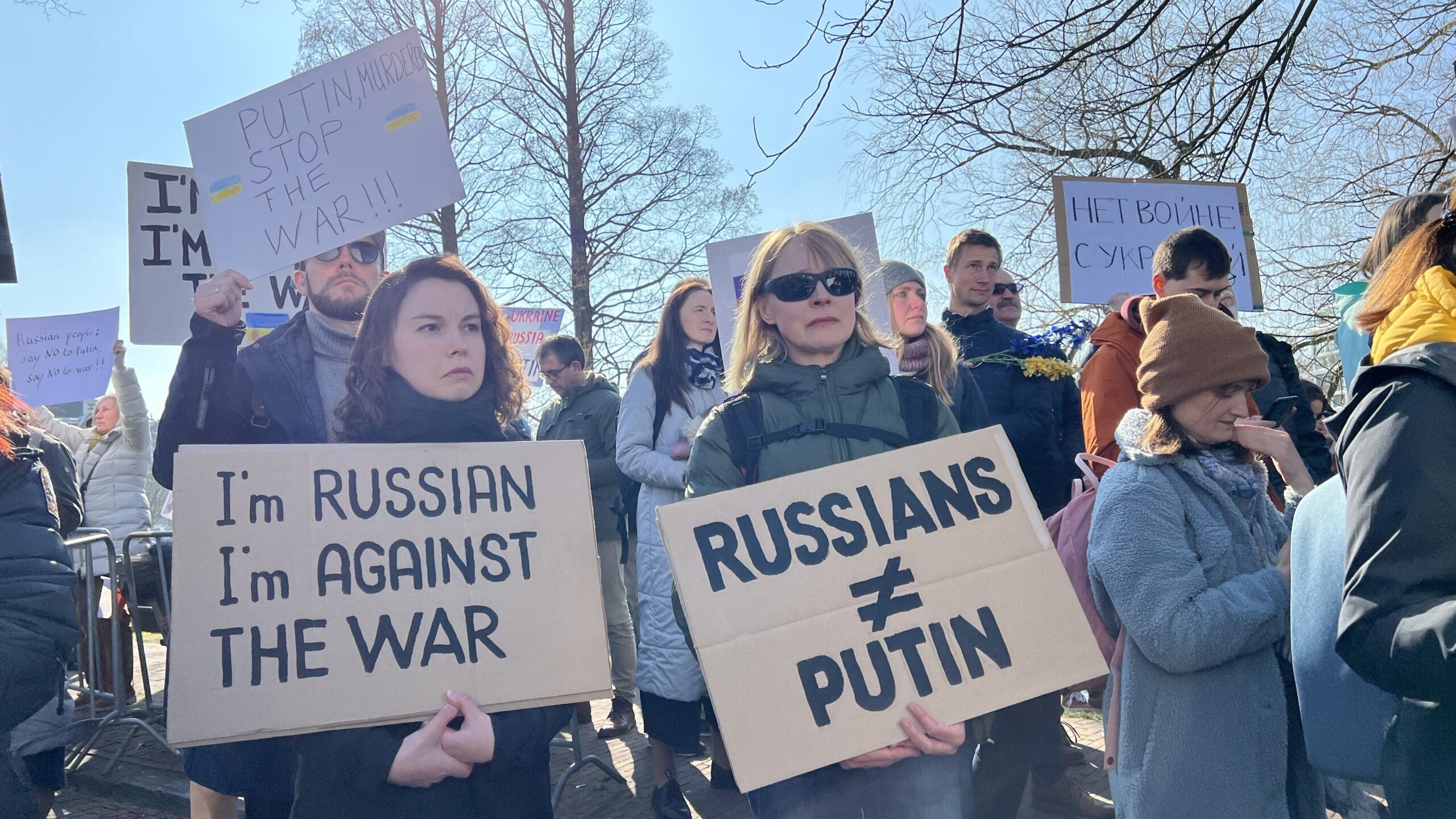
Even amid wartime repression and exile, Russian activists, independent media, and educators keep working beyond the Kremlin’s reach — sustaining civic life that Western policymakers are wrong to dismiss.
By Evgeny Roshchin and Samuel Greene
November 2026
The parlous state of Russian civil society would appear to be unambiguous. The ability of Russian citizens to exert pressure on their state — and to rise up where the state falls down — has long been tenuous. War, never a friend to democracy, has turned that tenuousness into outright collapse, as waves of repression have submerged Russians’ ability to communicate, organize, and act. Tens of thousands of antiwar Russian citizens have been driven into exile, while thousands of those who remain have faced violence and imprisonment.
It is thus perhaps not surprising that policymakers thinking about Russia’s future — whether in Kyiv, Brussels, or Washington — tend to treat Russian civil society as a negligible variable. And yet Russian civil society is not entirely absent. Human-rights organizations, newsrooms, and independent educational initiatives persist in exile. More importantly, they maintain sufficient connections with initiatives on the ground in Russia — and, in some cases, underground — that a clear dividing line between activity inside and outside Russia is difficult to draw.
Given the scale of wartime repression and displacement, even the idea of minimal civic resistance, let alone any hope for democratic change, can appear detached from reality.
Russian civil society and political opposition have long operated within narrow limits. Funding, organizing capacity, and mobilization have been severely restricted for a decade and a half. Most attempts to register political parties are routinely blocked by the state. Campaigns to endorse alternative candidates are obstructed. Key opposition leaders have been imprisoned, assassinated, or driven into exile.
Yet state-society relations under authoritarianism — including in Russia — resist easy definition. Even within those limits, Russian citizens and civic initiatives have historically found some room to exercise their civic rights. Until the start of the war, numerous civic initiatives continued to operate inside the country, and independent media outlets such as the Echo of Moscow radio station and TV Rain were permitted to broadcast, albeit under mounting government pressure. In other words, civil society continued to exist alongside the repressive authoritarian regime.
Nor has wartime repression entirely eliminated the ability of democratically minded Russians to discomfit the Kremlin. The visible enthusiasm for the openly antiwar presidential candidate Boris Nadezhdin in 2024 was an embarrassment for Vladimir Putin’s political team. By the time parliamentary elections rolled around in 2026, the prospect of a visible groundswell for the moderate antiwar position staked out by the Yabloko party had become not just an embarrassment, but a threat, with the result that Yabloko was simply removed from the ballot. According to independent pollsters, Yabloko’s vote share could have exceeded 20 percent had it been permitted to contest the elections, an outcome that could have given more Russians the sense that it was safe to bring antiwar views out into the open.
The areas of activism and public discussion that the regime believes may not be politically dangerous are increasingly few and far between. Popular influencers not normally known for their political positions periodically raise pointed concerns about the erosion of civil rights, at times with enough force that state propaganda is compelled to retreat on contentious policies. This has been true even of policies closely tied to the prosecution of the war, such as the preelection crackdown on online messenger platforms such as Telegram and WhatsApp. While the repressive capacity of the wartime authoritarian regime is administratively unlimited, Russian society itself remains a constraint on the Kremlin’s willingness to act.
The Problem of Exile
Crackdowns on opposition and civil society fall within the standard repertoire that autocrats use to suppress domestic discontent. But civil society has choices when it comes to how to respond, and those choices affect its ability to shape the future of the country. Exile, often necessitated by galloping coercion and political violence at home, makes those choices particularly stark.
Even in exile, however, choices matter. Chilean exiles decided to build coalitions that crossed ideological boundaries, helping to galvanize the coalition that would eventually bring down Augusto Pinochet. South African exiles opted for institutionalization, building a transnational infrastructure of education, advocacy, and, again, coalition building that would allow the African National Congress to survive apartheid. By contrast, exiles from Burma have allowed internal divisions — including conflicts with activists who remained in the country — to impede efficacy.
The question of how to maintain coherence and potency in exile is thus not new to researchers, nor indeed to activists. Posing it again in the context of Russia’s wartime political repression, however, requires accounting for a set of novel conditions: the Russian state’s capacity, including in surveillance and repression; its international posture and alliances; and the war itself, which has proven conducive not only to tightening restrictions but also to dividing the citizenry along lines of allegiance, and thereby to imposing moral constraints on resistance.
In a recent series of reports, the Center for European Policy Analysis set out to address this question by examining how the activities, approaches, and efficacy of Russian civic initiatives have been reshaped by war and exile. While the expression of dissenting political views heavily overlaps and intersects with citizens’ civic activity, this research intentionally brackets out the work of the political opposition as such, which is organized around a distinct set of goals that require a change of political conditions in the country — namely, the eventual ascent to power of anti-authoritarian forces. Russian civil society work is similarly constrained by restrictive legislation, intimidation and persecution, and transnational repression. Yet some of it continues even under existing domestic repressive conditions.
This research spans three broad domains of civil society — namely, media, human-rights work, and independent education — to show which groups are able to continue meaningful work despite authoritarian repression. The focus is limited to initiatives that either had to leave the country as organizations or were founded by individuals who left the country to preserve an antiwar and prodemocracy voice. While the picture is mixed and complex, the general finding is clear: Exiled Russian civil society remains surprisingly effective.
Defending Human Rights
Although it is becoming increasingly difficult, civil society groups are still able to expose authoritarian abuses of political, law-enforcement, and administrative power. Civic activists and groups organize to help Russian political prisoners and detained and displaced Ukrainian citizens, and to expose politically motivated discrimination, abuse of the law, and inhumane prison conditions. This work at times gains such prominence that even Putin’s spokesman, Dmitri Peskov, has had to deny publicly that there are political prisoners in Russia. Thanks to these groups, observers also know the details of the evolution of authoritarian practices, from electoral manipulation to the redistribution of power among state agencies.
Several critical adaptations make it possible for this work to continue. Under pressure from the state’s repressive machinery, activists had to transform structurally and adapt programmatically. Structural adaptation takes the form of dispersing people, offices, and functions across the border. Organizational leaders, who face higher security risks, have largely relocated to “safe” countries and take on tasks that would be difficult to carry out in Russia, including fundraising, coordination, training, and respite programs. Overseas offices remain in close contact with activists on the ground in Russia, who attempt to fly under the radar and work with much greater operational autonomy than they had done when the entirety of the organization was located in Russia. Programmatically, activists have shifted away from topics and rhetoric that the authorities could deem antigovernment. While this comes at a high cost, as some critical issues remain unaddressed, the priority for many of these organizations is essentially to overcome isolation, preserve community, and maintain the ability to help those who need it most.
An Independent Media Ecosystem
Exiled Russian media are probably the most politically and strategically consequential resource to have emerged outside Russian jurisdiction in resistance to authoritarianism and the war. Thanks to the work of these initiatives, many Russians know that alternative sources of information exist and have learned to access them despite state obstruction. This helps explain Russia’s exceptionally high rate of VPN use. Despite its efforts both to harass independent journalists — including the recent closure of Novaya Gazeta, Russia’s oldest independent newspaper, in November 2026 — and to throttle electronic communication, the civic muscle developed by both citizens and journalists has thus far made it impossible for the Kremlin to monopolize the information space. This is not to say that Russia has an open and competitive information environment in which citizens seek information to validate their democratic values, but rather that a critical mass of people are able to access important information, and that ability poses a challenge to the regime.
Exiled media outlets now form an ecosystem of general-interest, thematic, and investigative journalists who use and amplify one another’s work. Like the rights-based organizations, independent media similarly maintain robust networks of journalists on the ground in Russia, working anonymously and at great risk. As an ecosystem, independent media have become an influential source of alternative information for a significant share of Russians, competing with lavishly funded state propaganda at a fraction of the cost.
Center for European Policy Analysis research estimates that independent media’s audience in Russia stands at as much as 8 million regular monthly users, rising to as much as 25 million with algorithmically driven traffic and traffic generated by prominent news events. Thanks to this reach, state-controlled propaganda outlets have found it impossible to ignore the realities of the war, including casualties and Ukrainian strikes on strategic targets within Russia. Moreover, much of what the world knows about how Russia is prosecuting the war — including about the state of the Russian military and economy, and the treatment of Ukrainians living under occupation — has come to light thanks to independent Russian journalists operating in exile.
Uncensored Education and Civic “Skills”
Exiled academics are another distinct group in this landscape. Leveraging their size and expertise to launch several independent educational initiatives, ranging from informal online courses to small universities, exiled groups have carved out space for independent education, both for people who remain in Russia and wish to take part in collective learning free of warmongering, imperialist, and chauvinist propaganda, and for those who fled the country but did not intend to abandon it forever. These projects aim to do more than help exiled Russians obtain degrees, however. They impart a range of important civic “skills” and, like the work of rights activists and journalists, help to preserve horizontal ties among groups in exile and with people inside the country. These ties are limited in scope and become fragile when stretched beyond core constituencies; but within those core constituencies, the ties are intensive and overlapping, plugging active citizens into a range of loosely connected activities. This creates alternative channels of civic coordination and mobilization in defense of vulnerable social groups or causes of public significance, including environmental protection.
Those exiled academics who chose formally to join institutions in host countries have had to overcome European bureaucratic hurdles before they could begin enrolling small cohorts of students. Those who launched virtual classrooms with a wide selection of courses now count thousands of graduates, more than half of whom join from within Russia. While modest in scale, these initiatives demonstrate the continued demand for uncensored education inside Russia.
A Strategic Oversight
It would be wrong to say that Russian society is still fighting for greater liberalism and democracy. It would be equally wrong, however, to report that Russian society is entirely quiescent. Activist ecosystems across three key domains — rights defense, journalism, and education — form bastions of societal resistance to total authoritarian control. And this self-defense against authoritarian intrusion serves to complicate political compliance and allegiance, even if the overall picture of Russian society’s response to the war is one of compliance.
In moments of crisis — and, in particular, in crises where traditional tools of statecraft fail to gain traction, such as Western efforts to end Russian aggression against Ukraine — governments tend to prioritize security and defense at the expense of democracy and humanitarian support abroad. This pivot — including in the Baltic states and increasingly throughout the EU with the imposition of restrictions on Russian exiles, allegedly to prevent infiltration by security services — may be tempting. Research on Russian activism in exile, however, suggests that it may also be a strategic oversight.
Thus it is time to reconsider the idea of civil society support. At pivotal moments in world history, such as the one we are living through, it is worth recalling that prudent strategic calculus draws on a wide range of tools. Civil society support belongs in that toolbox as part of a larger strategy of building alliances and countering authoritarian aggression. Russian civil society is one such strategic resource, one worth investing in should the West begin to take long-term Russia policy seriously.
Evgeny Roshchin is director of the Democratic Resilience Program at the Center for European Policy Analysis. and author of Friendship Among Nations. Samuel Greene is professor of Russian politics at King’s College London. He is the author of Putin vs the People: The Perilous Politics of a Divided Russia.
Copyright © 2026 JoD Productions Inc
Image Credit: Abdullah AÅıran/Anadolu Agency via Getty Images
|
FURTHER READING |
||
How Putin Erases Dissidents and Critics |
Trust, Blood, and Power in Putin’s Russia
|
Inside Russia’s Psychological War on European DemocracyRussia’s influence operations are more concerned with reshaping voters’ fears and anxieties than convincing them of any specific falsehood. To survive, democratic values need to be defended and mobilized. |