
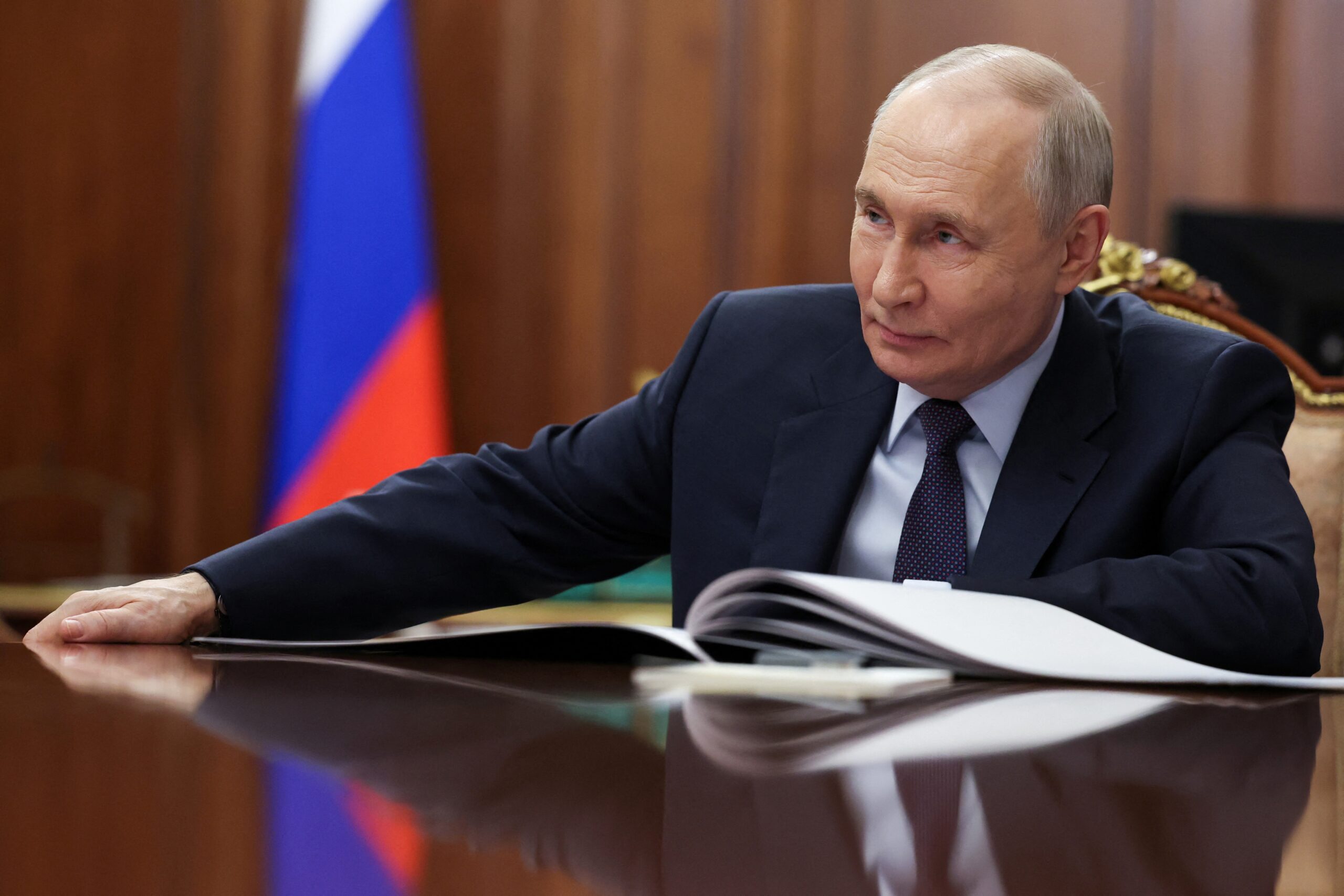
Vladimir Putin has signed a new “civic death” law targeting the Kremlin’s critics everywhere. The goal is to intimidate Russian citizens from speaking out against Putin’s crimes.
August 2026
Last week, Russian president Vladimir Putin signed a package of new laws imposing sweeping restrictions on Russians living abroad who have been convicted, often in absentia, under the country’s expanding catalog of political offenses. This new set of laws represents an extraordinary escalation in the Kremlin’s efforts to target its critics where it cannot otherwise reach them. With Putin’s signature, these new highly repressive restrictions take effect immediately.
In the leadup to the bill’s passage, the chairman of the Duma framed the measures as upholding the “inevitability of punishment” and “the supremacy of the law,” casting the extraterritorial persecution of government critics as routine enforcement against fugitives evading a sentence. In the same breath, he called the targets “scoundrels” who left the country and “continue to foul things from abroad,” branding them “extremists” and “traitors to the Motherland” sheltered by Western states. “They must understand that punishment will catch up with them in any case,” he said.
Human Rights Watch describes the bill as a “civic death” law. The phrase is apt: The measures are designed not to bring exiles home and not to prosecute them in any conventional sense, but to erase them as Russian citizens.
How to Erase a Citizen
The legislation creates a register, maintained by the Justice Ministry and published openly on its website, of Russians abroad deemed to be “evading” criminal or administrative penalties. The qualifying offenses, listed in the Duma’s own announcement, form a familiar cluster: “discrediting” the armed forces, calling for sanctions against Russia, urging violations of the country’s territorial integrity, and breaching the “foreign agents” law — the statutes that have anchored politically motivated prosecutions since the full-scale invasion of Ukraine in 2022. Participation in “undesirable organizations” also qualifies, which makes even students and professors affiliated with universities, including Princeton, Harvard, Yale, Tufts, and others, or those who have been connected to the British Council, Association of Slavic and East European Studies, Radio Free Europe, and other research organizations, targets of prosecution.
The package imposes fourteen restrictions. The list includes suspending the registration of all property rights inside Russia, freezing and blocking funds and all other assets, revoking the right to drive, denying state and municipal services delivered electronically, and barring registration as a sole proprietor. Amendments added before the vote require banks to block app and online account access and bar those listed from making money transfers. At Russian consulates, the targeted lose access to essential services: no new passports, no marriage registration, no official notarizations of any documents, and no certified powers of attorney, thus, no ability to conduct almost any legal business in Russia through a representative. Courts, meanwhile, gain the authority to raid frozen accounts to recover legal fees and court-ordered damages and nationalize the exile’s assets as a punishment. The intent has not been disguised: Duma deputy chairman Pyotr Tolstoy claimed that the restrictions would deter criticism, writing that “the wallet is a liberal’s most sensitive organ.”
Transnational Repression Everywhere All at Once
Scholars have called this the golden age of transnational repression: more illiberal states targeting more exiles in more countries through various techniques, including surveillance, targeted attacks, threats against family members, and, at the extreme, assassination. Russia has used all these methods. Every familiar technique of reaching dissidents abroad requires something: agents deployed, host states persuaded, planned secret operations or personalized intimidation campaigns. The new bill, however, requires none of it. The state simply weaponizes its own bureaucracy — the property registry, the notary system, the consular window — to treat listed citizens as if they no longer exist. There is no need to exploit Interpol and draw unwanted international attention or to rely on host governments to cooperate with the authoritarian home state to extradite, threaten, or imprison the critics when you can simply weaponize the citizenship itself.
Banks, notaries, consulates, property registries, educational-credential registries, and every possible agency issuing documents that one might need to build a life abroad are now moving out of reach for Russian emigrants. This method of transnational repression is known as autocratic legalism, operating not through physical punishment but through bureaucratic and institutional channels, including consular abuse. Anastasia Burakova, a lawyer whose organization, Kovcheg (The Ark), supports antiwar émigrés, argues that the law places targeted Russians “in the position of stateless persons” by “cutting off every avenue of interaction with the nation.” The bill’s sponsor, Vasily Piskaryov, has defended the measures by lumping political activists together with “terrorists, murderers, corrupt officials” and fraudsters, the rhetorical conflation of dissident with criminal that makes the bill look like law enforcement, a common characteristic in the global repertoire of autocratic legalism.
What is notable about the bill is that the Duma’s announcement does not speak of exiles, emigrants, or dissidents, but of “relocants” (relokanty), a flat, quasi-bureaucratic and misleading coinage, suggesting people who have merely moved to a new place. The word drains the political content from their departure, even as the law targets them for expressly political acts. To be a relocant in official language is to be an administrative category, not a political actor, which is precisely how a state that recognizes no legitimate opposition prefers to describe its opposition. Admitting that a massive number of young and well-educated people (between 500,000 and one million) have left the country in protest since the start of the war would contradict regime propaganda, which not only scapegoats the emigrated critics but hides the scale of the exodus from the public.
Despite the nature and context of the bill, Russia did not invent this technique so much as perfect it. In 2023, Nicaragua’s Daniel Ortega stripped citizenship from more than three-hundred exiled critics. Writers, priests, and opposition leaders were branded “traitors to the homeland,” and the state confiscated their property. Belarus now tries its exiled opposition in absentia, sentencing opposition leaders like Sviatlana Tsikhanouskaya to fifteen years in prison. Hong Kong authorities publish cash bounties for activists living in London and New York. Each is a fragment of the same idea: that a state’s power over its citizens should not end at the border. Where Ortega’s denationalizations were crude and internationally legible as repression, Russia’s law achieves the same erasure while publicly portraying it as ordinary law enforcement: a simple registry, a list of offenses, an appeals-shaped process.
A History Revisited
There is a precedent from Russia’s own history. In 1922, the League of Nations confronted a nearly identical problem: After the revolution and civil war, hundreds of thousands of Russians scattered across Europe, having been stripped of their citizenship by the Soviet government and left unable to travel, work, or prove their identities. The international response, engineered by the Norwegian explorer-turned-diplomat Fridtjof Nansen, was the Nansen passport: an internationally recognized identity and travel document for stateless persons that was eventually honored by more than fifty governments and carried by figures from Vladimir Nabokov to Igor Stravinsky. It was an imperfect instrument, but it did something essential: It refused to let a state’s erasure of its citizens stand as the final word on their existence.
A century later, the problem has returned. Russia’s new law does not formally revoke citizenship; that would too obviously be an act of repression. Instead, it hollows out citizenship from the inside, producing the same problem Nansen confronted: people with no host state willing to document them. How can the international community today document and protect the deliberately undocumented as the Nansen passport did in the twentieth century? Perhaps the answer is a coordinated European travel document for the Kremlin’s listed exiles, or expanded use of existing refugee travel documents under the UN’s 1951 Refugee Convention, or a brand new instrument built for the age of digital civic death.
The Registry Cuts Both Ways
The Kremlin’s theory is straightforward: raise the personal cost of dissent high enough and criticism will stop. The potential reach of the new bill is wide. The population immediately at risk includes more than 1,100 people officially designated as “foreign agents,” alongside the thousands detained or charged for donations, antiwar speeches, posts, and even social-media “likes” since February 2022. But also at risk are hundreds of thousands of Russian emigrants not yet charged in absentia for speaking up from abroad, joining political protests, signing petitions, making social-media posts, or donating money to what Moscow labels as “terrorist” organizations.
For many Russian exiles with property, income streams, or family still anchored in Russia, the law will have severe consequences. Emigrants who depend on pensions, disability payments, or state child support will be risking their livelihoods if they speak up publicly in their new host countries. Similarly, others — mostly younger people who intend to live abroad and might need to renew a passport or obtain education credentials, a birth certificate, or confirmation of a residence — will weigh the costs of speaking up abroad. Not everyone who leaves is a committed activist, and many don’t have enough money to sustain themselves abroad, let alone to pursue a second citizenship. Many emigrants, including those I have interviewed, are ordinary people with no institutional connections and no safety net abroad; many don’t have guaranteed jobs that can ensure them stability as immigrants, so they would prefer not to burn their last bridge home by criticizing the government.
It is these quieter émigrés, who are weighing whether to sign a petition or attend a rally, whom the public registry is most likely to discipline. Fear of retaliation for joining any kind of antistate resistance movement or organization is known to discourage political engagement abroad. In other words, the Russian registry does not need to catch anyone; it needs only to exist.
But the same measure that punishes can also unite and strengthen critics abroad. By severing exiles’ ties to the Russian state, the law destroys the very leverage that kept many exiles cautious. A person with nothing left to lose in their home country is, paradoxically, freer to speak. Heavy-handed homeland coercion often hardens oppositional identities and accelerates community-building abroad. In June 2026, a group of a hundred exiles met in Berlin to launch a new political party, “Peaceful Russia,” that may now attract even more members. The registry can thus double as both an honor roll and a directory for solidarity, legal aid, and mutual support.
Amnesty International has called on host governments to build practical countermeasures — including access to banking, travel documents and essential services — so that people stripped of their passports and accounts are not left in administrative limbo. Human Rights Watch has urged the same. The question is whether democracies will treat this as a bureaucratic curiosity and pretend that the law is legitimate or see it for what it is: a deliberate act of extraterritorial political repression.
Until now, humanitarian visas, residence permits, and asylum decisions were, for many émigrés, a matter of security and convenience. For Russians abroad, that just changed with the stroke of a pen — if they are critics of the Kremlin, they can now depend only on their host country for documents and rights. Support from democratic governments is no longer a gesture of solidarity; it is infrastructure critical for survival. The global community must read this new law as an act of transnational repression, and the EU should reconsider policies of reducing humanitarian visas and curbing asylum applications, including those that were already implemented against Russian immigrants. Cutting humanitarian visas for Russian political migrants when Moscow is stripping those same people of their passports is not caution, it is cooperation.
The Kremlin continues to come up with new ways to intimidate, bully, and repress anyone brave enough to criticize it for its crimes. The world’s democracies must counter this intimidation with innovative responses of its own.
Liudmila Listrovaya is visiting assistant professor at Amherst College and was previously a postdoctoral fellow at the University of Michigan’s Weiser Center for Europe and Eurasia. She is a political and environmental sociologist specializing in Russian transnational repression, authoritarianism, and Russian diaspora in Serbia and Georgia.
Copyright © 2026 JoD Productions
Image Credit: Photo by Alexander KAZAKOV / POOL / AFP via Getty Images
|
FURTHER READING |
||
Trust, Blood, and Power in Putin’s Russia |
Inside Russia’s Psychological War on European DemocracyDaria Azariev North and Vitaliy Shushkevich Russia’s influence operations are more concerned with reshaping voters’ fears and anxieties than convincing them of any specific falsehood. To survive, democratic values need to be defended and mobilized. |
David vs. Goliath: Defeating Russian AutocracyUkraine versus Russia is a modern David versus Goliath conflict that matters not only for the future of Ukraine, but for that of democracy itself. |