
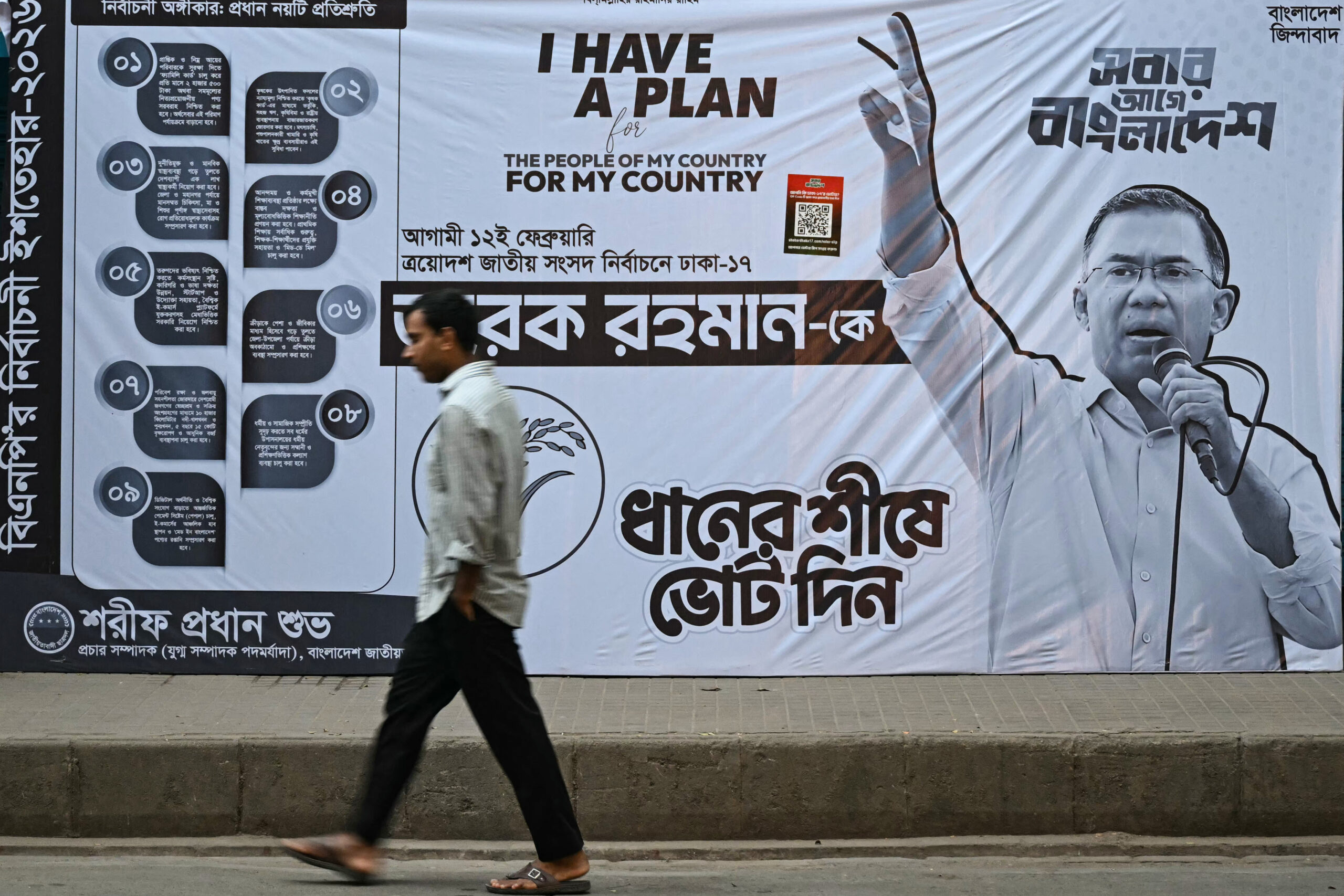
Bangladeshis resoundingly voted for constitutional reform, but executing on this promise will be no small task. The hardest work for this newly restored democracy lies ahead.
February 2026
Bangladeshis went to the polls amid festivity on February 12 to cast their ballots in the country’s first election since the dramatic ouster of Prime Minister Sheikh Hasina in August 2024. Voters were not only choosing their Parliament, but also deciding whether to approve a sweeping constitutional reform. The Bangladesh Nationalist Party (BNP) — one of the country’s two dominant parties along with Hasina’s Bangladesh Awami League, which was barred from the polls — emerged as the biggest winner with a sliver under 50 percent of the vote and 209 out of 300 directly elected seats in the 350-member Parliament (the rest are proportionally allocated reserved seats for women). The Bangladesh Jamaat-e-Islami, with 31.8 percent and 68 seats, and its electoral ally the National Citizen Party (NCP; a new formation that emerged from the 2024 mass uprising), with 3 percent and six seats, entered the parliamentary opposition. Turnout reached 60.4 percent.
The reform referendum, meanwhile, passed decisively with 68.6 percent of valid votes endorsing the package. All three parties appear broadly committed to constitutional reform. Early postelection gestures, including visits by BNP chairperson and now–Prime Minister Tariq Rahman to the residences of Jamaat leader Shafiqur Rahman and NCP leader Nahid Islam, have signaled a willingness to sustain the reform dialogue across government and opposition lines.
It is important to note, however, that nearly one in ten ballots was invalid, an unusually high figure in comparative terms, far exceeding spoilage rates in established electoral systems. In Ireland, for instance, spoiled ballots in national contests typically hover around just one percent. Even allowing for voter unfamiliarity with referendum procedures, the possibility remains that some of these ballots were cast as a form of dissent.
The anomaly also reflects the compressed architecture of consent under bundled constitutional approval, where voters were asked to ratify dozens of institutional reforms through a single aggregated choice, limiting opportunities for differentiated endorsement. Where institutional design forecloses granular consent, dissent does not disappear. It migrates to the spaces still available to it, including the invalid ballot. The referendum’s legal mandate may therefore be robust, but its expressive texture is more fragmented than the total vote count suggests.
Authorization Without Full Inclusion
If the mandate appears legally robust, the breadth of that authorization must be understood within the political field in which it was produced. The Awami League secured 48 percent of the vote in the 2008 parliamentary election, widely regarded as the last broadly accepted national poll prior to the democratic crisis that culminated in the July mass uprising. The party’s subsequent period in power between 2009 and 2024, and its contested role during that era, significantly eroded its public standing. Nationwide polling conducted in September 2025 indicated that the Awami League’s support stood at approximately 19 percent, a modest recovery from its immediate post-uprising low but still far below its electoral peak.
The party’s exclusion from the 2026 electoral process therefore represents not the displacement of a hegemonic majority but the institutional absence of a historically significant, though electorally diminished, constituency. Following its exclusion, the party leadership issued a boycott call under the slogan “No boat, no vote,” with the boat serving as the Awami League’s electoral symbol — a decision that likely shaped participation patterns within its support base. Had the party refrained from issuing a formal boycott directive, or adopted a more ambivalent posture, a larger share of its supporters might have participated in the referendum. Under such a counterfactual distribution, the approval gap between Yes and No votes could have narrowed perceptibly, even if the reform package ultimately prevailed. This, in turn, would have enabled opponents to frame constitutional authorization as resting on a comparatively thinner consent margin. The mandate would likely still have held procedurally, but its force might have appeared less decisive.
Meanwhile, the Jatiyo Party (JaPa), a longtime political ally of the Awami League during its years in government, secured less than one percent of the parliamentary vote and no seats. JaPa had actively campaigned against the referendum. Thus the party’s inability to translate antireform mobilization into legislative representation could be as much a reflection of voter disaffection toward the Awami League as a repudiation of the referendum position JaPa advanced.
Governing the Reform Mandate
If the referendum authorized reform, the parliamentary election determined who would implement it. The order governing the implementation of the July National Charter establishes a Constitutional Reform Council composed of newly elected members of Parliament and tasked with translating the approved referendum into binding institutional design. Council members will thus wear two hats—lawmaker and constitution-drafter. That is, the same legislature that conducts adversarial governance is simultaneously tasked with drafting constitutional amendments within a 180-working-day window and an overall 270-day institutional lifespan. Constitutional authorization and legislative execution therefore remain co-located within a reform-oriented parliamentary field, even as executive and opposition actors retain distinct interpretive preferences.
Even within this shared institutional mandate, early procedural frictions have surfaced. When the new Parliament and Constitutional Reform Council were sworn in this week, the BNP’s MP-elects took the oath for Parliament but not for the Constitutional Reform Council, citing constitutional sequencing concerns. Three lawmakers from BNP allies, along with several independents, followed suit.
The move initially drew a strong reaction from Jamaat and the NCP and their allies, whose elected representatives signaled that they would boycott the parliamentary oath proceedings if the BNP continued to abstain from the Council swearing-in. However, the opposition representatives were later sworn in as both MPs and Council members. The episode illustrates how reform implementation may itself become a site of legal interpretation and political negotiation rather than a purely technical legislative exercise.
Substantively, however, all three parties share important zones of agreement. Each has endorsed core structural reforms aimed at restoring electoral credibility, recalibrating executive authority, and strengthening judicial oversight. There is also broad alignment around institutionalizing safeguards designed to prevent the reemergence of one-party electoral dominance, a concern shaped by the last decade and a half under Hasina and the Awami League.
Yet where there is convergence on the intent of reform, there is divergence over institutional design. One potential site of disagreement concerns the formula for upper-house representation. While the Charter’s baseline model links seat allocation to national vote share, alternative proposals advanced during negotiations, including formulas that would apportion seats in proportion to parties’ lower-house seat share rather than their aggregate vote totals, remain politically salient. In such cases, tensions may emerge between referendum-endorsed institutional design and electoral mandate–based reinterpretation.
This configuration produces what may be described as asymmetric legitimacy. While constitutional authorization was strong, dissent within Parliament remains limited compared with the scale of referendum opposition, even as reform actors disagree among themselves on institutional design. A substantial minority rejected the referendum reforms, and boycott dynamics likely expanded the reservoir of unexpressed opposition. With major dissenting actors absent from legislative institutions, constitutional contestation may migrate beyond parliamentary arenas into civil society, judicial forums, or future electoral mobilization.
Now that parliamentary authority rests primarily with the BNP, which has a supermajority, reform implementation may either adhere to the Charter’s baseline institutional design or proceed through revision pathways embedded within the Charter itself. The interaction between these authorized interpretive routes is likely to become a central arena of constitutional negotiation. For instance, disagreement could deepen over the Constitutional Reform Council’s own institutional authority. Questions surrounding its legal grounding and oath administration may continue to generate interpretive arguments. While such disputes would unfold within reform institutions, they could shape both the tempo and legitimacy of the constitutional-amendment process. Disputes of this kind would not signal rejection of reform itself but rather disagreement over how the reform mandate should be carried out.
From Authorization to Parliamentary Implementation
Bangladesh’s transition now moves from authorization to execution. With the referendum passed and MPs in place, the reform process enters its operational phase, where institutional design must be translated into constitutional text under tight timelines.
The Constitutional Reform Council will function as the central arena of this translation. Draft amendment clauses will move through committee deliberations, interparty consultations, and staged parliamentary review before consolidation into formal constitutional proposals. The BNP’s parliamentary dominance gives it decisive agenda-setting capacity, but the Council’s dual composition ensures that Jamaat and the NCP remain structurally embedded in amendment negotiations. This institutional architecture makes unilateral redesign improbable, even with the BNP’s supermajority.
Early procedural developments surrounding Council oath-taking have already illustrated how implementation may unfold. Disagreements over constitutional sequencing, oath administration, and the Council’s legal grounding surfaced immediately, before any substantive reform drafting had begun. Yet the episode also demonstrated the system’s pliability: Initial resistance did not escalate into institutional rupture but was resolved within procedural channels. This pattern suggests that future disagreements — whether over amendment sequencing, drafting authority, or ratification procedures — is likely to be negotiated within institutional forums rather than expressed through systemic obstruction.
Disagreement is more likely to cluster around institutional design and authority allocation as specific reform provisions move from negotiated principle to legislative codification. Questions surrounding the powers of a proposed upper chamber, the sequencing of constitutional amendments, and the balance between legislative efficiency and oversight will test the elasticity of cross-party reforms. Structured but bounded contention of this kind is more likely to shape the reform trajectory than to derail it. The first amendment bills we see from the Council will likely provide the earliest test of how far convergence can hold under conditions of institutional-design negotiation.
The absence of the Awami League introduces a different kind of uncertainty. Its exclusion reduces institutionalized parliamentary dissent but expands the reservoir of extra-institutional contestation. Constitutional opposition may therefore migrate into civil society mobilization, legal challenges to reform procedures, and future electoral campaigns organized around the legitimacy of specific constitutional provisions rather than the transition itself. Whether this dissent becomes destabilizing will depend on how inclusively reform outcomes are implemented and publicly understood.
What’s to Come
The road ahead, then, is unlikely to be frictionless but also unlikely to be explosive. Bangladesh’s reform trajectory is poised to unfold through institutional negotiation rather than existential constitutional crisis. Legislative rivalry and constitutional refounding will proceed simultaneously within the same parliamentary arena, compressing conflict and cooperation into a single governing structure.
The referendum delivered authorization. The election supplied implementers. What follows will determine durability. If reform actors translate structural convergence into credible institutional design while managing dissent through procedural inclusion, Bangladesh’s democratic reconstruction may consolidate faster than many postauthoritarian transitions. If not, the gap between legal mandate and political ownership will widen before it narrows.
The system is now empowered. Its settlement will depend on how those entrusted with redesign govern the mandate they have jointly inherited — not only in constitutional text, but in the lived institutional practices through which that text acquires democratic legitimacy.
Kazi A. S. M. Nurul Huda is associate professor of philosophy at the University of Dhaka and Zuzana Simoniova Cmelikova Visiting International Scholar in Leadership and Ethics at the University of Richmond’s Jepson School of Leadership Studies.
Copyright © 2026 National Endowment for Democracy
Image credit: Sajjad HUSSAIN / AFP via Getty Images
|
FURTHER READING |
||
Will Bangladesh’s Massive Democratic Experiment Work?
|
The Return of Politics in Bangladesh
|
Did Muhammad Yunus Sign Up for Mission Impossible?
|