
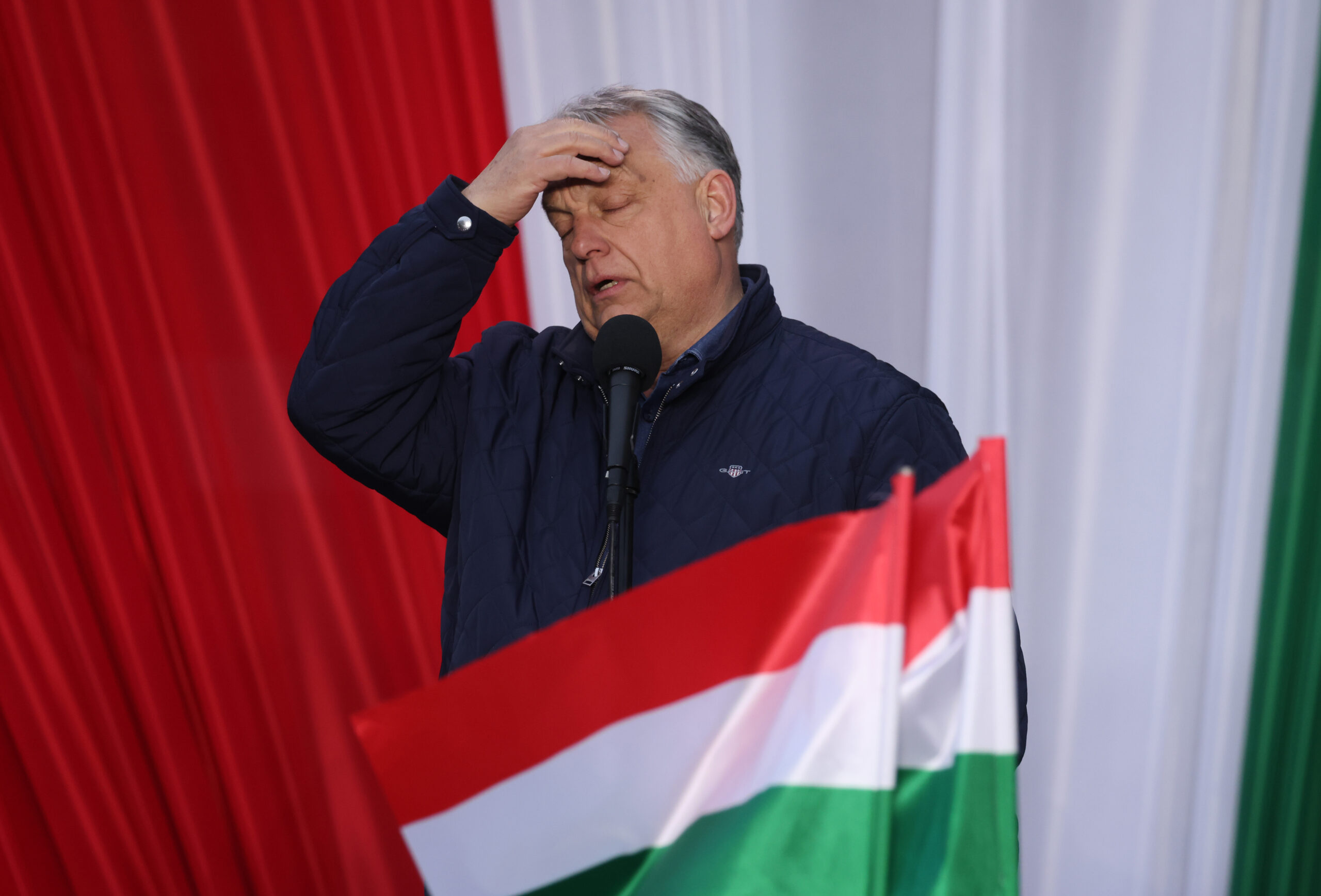
Opposition leader Péter Magyar overcame the rigged system that Orbán created and used it against him. The old playbook of disinformation and dirty tricks was no match for a disciplined campaign that gave Hungarians their voice.
April 2026
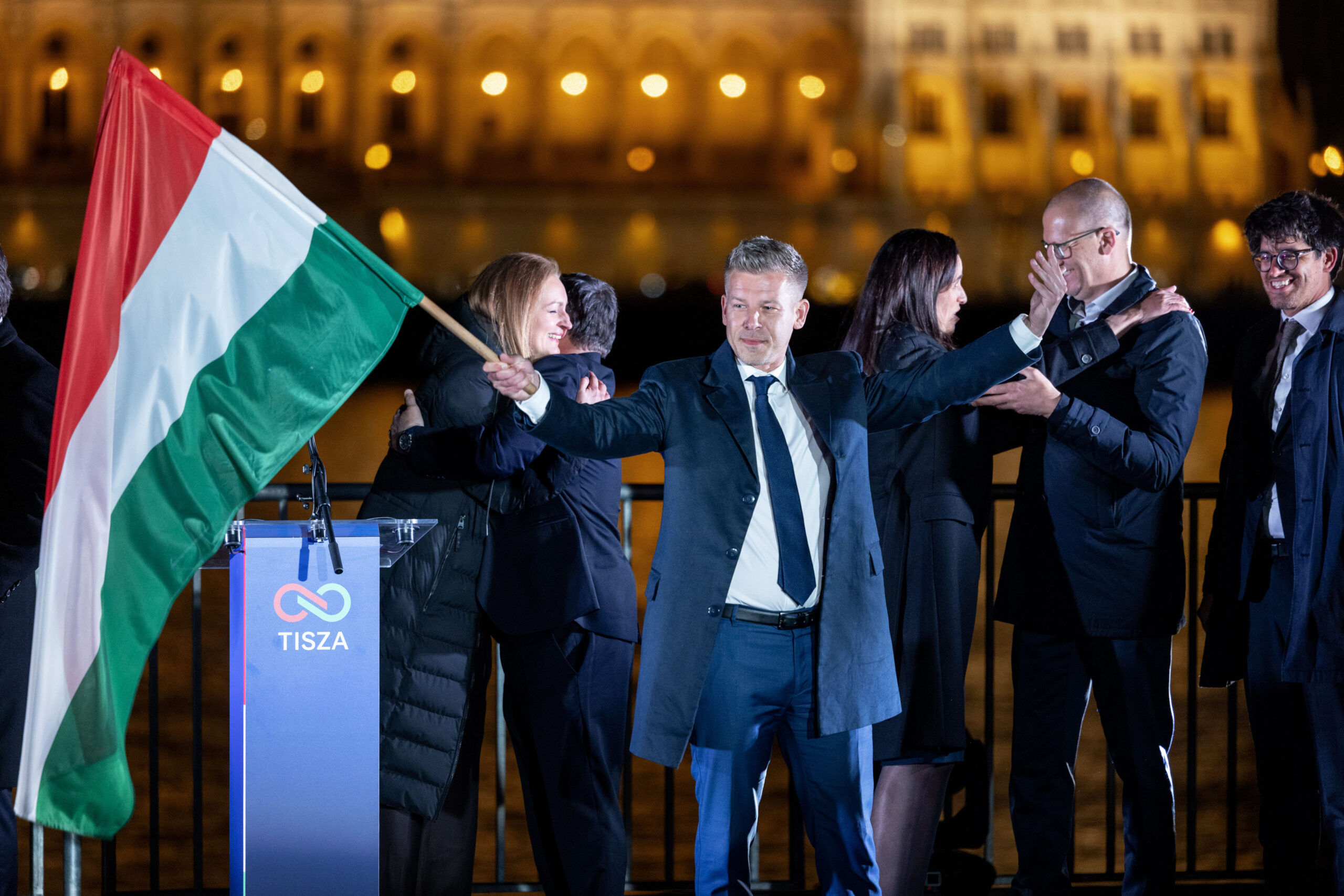
Election night in Hungary became a giant citywide party, as tens of thousands of people took to the streets to celebrate their liberation from the regime of Viktor Orbán. Young people thronged the avenues, the trams, and the subways, singing and chanting in celebration. Cars full of supporters cheering new Prime Minister Péter Magyar honked their way through Budapest’s giant boulevards. Magyar, always attentive to camera angles, passed through crowds of supporters while waving a giant Hungarian flag before giving a resounding victory speech on the banks of the Danube, with the beautiful baroque parliament building providing the backdrop.
“Arad a Tisza!” the crowd shouted, meaning “the Tisza floods!” It’s a pun. Tisza is the name of a major river in eastern Hungary and also the name of Magyar’s party. The election map that night showed indeed that Tisza blue had spread across the country where once only Orbán’s Fidesz orange reigned.

While Budapest’s big celebrations were broadcast around the world, this election was won in the countryside. Since his first term in office, Orbán had rigged the election rules so that he could keep winning his parliamentary supermajority with mere pluralities. The secret to the rigging was that rural votes were weighted much more heavily than city votes. Parliamentary districts in the countryside had sometimes as few as thirty-thousand voters while districts in the cities packed in up to ninety thousand. Given the first-past-the-post system, in which the candidate with the most votes wins the seat, rural districts required far fewer votes for victory. Plus, the countryside offered carrots and sticks. The mayors of virtually all the villages in Hungary were loyal to Fidesz, and shortly before this election, we saw what everyone knew — which was that those local mayors not only bought votes outright but also threatened to deny state benefits to constituents who might be tempted to abandon the party. These were the areas where Orbán racked up his votes to score those supermajority victories.
The election system that Orbán built contained a tipping point: Win enough of the countryside vote and the victor would gain a bonus of extra seats well beyond proportional representation. In fact, that’s the only way that a party could win a “constitutional majority” — enough votes to allow the party to change the constitution all by itself. If another candidate could figure out how to get to that tipping point, the overwhelming victories that Orbán won would flow to someone else. It’s just that the only sort of candidate who could do this had to be rather like Orbán. And Péter Magyar was.
It’s easy now to forget how young, handsome, and charismatic Viktor Orbán had once been. A smart lawyer, he was a natural orator who could nonetheless appeal to those far less educated than he. Orbán was also a master strategist with a disciplined hold over his party. Of the nine elections since Hungary emerged from Soviet influence in 1989, Orbán had won five — four with more than two-thirds of the parliamentary seats.
Péter Magyar will remind those with long memories of that young Orbán — handsome and charismatic with the fluency of a lawyer and an ability to speak easily to diverse crowds. He exuded energy and hope for the future, much as Orbán once did. Seeing Magyar jumping ahead in the polls, Orbán threw everything at him to get him to fail: The state-security services infiltrated Magyar’s campaign and tempted him with a female Fidesz agent who briefly became his girlfriend (and taped their conversations). Orbán’s loyal prosecutor sought to prosecute the Tisza leader for a minor crime (throwing someone’s phone into the Danube after a late-night bar brawl). The Orbán-controlled press demonized Magyar daily.
Still, Magyar’s support in the polls did not dip. Instead, it grew. The European Parliament refused to lift his parliamentary immunity, so he became prosecution-proof. His communications team parried back each negative attack. When someone (who else but someone in Orbán’s camp?) released a photograph taken from a surveillance camera in a hotel room showing a bed with rumpled covers, hinting something else would be “coming soon,” Magyar’s fans went to work creating AI memes of Orbán in bed with Putin, Trump in bed with Orbán, and many more couplings. The threatened sex tape never emerged. It would have been impossible to distinguish a real video from the proliferation of AI memes already flooding the zone.
Meanwhile, Magyar kept his eyes on the prize in a very disciplined campaign. For the last two years, Magyar has spent most of his time in the countryside, sometimes holding rallies in six or eight villages a day. Working around the Orbán-controlled media which gave Magyar zero airtime, his appeal relied primarily on in-person contact and a rapid-response social-media presence. As someone who had grown up inside the Orbán machine, where twenty years of party membership taught him the secrets of the Fidesz club, Magyar understood just how the elections were rigged.
The opposition coalitions that ran against Orbán in 2014, 2018, and 2022 rarely barnstormed outside the major cities. And they lost handily as Orbán retained his parliamentary supermajority in each election. Though Magyar is himself from a family of lawyers in Budapest (while Orbán himself is from the countryside), Magyar’s fearless (and relentless) energy plus his sense that he was on a patriotic mission to save Hungary from corruption and autocracy broke through. No village was too small to receive numerous visits from him. This attention to rural voters paid off. In the last election in 2022, Orbán won 88 of the 106 constituencies, leading with the rural vote. On Sunday, Magyar won 93, repeating Orbán’s strategy of sweeping the countryside while scoring higher in the cities than Orbán ever did.
After winning in 2022, Orbán announced proudly that his victory was “big enough to be seen from the moon.” This year, Péter Magyar’s victory was big enough to be seen from Mars. Election night found him racking up fully 138 of the 199 seats in the unicameral parliament — in a system in which 133 seats provides a big enough margin to amend the constitution and any other law in Hungary, all with the votes of his party alone. Only a supermajority of this size will allow him to break through the heavily entrenched system that Orbán has created over sixteen long years of autocratic capture. Magyar’s constitutional supermajority enables him to do what Orbán did — in reverse.
Election officials are still adding the votes of the “near abroad” Hungarians who live in neighboring states and who have reliably voted for Orbán ever since he gave them citizenship. So Magyar’s final tally may drop by a seat or two. But he has the cushion to survive the adjustment. The final results will be announced on April 19.
What sort of politician will Magyar be now — and how will he be different from Orbán? His background political views are center-right, and thus on many policy issues ranging from immigration to family values to economic policy, he will carry on with more of the same. He will be more pro-Europe but probably on the right flank of the European People’s Party, the center-right European parliamentary party. But thinking of Magyar that way misses a key point. This was not a left-right election. It was a democracy-autocracy election in which every other issue faded into the background.
Magyar was strongly supported by parties of the center and left, even though they don’t agree with him on very much. Everyone wanted to topple Orbán — to tackle the immense corruption of his regime, restore democratic institutions, shore up sagging public services like health care and transportation, and rejoin Europe, not least to recover the billions of euros that the EU has withheld from Hungary over corruption, attacks on judicial independence, and violations of fundamental rights. A vote for Magyar was a vote to end the Orbán rendszer (regime), the word that Magyar consistently used to describe the Orbán administration instead of the more usual kormány (government). Getting rid of autocracy unites left and right. As a result, even though Magyar had stayed away from the enormous Pride Parade last summer, which Orbán tried to ban, and had been studiously noncommittal on gay rights, gay couples were dancing in the streets of Budapest Sunday night, having voted enthusiastically for Magyar.
Magyar persuaded Hungarians to vote for him by creating an opening in the locked-down Orbán system for people to show up and realize how many other people were ready for change. Magyar’s rallies were joyous events, as he campaigned against fear and for restoring freedom again. The rallies got bigger and bigger over time as people realized that because Magyar was not afraid, they didn’t have to be either. Millions of Hungarians found their voice in this election and, in finding their voice, they also found each other.
Sociologist Antal Örkény, a keen observer of all things Hungarian, writing with the poetic voice of his famous author-father István Örkény, captured best what has taken place in Hungary over last two years in words I cannot improve upon (my translation):
What has just happened can be expressed in the most beautiful way by the word awakening. I felt that the country is waking up to self-consciousness. Just as we wake up every morning, Hungarian society woke up from an unbearable world into a normal and livable world. It took time, but I felt that in the last two years, people’s attitudes toward each other and politics have changed step by step. I followed closely the events of the Tisza party, because whoever saw these events could testify not only that more and more people came out to the streets to listen to Péter Magyar, but also these people were smiling more and became closer to each other, more joyful, more confident. And they were increasingly connected to the community with a sense of belonging. . . .
On the day after the election, as Peter Magyar put it simply, “This is the end.” And what lies ahead is change and creation.
Kim Lane Scheppele is the Laurance S. Rockefeller Professor of Sociology and International Affairs at Princeton University and a faculty fellow at the University of Pennsylvania Law School..
Copyright © 2026 National Endowment for Democracy
Image credit: Sean Gallup/Getty Images
|
FURTHER READING |
||
How Viktor Orbán WinsThe case of Hungary shows how autocrats can rig elections legally, using legislative majorities to change the law and neutralize the opposition at every turn, no matter what strategy they adopt. |
How to Defeat the Authoritarian MessageFilip Milačić |
How Péter Magyar Defeated Viktor OrbánSándor Ésik |