
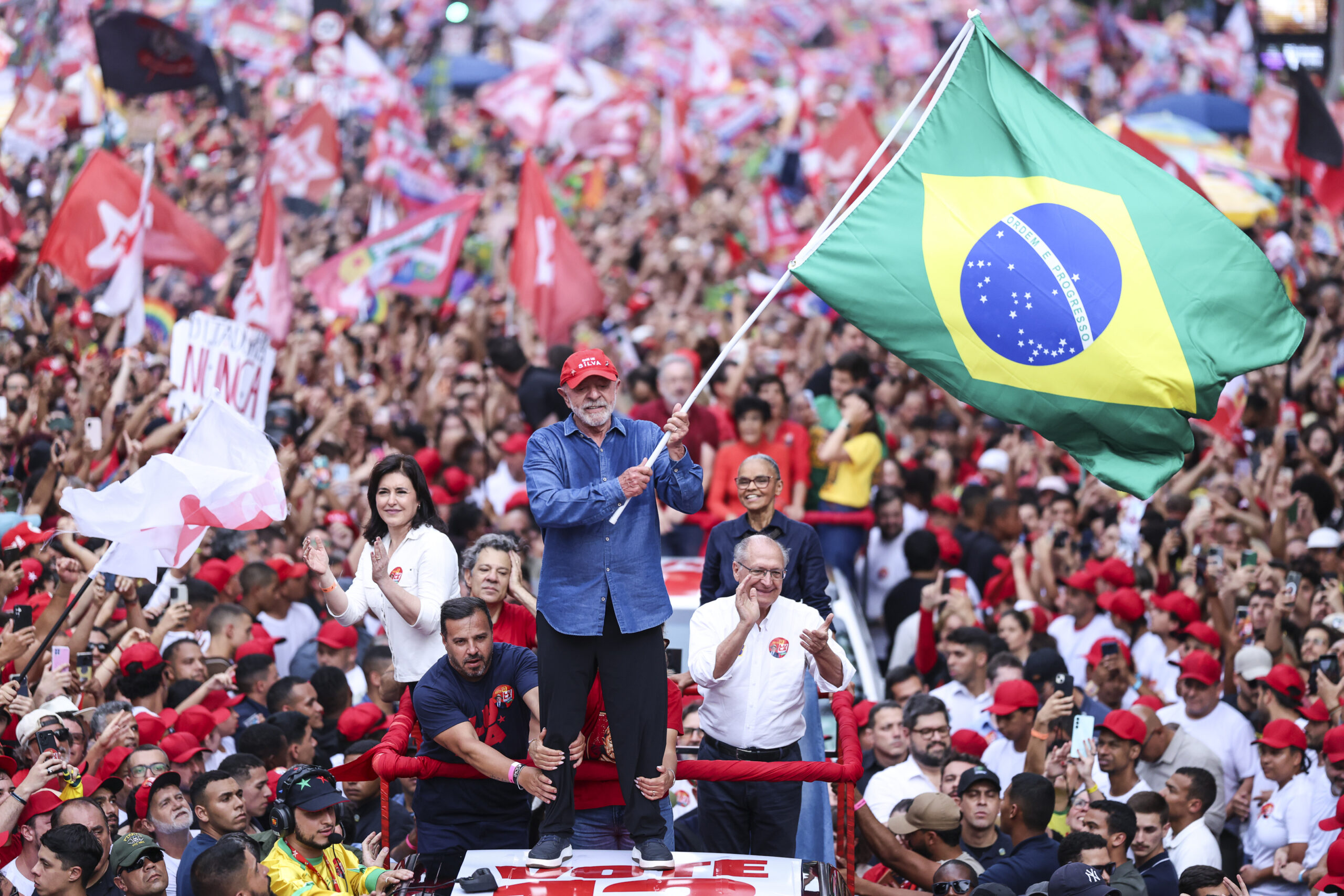
Most people thought it was the end of the road for the progressive champion. But Lula’s team deployed an innovative last-minute strategy for mobilizing support that should be studied for years.
October 2026
The week before the first round of Brazil’s elections, both Luiz Inácio Lula da Silva and Flávio Bolsonaro rallied supporters in hopes of winning the election outright. While neither reached the necessary 50 percent to avoid a runoff, Bolsonaro surpassed Lula by more than two-million votes, a devastating blow for the Brazilian left. The stakes were high. The next president would appoint at least four Supreme Court justices, shaping Brazilian politics for a generation. Bolsonaro had promised to reform the Court and release his father, former president Jair Bolsonaro, who is in jail for attempting a coup after he lost the 2022 presidential contest. No runner-up had ever won a runoff in a presidential race in Brazil. That is, until Lula pulled off the single greatest political upset in modern Brazilian history on 25 October 2026.
Going into the second round, Bolsonaro had a strong upper hand. Abstention rates, which generally grow from the first to the second round, were record-breaking and concentrated among potential Lula supporters. All but six of twenty seven gubernatorial races were settled in the first round, most for pro-Bolsonaro candidates, shrinking Lula’s friendly political terrain. Except for Lula, the three other relevant first-round presidential candidates had leaned to the right, and Flávio was deemed the likely heir apparent to their votes. Platform algorithms and AI guardrails also appeared to favor the political messages his campaign promoted. Plus, Bolsonaro had Washington’s support — on top of tariffs imposed in retaliation for the elder Bolsonaro’s imprisonment, the Trump administration had allegedly planned to question the election’s integrity in the event of an unfavorable result.
Still, the blue-collar candidate born into poverty in the northeastern state of Pernambuco will be sworn in as president for a fourth time. His secret? His progressive base, whose decentralized mobilization paved the way for a record-breaking result in a country where incumbents are typically punished by voters. Lula’s comeback rested on a highly specific strategy that converted mass online participation into interpersonal persuasion, street mobilization, and turnout. The base convinced absentees, people who intentionally spoiled their votes, as well as those who voted for other right-wing candidates, and even people who had voted for Bolsonaro in the first round to cast their ballot for Lula.
Adapting in Real Time
It began with a student rally in the city of Niterói, Rio de Janeiro, the day after the election’s first round. Students took to the streets in multiple cities in the days that followed. Videos of their marching bands and chants echoed across social media. Their urgency was a wake-up call to those still paralyzed: Every vote mattered.
Their call reverberated. For most Brazilians, voting is mandatory. But that’s not true for senior citizens older than seventy. Social-media campaigns hammered the message that these older voters mattered and that they could make a difference. These campaigns also called on people to help their elderly family members vote. Expatriates and Brazilians away from their home districts started organizing how they would travel to vote in a country with no absentee or mail-in ballot option. The deadlines for transferring registrations and voting in transit are often early, and plans change.
I, myself, did not vote in the first round because a knee injury prevented me from traveling from Santiago, Chile, where I live. For the second round, four days after my knee operation, I traveled six hours by car to cast my vote in São Paulo. No distance seemed insurmountable. Strangers transferred money for bus fares and offered rides. Videos of packed airports, bus stations, and boat docks full of people heading home to support Lula flooded social-media feeds.
The wider progressive camp continued producing online content supporting Lula, rallying influencers to campaign in favor of key issues on Lula’s campaign platform. But while influencers had resisted directly supporting Lula in the first round fearing backlash from creating overtly political content, they now did so enthusiastically. The stakes had changed. Many explained it was not a matter of liking Lula, underscoring the risk Bolsonaro presented for democratic politics. It was this broad appeal that mobilized the millions of Brazilians who flocked to Copacabana on October 18 for the Act in Support of Democracy concert organized by popular Brazilian musicians.
Independent journalists continuously reported on Bolsonaro’s history as a congressman, voting against female and minority rights, and his connection to Rio de Janeiro’s milícias — armed groups formed by police officers who violently coerce the population to vote for the milícias’ preferred candidates. His political record made it easier to communicate the risks with both right- and left-wing voters who care about enfranchisement and protecting political competition. Initiatives like Revelando Brasil, an investigative documentary series, adopted the aesthetics of right-leaning media to explain these connections and the risks of electing the younger Bolsonaro.
There were also some extraordinary efforts made to bolster Lula’s candidacy. André Janones, a federal deputy from Minas Gerais, independently built a digital base, amassing more than ten-million members in a WhatsApp channel. “Lula’s Army,” as the self-designated “General Janones” named it, grew exponentially. He challenged his followers to expand the group’s membership, moving the goalpost from three to five to seven and ultimately to ten-million members. Anxious and frightened, people followed suit, joining the channel and even producing their own pro-Lula content. AI-generated videos of Lula dancing joined an endless stream of video animations dramatizing the consequences of his opponent’s proposed budget cuts in real life, and of a musclebound Lula squaring off against a caricature of Bolsonaro whose muscles are no more than balloons. Teenagers rallied on Roblox.
In Janones’s WhatsApp channel, where only he could post messages, the “general” asked his “soldiers” to post specific hashtags, such as #LulaVaiVirar (Lula will turn the game around) and #NinguemCalaNossoExercito (No one can silence our army) in reaction to Bolsonaro’s attempt to close the channel, carefully explaining that his goal was to overcome the hurdles that disfavored progressive-coded content. He instructed his “army” not to engage with any content from the far-right, effectively reducing the reach of hate-filled echo chambers. The army of chat members also reclaimed symbols. Janones instructed his followers to simultaneously post selfies wearing green and yellow clothing, previously identified as uniforms of the far right and Bolsonaro supporters, and to bang pots and pans at 9 p.m. one Friday, a form of protest originally coded as left-wing that became connected to the right.
While others hired bots, Janones mobilized real people to shape the algorithms’ behavior. And they went beyond social media. In the final days, Janones rallied people to march and zeroed in on a powerful call to action: #SoMaisUmVotoProLula, Win one vote for Lula. He instructed his followers to talk to people they know, beginning with the undecided, and to ask questions about Bolsonaro and his track record. His followers did what bots could not do: They engaged people one-on-one, both online and in person. They posted on WhatsApp and reactivated Facebook accounts, reaching friends and family who were not on other platforms. They called their grandparents and made plans to take them to polling stations. On election day, they offered car rides to strangers in cities where public transportation was intentionally restricted, as happened in São Paulo and in Salvador.
Lula’s campaign also adapted. After a string of defeats in the first-round contests, Lula summoned a few successful left-wing representatives — most of them young — to ask what he had done wrong. They replied that he needed a cellphone and a future-focused message. Lula was notorious for having long relied on an aide instead of carrying his own phone. His selfie videos quickly gained traction. His campaign then shed its hubristic reliance on past glories and started focusing on new proposals to improve people’s lives: expanded cash transfers for students, a larger federal role in combating organized crime, protecting natural resources. The final days before the runoff saw mass marches in state capitals nationwide, and Janones held a 24-hour live stream on Lula’s YouTube channel. On election day, it was all-hands-on-deck to get as many people to the polls as possible.
Other developments reinforced the shift in momentum. Congress approved a five-day workweek, a key win for Lula. Bolsonaro, who supported the reform at the last minute, missed the vote to attend a campaign event. Bolsonaro’s poorly received debate performance, where he came across as snobbish and arrogant, and Lula’s energized responses, particularly when he explained how he had lost a finger in a work accident when he was just seventeen, sharpened the contrast. Lula won, Flávio left the country.
A Progressive Playbook
Brazil offers three lessons for progressives competing in close elections. First, it is possible to maximize social-media algorithms, but digital mobilization must get beyond the screen and translate into interpersonal connection and collective action. Bots cannot call a grandparent or offer a ride; you need real people for that. Second, people are more likely to engage when you articulate clear risks of democratic setbacks and emphasize why their vote counts. Finally, while having a clear enemy can mobilize action, having a credible vision of the future converts that fear into votes to resist setbacks.
But Lula’s comeback is owed to more than this. His campaign borrowed militarized language, algorithmic manipulation, and aggressive content and tactics from the populist right. The question is not simply whether those methods worked, but which elements democratic movements can replicate without reproducing the political culture they are trying to defeat. Can democracy be defended using the communication methods that have degraded it? Lula himself defended regulating social media to level the playing field. If such reforms succeed, parts of the 2026 playbook may — and perhaps should — stop working. The heart of Janones’ political strategy for connecting the digital world to the ballot box deserves attention: join, share, recruit, post, avoid amplifying opponents, reclaim national symbols, take the streets, and ask each follower to persuade one voter.
Janones called on ten-million people to secure one additional vote each for Lula. Ultimately, the president gained just over ten-million votes between rounds. The numerical symmetry is striking, but this result was aided by some relatively unique aspects of everyday Brazilian life. Brazilians are chronically online, particularly on WhatsApp, and have a knack for making and sharing memes. It is also a gregarious society. Tight family and friendship networks helped the effort to reach elderly voters and people who needed assistance traveling to the polls. Student organizations, neighborhood and favela associations, carnival groups, musicians, sound trucks, and experienced street organizers supplied the skills, equipment, and trust needed to fill the streets with throngs of people in red, green, and yellow. The defense of democracy also carried force in a country with recent memories of both military dictatorship and Jair Bolsonaro’s presidency. Artists who had lived under authoritarian rule could call people into the streets; younger voters could supply the urgency and digital fluency; and three decades of evidence about the Bolsonaro family’s politics made the democratic risks easier to communicate to a crowd driven as much by the fear of losing hard-won political gains as by the hope of achieving new ones.
Brazil’s tactics cannot be copied wholesale. Janones is already being invited to work with progressive campaigns worldwide. But his bombardment of text messages and voice recordings and his commanding tone may not be welcome in other cultures. The broader lesson, however, can travel: Progressive digital mobilization can alter a close election when grassroots organizers communicate risks and a credible vision of the future, connecting scalable online coordination to trusted personal networks and existing civic infrastructure, distributing achievable individual tasks.
Where citizens can unite, democracy retains the capacity to defend itself at the ballot box. In his victory speech, Lula credited the Brazilian people, not his old-school party and official campaign apparatus. He promised to bring citizens into his government. Janones told his “troops” to remain mobilized. What that participation will mean in practice, and whether it can sustain the campaign’s democratic energy beyond the election, is now the question.
Ana Paula Pellegrino is an assistant professor at the Pontifical Catholic University of Chile’s School of Government.
Copyright © 2026 JoD Productions Inc
Image Credit:Alexandre Schneider/Getty Images
|
FURTHER READING |
||
How to Build the Right Coalition |

How to Defeat the Authoritarian Message
|

The Election Fraud Epidemic |