
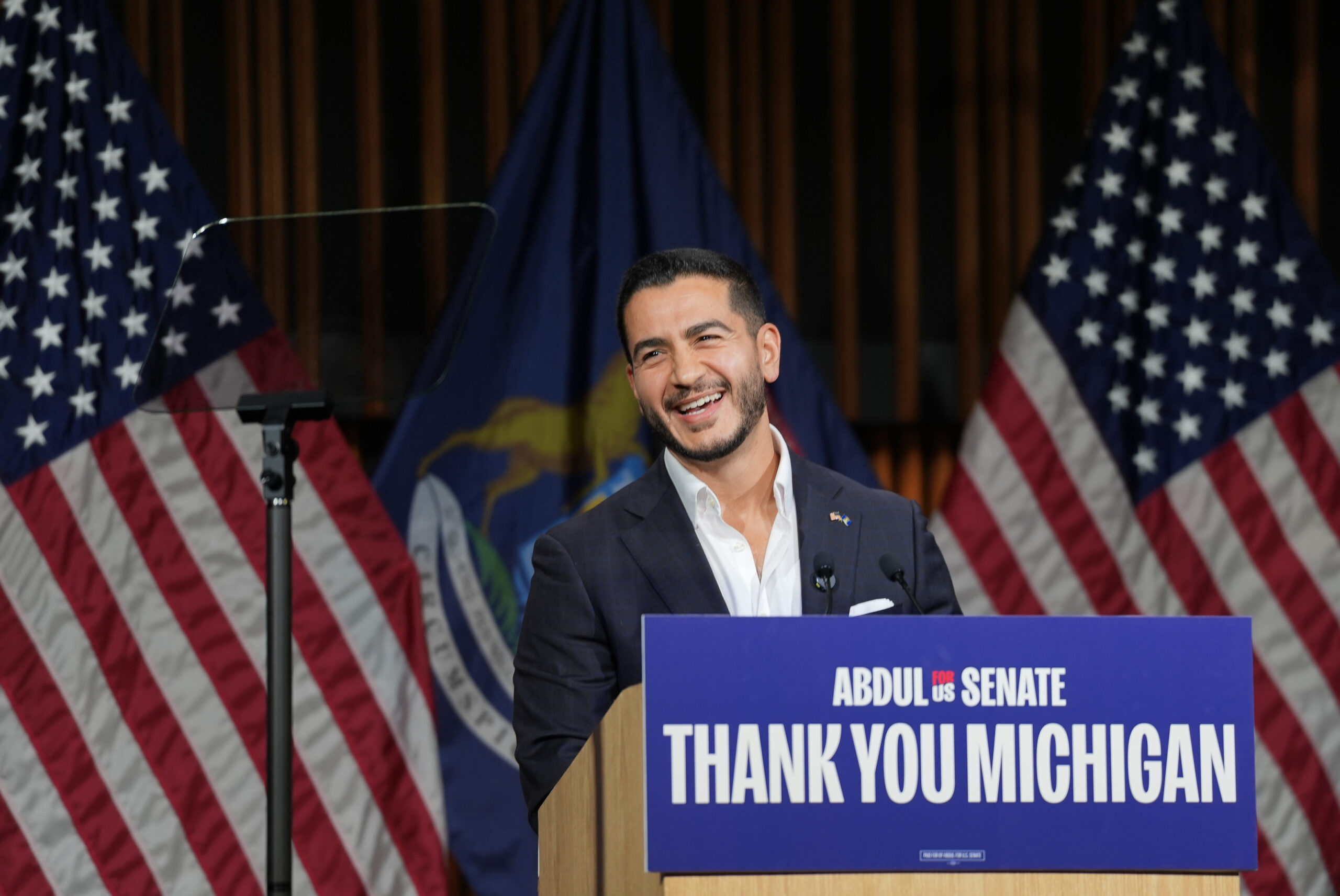
The election of Abdul El-Sayed and other Muslim officeholders has stirred fears of an Islamist takeover. But their records tell a different story. Our democracy can survive any group’s participation.
By Tarek Masoud
November 2026
Tarring ones political opponents as threats to democracy has become a regular feature of political life in Donald Trump’s America. Democrats routinely accuse Republicans of undermining the integrity of our elections and of spreading intolerance toward fellow citizens of different skin tones, sexual orientations, and religious beliefs. Republicans, in turn, accuse Democrats of being, variously, communists, social-justice totalitarians, and — if the target happens to be of Muslim background — “Islamists.” This latter charge has been leveled with special force in the U.S. mid-term elections that just concluded, in which seven (and possibly eight) Muslims won seats in Congress, and one — a Michigan doctor named Abdul El-Sayed — became the first Muslim elected to the Senate. President Trump called El-Sayed “a Jihadist Member of the Muslim Brotherhood . . . who should never be allowed inside of the Halls of our Great and Beautiful Capital [sic] Building.” Texas senator Ted Cruz accused El-Sayed of wanting “to subjugate nonbelievers and use government force to impose Sharia Law.” On election day, the conservative National Review advised that “Islamism is on the ballot.” And Fox News host and Trump advisor Mark Levin warned that the results signaled the ascent of a “Marxist-Islamist agenda” that seeks to wage “war on the Constitution and capitalism.”
It is easy to dismiss these claims as so much bigotry, but they are merely the most sensational expressions of old worries in mainstream Western scholarly and policy circles over Islam’s compatibility with liberal democracy. That they are today leveled by individuals whose own compatibility with liberal democracy can be justifiably questioned does not render them wholly unserious. After all, no one can deny two uncomfortable facts about the world we inhabit: First, that there are few Muslim-majority countries, and no Arab ones, that can claim to be fully fledged, liberal democracies; and second, that the Muslim world has given rise to some of the twenty-first century’s most violently antidemocratic and anti-American movements and organizations.
It is not unreasonable, then, to ask whether there is something about Islam that contributes to these two facts, and whether the growing number of Muslims in the West, and their rising representation in the halls of power, might portend the extension of those two facts to this part of the globe. There is even evidence that a not-insignificant number of American Muslims themselves believe these are fair questions. In a 2017 survey of 1,001 American Muslims conducted by the Pew Research Center, 21 percent answered “yes” when asked if there was a “natural conflict between the teachings of Islam and democracy,” 52 percent said they were “very concerned” about “extremism in the name of Islam in the U.S.,” and 14 percent said there was “a fair amount” or “a great deal” of “support for extremism . . . among Muslims living in the U.S.”
So, are we witnessing the beginnings of an Islamist takeover of the sort described in Michel Houellebecq’s 2015 novel, Submission, in which a branch of the Muslim Brotherhood wins France’s presidency and turns that country into an Islamic state? Of course, the election of a handful of Muslims to the 535-seat U.S. Congress can hardly constitute a takeover, and too often the label “Islamist” is used simply to denote a Muslim whom the speaker does not like. After all, any term that can be applied as promiscuously as Islamist has been, to everyone from the arch terrorist Osama bin Laden to the smiling New York City mayor (and avowed socialist) Zohran Mamdani, is one that could be said to have lost all meaning. But, in some instances, the overheated rhetoric is not entirely without foundation.
For example, those who believe El-Sayed to be a secret member of the Muslim Brotherhood — the century-old Egyptian political movement often considered to be the mother of global Islamism — point to a petition he signed in November 2012 supporting Egyptian president (and Brotherhood member) Mohammed Morsi. The petitioners — who included leaders of the Muslim American Society, the Union of Egyptian Imams in North America, the Council on American Islamic Relations, and Islamic Relief USA — endorsed Morsi’s assumption of extraordinary powers (including his declaration that his decisions were not subject to judicial review), chided him for not having done it sooner, and urged him to “purge the media and the police as quickly as possible.” El-Sayed’s opponents also point to his estranged mother’s involvement in an Islamic charity shuttered in 2004 by the U.S. Department of the Treasury for allegedly channeling money to al-Qaeda. And they note that both his parents were, according to El-Sayed and his sister, opposition political activists in Egypt at a time when the Muslim Brotherhood was the locus of such activism. The implication is that the United States’ first Muslim senator represents a first step toward a Submission-like scenario in this country.
My own read of these facts adds up to something less sinister. Though I was on the other side of the issue on which El-Sayed petitioned the former Egyptian president, it’s not obvious to me that El-Sayed was wrong, given that Egypt’s fledgling democracy fell to a military coup scarcely seven months later. Moreover, the petitioners noted their unease with Morsi’s new powers and asked him to pledge to give them up “as soon as the drafting of the constitution is completed” — hardly an endorsement of Islamic autocracy. And though the petition’s co-signatories included leaders of groups that certain American security analysts tie to the Muslim Brotherhood — whose Egyptian branch President Trump designated a terrorist organization only this year — they continue to enjoy federal tax-exempt status, even under an administration so zealous in ferreting out enemies that it threatens to remove that status from Harvard University. And, finally, even if El-Sayed’s parents were Muslim Brotherhood members or fellow travelers, that no more makes him a Brotherhood member than having had Communist or Socialist parents made party members out of playwright David Mamet or actor Richard Dreyfuss or any number of so-called red-diaper babies.
Islamism is not determined by a politician’s parentage or by the people he or she knows, but by his or her policy commitments. It is worth asking, then, whether we can detect traces of Islamism in the policy platforms of El-Sayed and his fellow Muslim legislators. Most scholars identify a party as Islamist if it insists that civil, criminal, family, and commercial laws must be derived from Muslim scripture — that is, if it demands the application of shari‘a. Others, like the terrorism scholar Thomas Hegghammer, apply a looser standard, defining Islamism as “activism justified with primary reference to Islam.” By either definition, there is little evidence of Islamism among the crop of Muslims now in American public office. Critics of Islamism have correctly condemned it for its subordination of women and its extreme intolerance toward lesbians, gays, bisexuals, and transgender people. Abdul El-Sayed, in contrast, defends women’s access to reproductive care (“We must protect the right to choose”), supports gay rights (“I stand with the LGBTQ+ community in their struggle for equal rights and dignity”), and resists attempts to curtail the rights of transgender people (“it’s really important for us to fight at the state level to protect access to bathrooms, to locker rooms, to sports teams of choice for young people”). Hassan al-Banna, the founder of the Muslim Brotherhood, would not have approved.
Practically every Muslim (Democratic) candidate for office takes the standard progressive — and decidedly non-Islamist — positions. That includes the one Muslim candidate this year against whom credible claims of Islamist associations have been made — a New Jersey physician and congressman-elect named Adam Hamawy. As a twenty-something in the 1990s, Hamawy consorted with Sheikh Omar Abdel Rahman, the blind Egyptian cleric who in the 1970s led Egypt’s premier jihadist group and inspired both the 1990 assassination of Jewish militant leader Meir Kahan and the 1993 World Trade Center bombing. Hamawy was close enough to the sheikh to have testified for the defense at his trial, and his refusal today to answer detailed questions about that time in his life is so troubling as to be, to this author at least, disqualifying. Yet Hamawy also served in the U.S. military, treated first responders on 9/11, and today advances the kind of political platform that would have earned him a condemnatory fatwa from the militant sheikh he once befriended. His campaign website calls the “draconian policies enacted after the overturning of Roe v. Wade” a “stain on our country;” denounces as “disgraceful” what he describes as “a recent wave of policies targeting the LGBTQ+ community;” and endorses both the Transgender Bill of Rights (“which establishes clear federal anti-discrimination protections”) and the Transgender Health Care Access Act (“which expands education and training for healthcare providers so we can deliver competent, respectful, and evidence-based care to transgender patients”). One can oppose these stances for any number of reasons, but fealty to shari‘a is not one of them.
Indeed, in at least one instance, a progressive Muslim legislator actually sought to punish a country for adopting shari‘a. In April 2019, the small, wealthy, Southeast Asian nation of Brunei implemented a “Shari‘a Penal Code,” which prescribed the death penalty for apostasy, adultery, and homosexuality (the latter two by stoning), mandated the amputation of limbs for those convicted of theft, and imposed hefty fines and prison sentences for anyone receiving or providing an abortion. In response, one of the few Muslim members of Congress at the time introduced a bill called the “Brunei Human Rights Act.” If passed, the bill would have imposed sanctions on any Brunei government official who implemented these laws, which the congressperson decried as “anathema to our values as humans.” That congressperson was Minnesota representative Ilhan Omar, who was recently invited by one outgoing Republican legislator to “take [her] sharia-loving, anti-American self back to Somalia.”
This image of Muslim American legislators as staunch defenders of freedoms that Islamists oppose is largely confirmed when one examines the voting records of all six legislators of Muslim background who serve in the current session of Congress. (The count excludes Aisha Wahab of California, who assumed her seat in a special election only three months ago). The table below summarizes the performance of each member on scorecards by national civil rights organizations: the American Civil Liberties Union, the gay rights–focused Human Rights Campaign (HRC), and Planned Parenthood. Five of the six congresspeople earned perfect scores from both HRC and Planned Parenthood and also earned scores of at least 90 percent from the American Civil Liberties Union (ACLU). Only one congressperson of Muslim background earned the low scores from HRC (0 percent), Planned Parenthood (0 percent), and the ACLU (5 percent) that one might expect of an Islamist: Abe Hamadeh, a Republican from Arizona who grew up in a mixed-faith Muslim-Druze household, identifies as “non-denominational,” and was lauded by President Trump as someone who “knows that if the flame of freedom is extinguished, it may never come back again.”
Muslim-background members of the 119th Congress on civil liberties, gay rights, and abortion (2025–26)
| Member | District | ACLU (civil liberties) | Human Rights Campaign (LGBTQ+ rights) | Planned Parenthood (reproductive rights) |
| Yassamin Ansari (D)* | AZ-3 | 90% | 100% | 100% |
| André Carson (D) | IN-7 | 90%† | 100% | 100% |
| Abe Hamadeh (R)* | AZ-8 | 5% | 0% | 0% |
| Ilhan Omar (D) | MN-5 | 90%† | 100% | 100% |
| Lateefah Simon (D) | CA-12 | 90%† | 100% | 100% |
| Rashida Tlaib (D) | MI-12 | 95% | 100% | 100% |
* Religiously unaffiliated
† Recorded incorrectly by ACLU as voting in favor of 2025’s “Illegitimate Court Counteraction Act.” The correct score is 95%.
What makes the social progressivism of most Muslim American politicians and candidates so remarkable is not just that it is clear evidence of their distance from Islamist ideology, but also of their distance from their own religious community. Muslims tend to be socially conservative. And though American Muslims are, anecdotally, more liberal than their counterparts in the Middle East, they are somewhat less liberal than their fellow Americans, and far less liberal than the Muslims in Congress.
In the 2017 Pew Survey of Muslim Americans, only 52 percent said that “homosexuality should be accepted by society.” And while 58 percent of respondents in that same poll said that “there is a lot of discrimination” against gays and lesbians, only 39 percent said both that gays and lesbians should be accepted and that they face lot of discrimination. It seems reasonable to assume that politicians seeking to faithfully represent the religious sensibilities of a community with those views would not earn perfect scores from the Human Rights Campaign.
The gap on social issues between American Muslims and their ostensible representatives in Congress underscores the fact that most of the Muslim members of Congress are not simply representing their fellow Muslims, but reaching for something broader. Whether this is because they are true believers in the liberal progressive project, or just canny political operators doing what they must in order to build winning electoral coalitions, is immaterial. As I have argued in these pages, democracy emerges and survives not when everyone who runs for and wins office is a true believer, but when they are forced to behave that way by a society that is too complex to be ruled by command, and full of competing, organized groups capable of withdrawing consent from leaders who betray their trust.
If the United States tomorrow were to suddenly transform into a society more similar to the one from which El-Sayed’s parents (and mine) immigrated — with low levels of literacy, meager economic opportunities, anemic civic organizations, and a near total absence of the liberal democratic values we take for granted — I might worry that democracy in America was not long for this world. That is not likely to happen, and if it does, it won’t be because of a handful of progressive Muslims in Congress.
A skeptical reader may at this point object that the social progressivism of Muslim American politicians simply masks their real aim of advancing foreign-policy goals dear to Islamists — such as disrupting the U.S.-Israel special relationship and forcing an American retreat from the Middle East. This is a claim that is impossible to disprove, insofar as it rests on assumptions about true motives, which are, of course, unobservable. But it is also the kind of claim that, when made about other groups, we instantly recognize as odious.
When the right-wing commentator Tucker Carlson says of Jewish American politicians and donors, that “their loyalty is not to the United States, it’s to a foreign country,” we reject that for the chauvinistic calumny that it is. It’s not clear why we should treat analogous claims about American Muslim politicians any differently, especially when their views overlap considerably with those of the current vice-president, who recently declared (presumably approvingly) that voters want to “end the [Iran] war” and “change our relationship to Israel.” If JD Vance can believe these things and not be branded an Islamist, Abdul El-Sayed and Ilhan Omar can, too.
Moreover, whatever one thinks of the foreign-policy views of most American Muslim politicians, there is no obvious connection between those views and their holders’ commitments to the Constitution. One might believe, for instance, that Abdul El-Sayed’s fervent desire to defund the Israeli and Egyptian militaries is inimical to U.S. national interest, but it requires more imagination than is at this author’s disposal to conclude from this that El-Sayed’s presence in the U.S. Senate imperils American democracy. Indeed, it could be argued that the rise to high office of a child of Muslim immigrants is less a threat to our democracy than a testament to it.
Finally, even if all of the above is excessively naïve, optimistic, and Panglossian, it’s worth remembering that democracy is, as Joseph Schumpeter explained more than eighty years ago, a political system in which individuals acquire power “by means of a competitive struggle for the people’s vote.” Muslims make up around 1 percent of the American population, and in no congressional district do they constitute anywhere near a majority. Islamists are but a fraction of that 1 percent. As long as candidates for public office — Muslim or otherwise — have to secure the votes of a plurality of their fellow Americans to get there, our democracy can survive any group’s participation in it.
Tarek Masoud is the Journal of Democracy’s coeditor and the Ford Foundation Professor of Democracy and Governance at Harvard University’s John F. Kennedy School of Government.
Copyright © 2026 JoD Productions Inc
Image Credit: Salwan Georges/Getty Images
|
FURTHER READING |
||
Religious Exclusion and the Origins of Democracy |
Competitive Authoritarianism in America |
Polarization Is Not the Problem |