
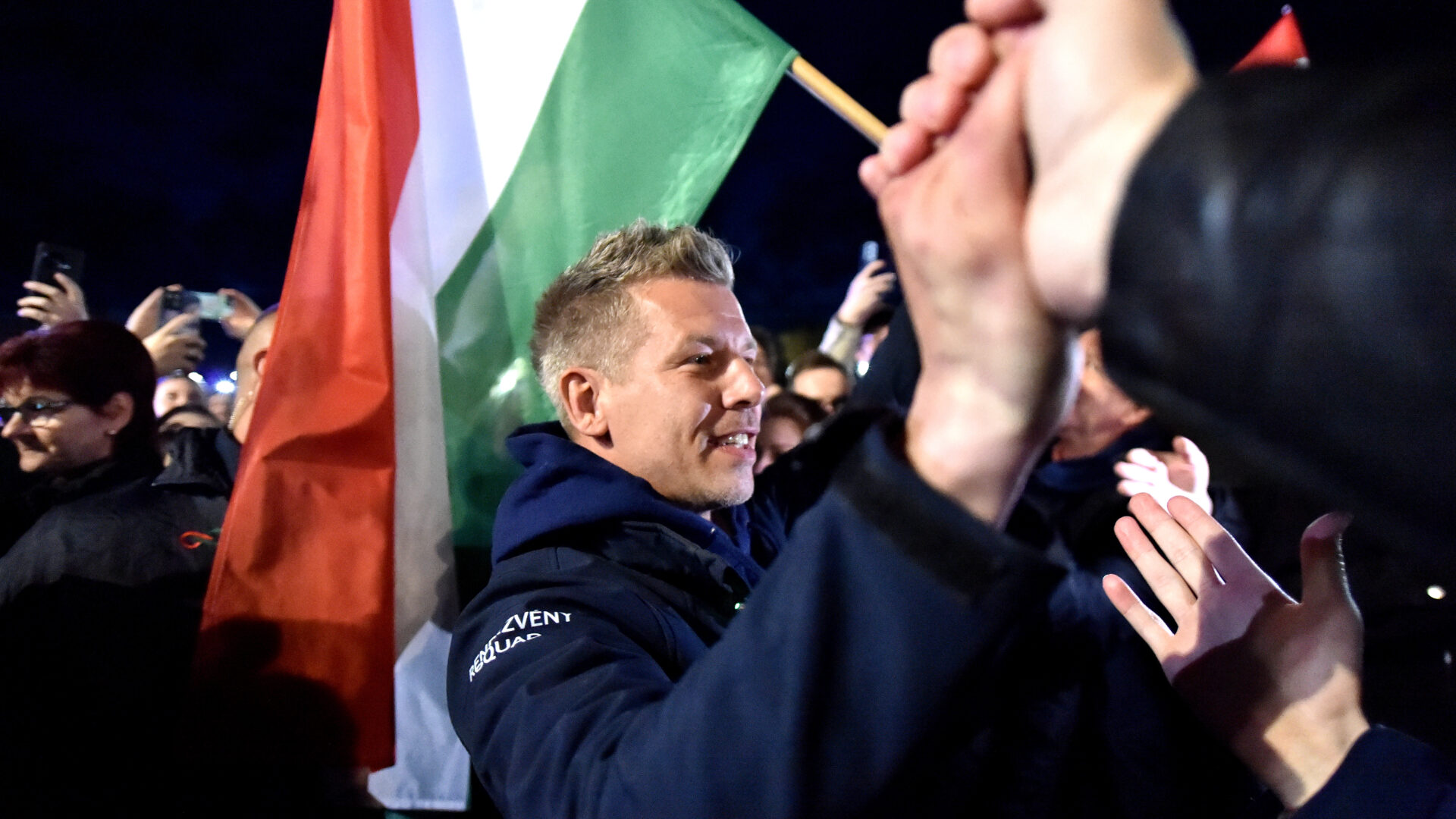
This essay asks whether Viktor Orbán’s electoral defeat can actually restore Hungarian democracy. Péter Magyar—a politician almost unknown three years earlier—won 71 percent of parliamentary seats, a supermajority that on paper lets his Tisza government do whatever it wants. The reality, the author cautions, will be more difficult to confront. After four election cycles of autocratic capture, institutions have been compromised, courts and media reshaped, and democratic habits abandoned; entrenched veto players remain, and the new government inherits a hollowed-out state with empty coffers. Hungary thus joins the ranks of countries attempting a “democratic U-turn,” a path that research shows is steep, and Magyar confronts deeper damage than counterparts in Brazil, Poland, or the United States faced. Yet it is never a winning strategy to count Hungarians out.
Hungary’s longtime prime minister Viktor Orbán finally lost an election.1 Péter Magyar, an upstart politician whom few Hungarians had heard of as recently as three years ago, clinched a huge victory by reverse-engineering the Orbán electoral playbook.2 Magyar’s Tisza party won 71 percent of the seats in the unicameral parliament—where a two-thirds majority is enough to amend the constitution. Magyar’s new government should now be able to do anything it wants.
Unfortunately, it is not so simple. When an aspirational democrat wins an election in an autocratic system, a tide appears to turn. But years of autocratic capture still need to be washed away before robust democracy can be restored. This may be especially true when autocratization has lasted through multiple election cycles—four in the case of Hungary. Many veto players are still entrenched, and most public institutions have been irreparably changed. It would be a heavy lift just to get the country back to where it was before autocracy set in, let alone to safeguard it against democratic collapse yet again.
Good messaging and good teams are a start. Throughout the campaign, Magyar remained focused on what it would take to restore democracy: Root out corruption, restore faith in the government’s ability to perform essential services, return to Europe (and regain European funds), and ensure that those who crashed Hungarian democracy face consequences. Since the election, the new prime minister has been praised for naming a cabinet of experts who have hit the ground running with innovative ideas. Having the right goals and the right team will surely help, but global experience shows that much more is needed to reestablish an enduring democratic system.
Hungary now joins the family of states that have attempted democratic U-turns. These occur when a government falls victim to autocratization and then gets a chance to recover the prior state of affairs after the autocrat is dislodged. Every aspirational democrat who wins an election under autocracy soon learns that autocratic capture leaves scars on the body politic—scars that track injuries and amputations that are hard to heal. During the autocratic period, institutions are compromised and democratic habits are abandoned. Opposition figures leave the country, and the government is populated by those who are either actively complicit or willing to go along. Democratic infrastructure in civil society is damaged, and the media become accustomed to spreading lies.
The longer the autocratic period lingers, the more people who will have known nothing else. The muscle memory of democracy, in turn, weakens. After the initial euphoria of unseating the autocrat, the hard reality of governing sinks in. No aspirational democrat comes to power with a spare government (or, for that matter, a spare judiciary) on hand. The new leader must work with what he has inherited to turn things around.
Research shows that an aspirational democrat faces long odds in such a situation. A recent study of attempted U-turns from 1900 to 2023 at first glance gives cause for hope.3 Nearly 70 percent of the 102 cases became democracies. In the subset of 45 countries that had been democracies before autocratization set in, fully 33 out of the 39 that suffered a full democratic breakdown restored democracy again. But look a bit farther out from the initial U-turn and trouble appears. Building on the data from that first study, another group of scholars, writing in these pages, show that continued democratic progress five years out from the initial U-turn is rare. In the last thirty years, 90 percent of the democracies that suffered autocratic capture and then experienced democratic turnarounds experienced another autocratic episode within five years.4 In general, then, countries that have fallen victim to autocratic capture can manage one good election that seems to demonstrate democratic resilience, but then have trouble sustaining a robust democracy after that.
Where will Hungary be five years from now? Of course, we cannot know the future, but we can learn from other similar cases. The countries that are most analogous with Hungary are Poland, Brazil, and the United States. All three are still oscillating between autocracy and democracy after their U-turns, illustrating how hard it is for a democrat to undo what an autocrat has done, even when autocrats are in power for much shorter periods than Orbán.
Cautionary Tales
Brazil’s Jair Bolsonaro (r. 2019–23) and the United States’ Donald Trump (r. 2017–21 and 2025 to present) were each president for only four years before being voted out of office. Neither Bolsonaro nor Trump in his first term had moved quickly to take over many public institutions or to consolidate their power beyond the state.
During the covid-19 pandemic that engulfed the world in 2020, both Bolsonaro and Trump responded with what David Pozen and I called “executive underreach.” They governed by chaos rather than using the pandemic emergency to dig themselves in for the long term. Neither responded expeditiously or effectively to the crisis, nor did they fill key positions in their governments or spend money to entrench themselves. Instead, they allowed government to atrophy. Whereas real autocrats let nothing slip from their grasp, both Bolsonaro and Trump seemed content to let their governments fall to the floor and see if they would break.5
If an aspiring autocrat does not lock down power while he can, he can easily be dislodged. And indeed, both Bolsonaro and Trump were voted out at the first opportunity, though by surprisingly narrow margins given the shambles (and high covid death rates) they left behind. Both then mobilized their supporters to engage in violent attempts to overturn the elections they lost. Both plots were foiled, and the prodemocratic successor governments investigated the conspiracies to reverse the election results. Both ex-presidents were charged with attempting to overthrow an election.
After that, the recovery paths of Brazil and the United States diverged. The Bolsonaro trial resulted in his conviction on the most serious charges and a sentence of 27 years in prison, thanks in large measure to the independent “fourth-branch” institutions6—the federal police, federal prosecutor, and Supreme Federal Tribunal. The Trump trial, by contrast, was stalled by endless procedural motions, including one that went to the Supreme Court. The Court, with a majority of Republican-appointed justices including three appointed by Trump himself, slow-walked the case before voting to immunize much presidential conduct from prosecution. Another round of judicial determinations then had to sort out which acts were protected before the trial could go forward. Stalled by endless procedure, the trial could not be held before the 2024 election, in which Trump was running.
After a term out of office, the former president was narrowly reelected. And he has not made the same mistake twice. In his second term, Trump has engaged in a swift takeover of the entire executive branch and weaponized the power of the state against potential sources of opposition. He is engaged in what I call a counter-constitutional revolution,7 using a blitz of executive orders to generate lawsuits which—when they reach his packed Supreme Court—may change the constitution in fundamental ways. This time around, Trump has presided over a far more serious episode of autocratization than in his first term. The United States therefore fits the pattern we know from the statistics—which is that democratic turnarounds have trouble lasting more than five years.
In Brazil, reckoning with autocracy appeared more successful at first. Bolsonaro’s trial and conviction seemed to show that democratic regeneration is possible. But in Brazil’s polarized political landscape, the former president’s supporters never deserted him. The Brazilian National Congress has already overridden a presidential veto and reduced Bolsonaro’s sentence from 27 years to two. In the election to come later in 2026, most expect Bolsonaro supporters to dominate the upper house of Congress—and a simple majority vote in the Senate is all it would take to impeach the judges who convicted Bolsonaro, which could pave the way to reversing their decisions.8 In the meantime, Bolsonaro may have been disqualified from running for president again, but his son has picked up the mantle and was ahead in the polls until a financial scandal dented his support. Nonetheless, the presidential race looks close. Like the United States, Brazil could well end up confirming the general pattern in which the autocrat—or the autocrat’s double—returns to strike again at the heart of democracy.
Perhaps, then, Poland provides a more optimistic scenario for Hungary’s possible future? The Law and Justice (PiS) party controlled the Polish government for eight years (2015–23) and moved the country in a sharply autocratic direction. The government captured the public media, the prosecution service, and the judiciary, but was often blocked by popular pushback from going further. Since a prodemocratic coalition won (narrowly) in 2023, the new government has tried to restore the operation of the institutions that PiS corrupted. But it has been slow work around immovable roadblocks.
The president of Poland (who must sign all laws) is still a PiS affiliate, even after an election in which the prodemocratic Civic Coalition led by Donald Tusk could have elected its own ally into that office but failed (narrowly) to do so at the ballot box. The Constitutional Tribunal is still packed with PiS supporters who can block lawful change that bypasses the president’s signature. It has not helped that the Venice Commission, a democracy-promoting arm of the Council of Europe, rejected in a highly formalist manner the Polish government’s first plans to reform the judiciary by selectively breaching Polish laws—laws that the Venice Commission had told the autocratic Polish government not to enact in the first place.9 And so now, three years into a four-year term, the ruling coalition has only modest gains to show for its time in office despite promising that corrupted institutions would be returned to democratic form.10
As Civic Coalition struggles to notch achievements, PiS has shot ahead in opinion polls—that is, until internal fights dented its public support.11 Instead of turning to Civic Coalition, however, PiS voters seem to be headed to parties even farther to the right. In short, the Polish political landscape shows signs of further fracturing, putting a solid prodemocratic majority even farther out of reach for next year’s election.
These three cases—Poland, Brazil, and the United States—reaffirm what the statistics show: that victories for prodemocratic forces after a period of autocratic capture may generate wild celebrations at election time, but the newly elected prodemocratic governments struggle to restore democracy after that. The clearest examples of stable democratic turnarounds come from the total defeat of the Axis forces in the Second World War and the collapse of the Soviet Union.
But the current situation is very different. Aspirational autocrats do not suffer total defeat these days. They may be voted out of office, but they still retain substantial popular support. Autocrats today regroup and come back, something unthinkable after World War II or at the end of the Soviet era (though in the former Soviet space, there are plenty of new autocracies, but not in the name of communism). What the recent cases show is that it may be impossible in only one or two electoral cycles for even the most determined democrats to rebuild democratic institutions that can survive another autocratic onslaught.
Orbán’s Deep State
In many ways, Péter Magyar faces a more daunting landscape than did the prodemocratic successors in Poland, Brazil, or the United States, where the autocratic predecessors had either not dug deep roots or failed to capture all they wanted while in office. Plus, none of these comparison countries had an aspiring autocrat who remained in power as long as Orbán did.
For a decade and a half, Orbán towered over a hapless and disorganized opposition that never came close to seriously challenging him. Without effective pushback, he was able to achieve virtually everything he set out to do. All state institutions were deposited into the hands of his cronies. The civil sector was crushed, and 80 percent of media outlets were taken over by his loyalists. The universities were privatized, while a huge boot camp and propaganda factory under the guise of a university received substantial state funds.12 That a massive social movement with little institutional infrastructure could defeat the Orbán regime after all that is nothing short of stunning. But state institutions are still packed with Orbán loyalists who are there, legally, for the long haul, and the civil sector that in theory could backstop democratic reform is weak.
The Fidesz government has left behind numerous veto players who can gum up the works for Magyar’s team. The effect is magnified because Orbán’s system of autocratic capture involved placing loyalists into key offices for very long terms—terms that exceed the length of the electoral cycle. Magyar won office only until 2030. Many Orbán appointees have terms of six, nine, and twelve years. So they can simply outlast him while creating mischief in the meantime.
Just as in Poland, both the national president and all the judges on the Constitutional Court were picked for their loyalty to the autocrat. Since the 2026 election, Magyar has repeatedly called on them—plus the prosecutor general, the president of the Supreme Court, the head of the media council, and others—to resign. After an initial silence, Orbán’s loyalists have made it clear that they are not leaving.
President Tamás Sulyok initially indicated that he was willing to work with Magyar, but has since followed his party’s line to proclaim that the new system needs checks and balances.13 Never mind that none of the Fidesz loyalists in “independent” offices ever balked at rubber-stamping whatever their party wanted without a word about checks. Now they are suddenly interested in constitutional limits. As Sulyok dug in, so did Magyar, who insisted that the president must resign from office by May 31—or else.
As this issue was going to press, Magyar confronted Sulyok and announced that the Tisza supermajority in parliament would amend the constitution to oust him. Sulyok has appealed his fate to the Venice Commission, hoping that it will insist that the rule of law must be scrupulously followed in the short term, even at the cost of abandoning it in the long term. Observers expect that Sulyok will also refer any constitutional amendments that remove Orbán allies (including himself) to the Constitutional Court—which is, of course, packed with Fidesz supporters. The 2013 Fourth Amendment to Orbán’s 2012 Constitution bars the Constitutional Court from reviewing constitutional amendments for their substance, a move that was criticized by many prodemocratic forces at the time.
Now the Constitutional Court may well side with those former prodemocratic Orbán critics to block an overwhelming democratic election result from sweeping away the autocrats. Either way—whether the Venice Commission sides with Sulyok or the Constitutional Court blocks the reform—the Magyar government will be faced with a choice between following a cramped conception of the rule of law or breaking the system to remake it in order to strengthen the rule of law down the road. Dilemmas like these are what make permanent U-turns so hard to achieve.
As this looming conflict foreshadows, the judiciary is also going to create major problems for Magyar’s government. The Constitutional Court consists of fifteen judges appointed for twelve years, and only five have terms that end within the next four years. Not enough judges will rotate off the Court in the normal order of things to allow a professional and neutral Court to help reestablish constitutional integrity and democratic institutions. The current Court president, Péter Polt, was a founding member of Fidesz and Orbán’s loyal prosecutor general from 2010 through 2025. In that time, Polt never prosecuted anyone in Orbán’s circle, no matter how visible their corruption was. Polt became president of the Constitutional Court just last year; his term expires in 2037. Magyar’s supermajority parliament has enough votes to amend the constitution or to pass any law altering the composition of the Court; but again, the president may refer such amendments or laws to the Constitutional Court, which could declare all reforms unconstitutional.
Over at the Supreme Court (Kúria), other knotty problems await. Kúria president Zsolt András Varga was controversially appointed in 2021 through the amendment of a set of laws to allow him to qualify. His term expires in 2030.14 Once in office, he was handed extraordinary powers to appoint new Kúria justices and proceeded to cherry-pick Orbán-friendly judges for the jobs. With the power to decide which judges hear each case, Varga could ensure that cases important to Orbán’s government would go before sympathetic judges. The Magyar government thus has the additional hurdles of cleansing the Kúria of politically appointed justices, reforming the system of case assignments, and ridding Hungarian jurisprudence of Kúria-issued guidance opinions that direct lower-court judges to interpret the law in ways that Fidesz wanted. The Supreme Court therefore also contains veto players who could block reforms.
When Orbán’s government enacted the new Hungarian constitution (the “Basic Law”) in 2012, a trap door was inserted into the text that could be used if Orbán ever lost an election: Article 44 created a “fiscal council,” a body whose consent is necessary for any national budget to be enacted by parliament. And under Article 3(3)(b) of the Basic Law, the parliament must adopt a budget by March 31 of each year. If it fails to do so, the president can dissolve it and call new elections. The two articles together can therefore set a trap.
The Fiscal Council’s three members were all appointed by the Orbán government: The council chair’s term ends in 2029, the governor of the central bank has a term that lasts through 2031, and the term of the head of the state audit office ends only in 2034. It would take only two of the three members of the Fiscal Council to engineer a veto of the national budget on the eve of the constitutional deadline. Should that happen, President Sulyok would be required to dissolve parliament and call a snap election. If Fidesz decides it is ready to challenge the Magyar government by next March, Péter Magyar might not last through an entire year. Every March, his government will face this sword of Damocles again.
The democratic transition has already begun in Orbán’s controlled media, which Magyar has labeled a “factory of lies” and promised to suspend until a more professional team can be put in place.15 But there, at least, cracks are beginning to show. Public broadcast media, along with the public news service, for example, have already invited Magyar on television for interviews (something denied to him during the campaign). The most popular television channel, TV2, fired its news director and stopped broadcasting news after the election. An Orbánallied oligarch with substantial media holdings has offered to hand them all over to the new government for free.16 And the billboards plastered across the country during the campaign promoting only Fidesz (because they are all owned by a pro-Orbán company) have been removed so that the streets are free of Fidesz messaging. Perhaps these changes will allow reality to return to the public sphere. That said, the regulator with substantial powers to punish media outlets remains in the hands of Orbán loyalists, including its president, András Koltay, whose term extends through 2030.
And then there is the financial situation that Orbán left Magyar to fix. Everyone knew that the budget was not healthy, but they blamed it on the EU’s denial of funds since December 2022 that otherwise would have gone to Hungary for regional development and other projects.17 Unfreeze those funds, and the Hungarian budget would revive like a wilted flower. Or so all sides proclaimed. Not surprisingly, Magyar prioritized negotiations with Brussels and, at the end of May, achieved an agreement with the EU to release 16.4 billion euros, conditional on the reform of institutions and rules that will ensure that money can be spent free of corruption and with restored judicial independence. Money to rebuild the universities will also flow, once they are removed from the hands of Orbán’s cronies. But making all these reforms means running the gauntlet in which the national president and Constitutional Court still have vetoes.
EU funds are critical to the recovery of the Hungarian economy, since state finances are in much worse shape than Fidesz had let on.18 The 5 percent deficit that the Orbán government had projected for this fiscal year now looks more like 6.8 percent—high above the 3 percent deficit that EU member states are permitted to run. The Fiscal Council has said that “severe austerity” will be needed to bring the budget back into line, and debt raters are advising “fiscal consolidation”—another word for austerity. Restoring faith in democratic government with steep budget cuts will not be easy.
And it is not just that the budget looks bad on paper. As they fan out into their ministries to see the facts on the ground, Magyar’s new ministers are finding that persistently underfunded infrastructure will need huge infusions of cash just to bring them back into working order. The new health minister, Zsolt Hegedűs, whose joyful dancing went viral on election night and inauguration day, has swiftly taken control of the country’s decrepit hospital system—but operating rooms in one regional hospital lost air conditioning during an early heat wave just weeks into Hegedűs’s tenure. Upon examination, he discovered that Hungarian hospitals’ air-conditioning systems are, on average, fifteen years old, with some more than forty years old. Upgrading these systems cannot be done without upgrading the electrical grid.19 How will the Magyar government deliver on its promises to fix the dysfunctional health-care system, plus the schools, the public transportation system, and now the electrical grid, all while practicing “severe austerity”? EU funds may come to the rescue on some of these infrastructure projects, particularly on upgrading the power grid, but the repairs may be more than the EU can cover. Besides, such fundamental repairs take time in a four-year election cycle with roadblocks along the way.
Rebuilding Democracy in Hungary
Immediately after the election, Fidesz fell quiet. The party’s silence was almost unnerving given how prominent its propaganda had been for a decade and a half. Orbán conceded the election quickly and, on schedule, moved out of the Carmelita, the monastery that he had remodeled as a palace for a king. Many state employees from public broadcasting to the security services wrote to the Magyar team pledging loyalty and offering to restore their institutions to democratic health. Thumb drives containing scanned documents that Orbán’s people had ordered shredded leaked out of one ministry after another.
Weeks passed with nary a word from Orbán or his team. Opinion polls conducted after the election showed an even greater collapse in the party’s support than the election had revealed. While 39 percent of the voters had chosen Fidesz at election time, support had dropped among eligible voters to 25 percent two weeks later.20 In those first heady weeks, it appeared as if Fidesz’s seemingly impenetrable autocracy had been nothing more than a Potemkin front after all.
As the shock of the election started to wear off, however, Orbán and his forces began to regroup. Orbán is only 63 years old, and he has always been a competitive fighter. Despite some initial wobbling by Fidesz party members who, after realizing the depth of their defeat, attempted to make nice with Magyar’s team, Orbán has once again been reaffirmed as party leader. By Orbán’s design, there is no successor who can lead the party. Even with Orbán operating from the shadows, party discipline has quickly begun to snap back.
Before the new parliament could convene on May 9, Orbán shuffled the Fidesz deck, sending some of his strongest (and guiltiest) supporters off to the European Parliament to hold the fort (and, not so coincidentally, to be rewarded with large salaries and parliamentary immunity) in the Patriots for Europe party he led to victory in the last European election. In the Hungarian parliament, Orbán pulled former Fidesz back-benchers into the front benches; most of these lawmakers had not been central to Fidesz’s consolidation of power or complicit in its corruption. Orbán has now moved his own offices into Fidesz headquarters to plot the party’s comeback. The midsummer Fidesz party congress, traditionally held in the Hungarian region of Romania, is still on—and it appears that Orbán will lay out his new vision for party renewal then. In short, as foretold by Poland, Brazil, and the United States, the defeated autocrat is regrouping and will try again. It has never paid to underestimate Orbán. He has been defeated before, in 2002 and 2006, and in 2010 he came back stronger.
In the meantime, Magyar has named a strong cabinet, consisting mostly of experts in the fields of their portfolios. The new foreign minister has a U.S. doctorate in international law and diplomacy and stepped down from her position as director of public affairs at Vodafone London to take this job. The new economy minister was global executive vice-president of Shell for ten years. The new health minister worked for a decade in the U.K. National Health Service before returning to Hungary to campaign for improved ethics in the medical field. And so on. Magyar says that he will delegate serious responsibilities to each of them, and they in turn have already appointed deputies and made plans for their respective ministries—following through with what the campaign had promised, which was apolitical expertise applied to Hungary’s problems.
Not only are Magyar’s cabinet members hitting the ground running, they are keeping the promise to share what they are doing, step by step, on ministry websites and social media. The new health minister is not alone in finding a government in shambles after years of corruption and a budget deep in the red. Building back would be a challenge even if there were no political headwinds. Doing so while Orbán’s forces are regrouping for another assault on democratic government lends urgency and difficulty to the task.
Can Magyar Beat the Odds?
Magyar’s early steps toward democratic restoration have been surefooted. The first law he put before parliament ended Orbán’s state of emergency, which had been continually renewed by his loyal MPs since the covid pandemic in 2020. The new government’s legal handiwork has been very professional. Rather than just grab headlines by declaring an end to the forever emergency, Magyar’s team crafted a sixty-page bill which acknowledged that in order to avoid legal uncertainty, many of Orbán’s decrees will have to be phased out or replaced rather than simply canceled. In this bill, they mapped out the path back to actual lawmaking in the parliament.
Shortly thereafter, Magyar’s team proposed a set of new laws—all with an eye to restoring democracy. First was a constitutional amendment that would limit the lifetime years in office for any Hungarian prime minister to eight, starting now. Magyar has agreed to abide by this amendment, which would also disqualify Orbán from returning.
Another law would dissolve the Sovereignty Protection Office (SPO), an institution that Orbán created in his last years. Its formal mandate was to investigate anyone who might be under foreign influence, but in reality it targeted anyone who might be able to challenge him. The SPO enjoys a wide-ranging jurisdiction, insulation from any judicial oversight, and the ability to put anyone under investigation using the most intrusive tools available to the state. This led the EU to launch an enforcement action against Hungary for violating European law and to call for the office to be dissolved. Magyar himself was subject to SPO investigations once he started to look like an electoral threat, so he understands how important it is to scrap this agency. Assuming the new law passes, the SPO will be gone ahead of the expected European Court of Justice decision.
The Magyar government also proposes to restore public ownership of the 21 universities and other public institutions that have been walled off from public accountability (no freedom-of-information requests, no public audits) since being “donated” to private foundations charged with “public interest asset management.” The EU took action in 2022 against Hungary for infringing on academic freedom by putting universities under the control of Orbán’s political allies. Returning these institutions to public ownership would go a long way toward reviving academic freedom—which in turn will unlock EU funds.
In addition to all this, five new parliamentary committees will be formed with investigatory powers to probe the Orbán regime. The committees will examine how state contracts were used to enrich Orbán’s friends, family, and loyalists; probe the suspicious “foundations” associated with the National Bank that spirited public money into private pockets; and investigate the cases of child sex-abuse in state homes as well as other scandals. The investigations, which will shine a spotlight on the Orbán government’s corruption and misdeeds, will begin immediately.
Magyar’s government has also proposed establishing a new public office, under parliamentary control, that would act on the findings of the corruption investigations: the National Asset Recovery Authority. This office would be tasked with reclaiming the public money that was corruptly given to private actors so that it can be reinvested into the state budget. In addition to these anticorruption initiatives, Magyar has already signed an executive order pledging that Hungary will join the European Public Prosecutor’s Office, an EU institution with the power to investigate corrupt spending of EU funds—with dedicated, noncorrupt European prosecutors ready to collaborate even if it will take some time to purge the Hungarian public prosecutors office of Fidesz loyalists.
Another hurdle facing the new government is the TEK, the secret police force Orbán ostensibly created to fight terrorism.21 TEK’s leader had previously been Orbán’s private bodyguard, and though the force technically reported directly to Orbán’s cabinet, everyone knew that TEK worked for the prime minister himself. TEK’s higher salaries, state-of-the-art equipment, and elite assignments demoralized the ordinary police and could cause serious trouble for the new government if it remains loyal to Orbán. Just a few weeks into his term, Magyar fired the head of TEK and has vowed to revisit the overall organization of the police.
Faced with the massive budget disaster, Magyar has cut his own salary in half and reduced the salaries of all his ministers. He also proposes to lower the pay of MPs and heads of state-owned companies. Magyar and his team have foresworn state-provided luxuries: Magyar will not move into the prime minister’s decadent state residence and instead will stay in his own house. He will drive his own blue Skoda rather than be chauffeured in the luxury car bought for Orbán. Magyar and the new foreign minister were already seen flying to Brussels for negotiations over EU funds on a commercial plane rather than in a private jet.
Magyar has already made substantial progress unfreezing the European funds that were withheld due to corruption, failures of judicial independence, and hits to academic freedom, though the EU will be watching closely as it disperses these funds to ensure that they are spent properly.22 Another 17 billion euros for rebuilding European defense capabilities could be released if Magyar can eliminate corruption in the defense sector, which Orbán hurriedly privatized and handed to his cronies ahead of the 2026 election.
Of course, all new laws are subject to the veto of President Sulyok and review by the packed Constitutional Court, both of which are digging in to defend Orbán’s legacy. We can expect that Sulyok will block the constitutional amendment that would disqualify Orbán from running again along with anything that would allow Magyar’s team to prevent Fidesz from returning or to investigate Orbán’s sixteen-year reign. Perhaps some laws will get through, but the most important ones for democratic recovery will almost surely be stalled at best, leaving Hungary in the unenviable situation of Poland, where the new government came in raring to restore democracy only to find many of their efforts foiled by veto players left over from the past regime.
If Sulyok and the Constitutional Court continue to block reform, perhaps with the blessing of the Venice Commission, Hungary will experience a constitutional crisis. But Magyar may be able to buy himself some time with a technical fix from European Union law that he could lean on as an “interim constitution” until he finds a way to remove the veto players for good.
I believe that certain vetoes by Sulyok and corresponding decisions of the Constitutional Court can be set aside—”disapplied” is the word used in EU law—if they have the effect of blocking the implementation of EU law.23 (If Magyar’s legal team feels that leaning too hard on EU law is politically unwise, this is not the only argument in Hungarian law that would accomplish this aim.24) EU law is limited by its treaties to certain subjects, however, so running Hungary’s democratic transition entirely from the dashboard of EU law will not allow for everything that Magyar needs to do. But it might give him the necessary time to achieve many of the reforms his campaign promised—for example, reconfiguring the judiciary to restore judicial independence, joining the European Public Prosecutors’ Office to fight corruption, firing the data-protection officer to end Orbán’s surveillance state, deprivatizing formerly public universities to restore academic freedom, and more. All these steps are required by EU law, which has primacy over domestic law. So passing national laws on these issues might allow Magyar to lawfully ignore certain Sulyok vetoes and contrary decisions of the Constitutional Court.
Magyar’s legal team has already shown themselves to be bold and savvy, so they are no doubt devising other legal workarounds to the barriers that Orbán has erected. But undoing all the damage will be a heavy lift, especially with budget coffers bare. As the new ministers and their teams fan out across the Hungarian government, they are discovering an infrastructure nightmare that will require an even larger set of fixes than the Magyar team might have imagined. Magyar faces far greater challenges than those encountered by Presidents Luiz Inácio Lula da Silva (Bolsonaro’s successor) and Joe Biden (Trump 1.0’s successor) and Prime Minister Donald Tusk (leader of the party replacing PiS). Orbán was dug in deeper, for a longer period, with more corruption, and he left a greater wreckage of a state for his successor to clean up—with little money.
Hungarians specialize in despair. A favorite English children’s book, Winnie the Pooh, was translated into Hungarian in 1935 by the famous poet Frigyes Karinthy. Not only does Micimackó appear in Hungarian as a long poem taking substantial liberties with the original, but Eeyore, the depressive donkey, has an even-more-starring role. Hungary is a country that lost every war it ever fought, and the national anthem recalls a litany of national failures before seeking God’s mercy to have a single happy year. Much in Hungarian culture counsels pessimism as a virtue.
But there is another side of Hungarian culture, one that is capable of accomplishing great feats against long odds. For a tiny country on the edge of Europe, Hungarians have excelled at making world-changing discoveries—the healing properties of Vitamin C (Albert Szent-György), the importance of hand washing in medicine (Ignaz Semmelweis), and the mRNA vaccine that ended the covid pandemic (Katalin Karikó), to name just three. Hungarians are also responsible for inventions that have changed how we live and work—from the ballpoint pen (László Bíró), color television (Péter Károly Goldmark), and Microsoft Word (Charles Simonyi) to the particle accelerator (Károly Simonyi) and the atomic bomb (Leo Szilard). Each year, when Nobel prizes are given out, the people of Hungary stay glued to the announcements, eager to find out how many Hungarians have won. Given these accomplishments, there is reason to hope they can triumph yet again against terrible odds—long though they may be—and revive their democracy for good. It is never a winning strategy to count Hungarians out.
NOTES
1. Kim Lane Scheppele, “How Viktor Orbán Loses,” Journal of Democracy, April 2026, https://www.journalofdemocracy.org/online-exclusive/how-viktor-orban-loses/.
2. Kim Lane Scheppele, “How Viktor Orbán Wins,” Journal of Democracy 33 (July 2022): 45–61, https://www.journalofdemocracy.org/articles/how-viktor-orban-wins/.
3. Marina Nord et al., “When Autocratization Is Reversed: Episodes of U-Turns Since 1900,” Democratization 32, no. 5 (2025): 1136–59.
4. Matías Bianchi, Nic Cheeseman, and Jennifer Cyr, “The Myth of Democratic Resilience,” Journal of Democracy 36 (July 2025): 33–46.
5. David Pozen and Kim Lane Scheppele, “Executive Underreach, in Pandemics and Otherwise,” American Journal of International Law 114 (October 2020): 608–17.
6. Mark Tushnet, The New Fourth Branch: Institutions for Protecting Constitutional Democracy (Cambridge: Cambridge University Press, 2021).
7. Kim Lane Scheppele, “Trump’s Counter-Constitution: ‘He Who Saves His Country Does Not Violate Any Law,'” Verfassungsblog, 21 February 2025, https://verfassungsblog.de/trumps-counter-constitution/.
8. Igor Andrade and Fernanda Arbex, “Senate 2026: The Race That Could Redefine Institutional Balance,” 24 February 2026, https://www.ccbc.org.br/en/publicacoes/artigos-ccbc-en/senate-2026-the-race-that-could-redefine-institutional-balance/.
9. Kim Lane Scheppele, “Blinded by Legality: The Venice Commission’s Change of Heart on Restoring the Rule of Law in Poland,” Verfassungsblog, 23 December 2024, https://verfassungsblog.de/blinded-by-legality/.
10. Stanley Bill and Ben Stanley, “Democracy After Illiberalism: A Warning from Poland,” Journal of Democracy 36 (July 2025): 16–32.
11. Daniel Tilles, “As Its Support Falls to Lowest in 14 Years, What’s Gone Wrong for Poland’s Opposition PiS Party?” Notes from Poland, 2 March 2026, https://notesfrompoland.com/2026/03/02/as-its-support-falls-to-lowest-in-14-years-whats-gone-wrong-for-polands-opposition-pis-party-opinion/.
12. Valerie Hopkins, “Campus in Hungary Is Flagship of Orbán’s Bid to Create a Conservative Elite,” New York Times, 28 June 2021, https://www.nytimes.com/2021/06/28/world/europe/hungary-orban-university.html.
13. “‘Even the Appearance of Solutions That Do Not Respect the Rule of Law Must Be Avoided’—Interview with Tamás Sulyok, President of Hungary,” posted on the website of the president of Hungary, 18 May 2026, https://www.sandorpalota.hu/en/even-appearance-solutions-do-not-respect-rule-law-must-be-avoided-interview-tamas-sulyok-president.
14. Hungarian Helsinki Committee, “Tribunal Established by Sleight of Hand,” 4 September 2022, https://helsinki.hu/en/tribunal-established-by-sleight-of-hand/.
15. Ashifa Kassam and Flora Garamvolgyi, “‘Factory of Lies’: What Will Péter Magyar Do About Hungary’s State Media?” Guardian, 6 May 2026, https://www.theguardian.com/world/2026/may/06/factory-of-lies-peter-magyar-hungary-state-media.
16. Marton Kasnyik and Thomas Escritt, “Orban Ally Offers to Hand Media Empire to Hungary After Election,” Bloomberg, 5 May 2026, https://www.bloomberg.com/news/articles/2026-05-05/orban-ally-offers-to-hand-media-empire-to-hungary-after-election.
17. Kim Lane Scheppele and John Morijn, “Frozen: How the EU is Blocking Funds to Hungary and Poland Using a Multitude of Conditionalities,” Verfassungsblog, 4 April 2023, https://verfassungsblog.de/frozen/.
18. Thomas Escritt and Marton Eder, “Hungarian Budget Data was ‘Falsified,’ Premier Magyar Warns,” Bloomberg, 21 May 2026.
19. Zsolt Hegedűs, Facebook post, 26 May 2026, https://www.facebook.com/share/p/1BTMmhsFg8/.
20. Ferenc Bakró-Nagy, “66–25: Poll Shows Dramatic Spike in Tisza’s Popularity Since Election,” trans. Andrea Horváth Kavai, Telex, 23 April 2026, https://telex.hu/english/2026/04/23/66-25-tisza-s-popularity-shot-up-dramatically-since-election-according-to-recent-poll.
21. Kim Lane Scheppele, “The New Hungarian Secret Police,” on Paul Krugman’s Conscience of a Liberal blog, 19 April 2012, https://archive.nytimes.com/krugman.blogs.nytimes.com/2012/04/19/the-new-hungarian-secret-police/. I was the first to discover the way that the Orbán government had established this new service with no meaningful legal checks on its operation. The European Court of Human Rights has since confirmed my analysis in the Szabó and Vissy case, https://hudoc.echr.coe.int/eng#{ percent22itemid percent22:[percent22001-160020 percent22]}.
22. John Morijn and Kim Lane Scheppele, “Unfreezing EU Funds Without Melting the Rule of Law,” Verfassungsblog, 25 May 2026, https://verfassungsblog.de/unfreezing-eu-funds-without-melting-the-rule-of-law/.
23. Kim Lane Scheppele, “Hungary’s European Rebirth: Using European Law as Hungary’s Interim Constitution,” Verfassungsblog, 21 May 2026, https://verfassungsblog.de/hungarys-european-rebirth/.
24. Kim Lane Scheppele, “Escaping Orbán’s Constitutional Prison: How European Law Can Free a New Hungarian Parliament,” Verfassungsblog, 21 December 2021, https://verfassungsblog.de/escaping-orbans-constitutional-prison/.
Image Credit: Balint Szentgallay/NurPhoto via Getty Images