
ESSAY — SEPTEMBER 2026
What “Leaderless” Actually Means
Gen Z protests are about more than a generation. Uprisings like the one we helped lead in Kenya are rewriting how movements organize, and how states fight back.
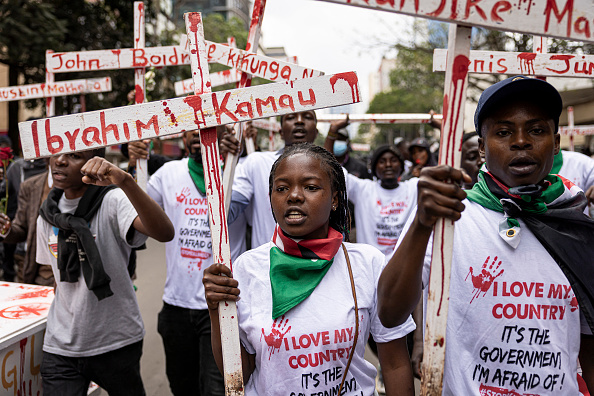
When Kenya’s Gen Z uprising forced President William Ruto to withdraw a controversial 2024 finance bill, the world took notice. Within weeks, the story was everywhere: A horizontal, leaderless, seemingly youth-led movement had done what conventional opposition leaders had failed to do. Here was proof, commentators argued, that social-media-native organizing could match or surpass the power of parties, unions, and formal civil society.
The “leaderless” label has become a frame that obscures more than it reveals. The uprising was not unled; rather, it was intentionally organized without a single claimable public leader. That distinction matters, and we want to be explicit about it from the start: A movement can be genuinely decentralized and genuinely coordinated at the same time. The harder question — which we take up here as organizers who were inside the uprising — is whether that combination is enough not only to win concessions from a government, but to hold on to what was won and build the capacity to fight the next battle from a stronger position.
This is not a uniquely Kenyan question. Youth-led movements have forced governments into concessions in Bangladesh, challenged state power in Indonesia, and are taking shape in India — all organized across digital networks, all facing the same morning-after problem of turning protest energy into durable political power. We write this account as practitioners, not theorists: What follows is a clear-eyed look at what the leaderless model achieved over three years, what it cost, and what we would do differently.
Denying the State Its Tools
June 2024 marked a turning point in Kenya’s postindependence history. Although the uprising has come to be known as the “Gen Z protests” — a label we use here only as shorthand, since the uprising was never just a generational story — that label misrepresents what unfolded. It reduces a struggle against debt, corruption, imperialism, and state violence to the story of a single generation, obscuring the deeper issue: The colonial foundations of Kenya’s political economy and the unfinished project of national liberation. The 2024 finance bill proposed steep new taxes to help the government manage its mounting public debt. Protests forced its withdrawal, but the underlying fiscal pressure didn’t disappear — a new finance bill passed in 2025. The bill didn’t cause Kenya’s debt crisis or the inequality behind it. It just forced both into public view, sparking a confrontation with the same political and economic order that had already failed millions of Kenyans.
We both entered the protests as community organizers within Kenya’s Social Justice Movement, a grassroots organizing network that we had been part of for years. We were accustomed to being branded “commercial activists” — accused of protesting for money — by government propaganda and portions of the media. In reality, the vast majority of community organizers survive hand-to-mouth, working out of moral and political conviction rather than for pay.
We had joined demonstrations before, but never seen political consciousness spread this fast. Within days, “Reject the Finance Bill” evolved into “Ruto Must Go” and “Reject the IMF.” That speed was real — but it was not spontaneous. What looked like an overnight uprising was the product of years of grassroots organizing and political education that had simply never before coalesced on a national scale.
Decades of IMF-driven structural adjustment and privatization had already weakened, depoliticized, or dissolved the trade unions, cooperatives, and civic institutions that once organized popular struggle in Kenya. Our generation therefore faced a double task: resisting the state and building new spaces, many of them digital, where political organizing could happen.
Much of the international commentary fixated on the apparent absence of leaders. In reality, leadership had been deliberately distributed. We used horizontal organizing to bypass Kenya’s elite-driven political hierarchies. By branding the movement as leaderless, tribeless, and partyless, we denied the state its usual tools: cooptation, ethnic mobilization, and backroom deals with a handful of leaders.
Coordination ran across interconnected digital platforms. X Spaces hosted strategic debate and real-time coordination; WhatsApp and Telegram groups managed protest logistics and travel routes as police moved; TikTok and Instagram creators translated dense fiscal policy into plain-language explainers that millions could understand. Platforms once used for memes and sports talk became infrastructure for political education and coordinated action.
None of this ran on NGO money. Ordinary Kenyans funded it directly, through M-Pesa (Kenya’s mobile-money system) accounts run by trusted organizers, covering hospital bills, bail, and support for bereaved families — with every shilling publicly accounted for. Volunteer doctors, nurses, and lawyers provided free emergency care and legal defence.
As the state flooded these same platforms with misinformation, fake protest routes, and abductions of prominent organizers, we came to rely on organizers whose credibility had been earned over years, not on whoever had the most followers. When police blocked a route, protesters rerouted within minutes, acting on the advice of trusted networks. When one organizer was arrested or disappeared, another stepped up.
That resilience came at a terrible cost. Kenya’s police-oversight body recorded 62 deaths linked to the 2024 protests. The national human-rights commission documented 60 deaths and 601 injuries in a single month. Amnesty Kenya logged 83 abductions and more than 2,000 arbitrary arrests. Nearly two years later, only three of those extrajudicial murder cases have made it to a courtroom.
The violence didn’t stop with the bill’s withdrawal: The 2025 anniversary brought 27 more deaths, and July’s 2025 Saba Saba protests — which mark Kenya’s 1990 prodemocracy demonstrations — brought 38 more. Eighteen bodies were later pulled from a dumpsite in a Nairobi settlement, never officially tied to the protests but widely understood by residents as more state violence. By the second anniversary in June 2026, repression had not let up: Police met mothers of the dead laying flowers outside Parliament with barricades and force, and one of the protest’s most recognizable organizers was abducted by the rogue Directorate of Criminal Investigations officers and held for five days before being released after fellow organizers threatened to return to the streets.
Our movement also upended longstanding assumptions about leadership. Kenya’s political history is full of elite bargains struck over popular movements’ heads — the 2008 coalition government after postelection violence, the 2018 “Handshake” between rival leaders — deals that left the underlying demands for justice unresolved. We feared history repeating itself: that politicians would absorb or usurp the uprising’s energy, trade popular anger for government positions, and leave the real grievances untouched.
That fear proved justified, and the movement was tested twice. First, when opposition leader Raila Odinga struck his own accommodation with Ruto, resulting in opposition figures joining the government. We rejected the deal outright, and maintaining political autonomy became one of our most important collective principles. Second, when one of our own — a young organizer with real standing in the movement — publicly aligned himself with Odinga and the Ruto government, the movement simply withdrew its confidence in him. He lost his platform almost overnight as others absorbed his responsibilities. The lesson: Legitimacy lived with the collective, not with any individual, and the movement didn’t have to collapse just because a highly visible figure was co-opted.
The Limits of “Leaderless”
But horizontal organizing has real limits, too. After the historic occupation of Parliament on 25 June 2024, the challenge shifted from getting people into the streets to building something durable — without recreating the hierarchy we had rejected. The same structures that made us resilient under repression made it hard to resolve strategic disagreements, hold anyone accountable, secure funding, or build institutions that could outlast any single organizer.
Our first attempt to solve this was the National Coordinating Committee for the People’s Assemblies (NCCPA), a coalition of grassroots organizations, political parties, and organizers formed to carry the uprising’s lessons forward. Its founding argument was that Kenyan independence had never actually ended foreign economic control—it had merely handed the day-to-day management of the state to a local elite serving global capital. We briefly succeeded in coordinating another national mobilization, but the experiment fractured under the weight of deep ideological friction, as the committee brought together a volatile mix of liberals, anarchists, and Marxists, and historical personal rivalries, which led many to act in bad faith by actively refusing to popularize or build the assemblies within their own communities. This structural fragility was further exploited by opportunism, as key representatives fought over the meager financial resources raised for the local assemblies, while a few prominent members joined the camps of backward legacy politicians. The lesson was a hard one: agreeing on what we opposed proved far easier than agreeing on what we were collectively building.
What followed wasn’t one successor organization but several parallel experiments, each betting on a different structure. The National People’s Council set out to build people’s power councils from the grassroots up, following the 2025 commemorations. It brought together a number of grassroot organizers, but we moved too fast without rooting it in grassroots debate, and it stalled after a single convention. The Kenya Left Alliance, uniting anticapitalist and social-democratic organizations, is still trying to build lasting political capacity rooted in workers and the unemployed. And the Pan-African Socialist Alliance, formed years before 2024, offers its own cautionary tale: how revolutionary politics curdles inward when it’s not continually rooted in everyday struggle.
We’ve also joined the Niko Kadi campaign—a youth-led mass voter registration movement —turning the consciousness this uprising created into an organized youth voting bloc ahead of 2027, exercising the most basic constitutional power available: electing leaders who respect human rights and the rule of law. Many young Kenyans were killed, abducted, or arrested for demanding exactly that; we need leaders who we don’t have to die to be heard. Niko Kadi has already registered more than two-million new voters.
The absence of any single visible leader has left a vacuum in national politics, one that individual figures have now started to fill. Nairobi Senator Edwin Sifuna—the ousted Secretary-General of the Orange Democratic Movement (ODM) who fiercely opposed his party’s alignment with President William Ruto’s administration and the “broad-based” government framework—has become a source of hope. While ODM’s central leadership embraced the coalition, Sifuna stood with protesters rather than join Raila Odinga’s accommodation with Ruto, routinely criticizing the government over Gen Z protest abductions and public overtaxation. Many of the youths have joined Linda Mwanainchi and his nationwide rallies.
What Kenya Teaches Us
The movement that filled the streets in 2024 doesn’t exist in the same form today. Many of the WhatsApp and Telegram groups have gone quiet. Some organizers have withdrawn, worn down — financially, emotionally, mentally. But the digital infrastructure hasn’t disappeared. We still use X Spaces and TikTok for organizing and debate, and most organizers have returned to grassroots work while preparing for the next election cycle, some as candidates, others as voters.
Kenya’s uprising was one instance of a much wider crisis across the Global South: debt, austerity, shrinking democratic space, and governments meeting resistance with force while international lenders kept prescribing the same market reforms.
Kenya’s experience tests specific claims about what distributed organizing can and cannot do — and the answer matters for every movement now facing the same morning-after problem. The model did exactly what it was built to do: It denied the state its usual tools of cooptation, kept opposition politicians from absorbing the uprising’s energy, and proved, concretely, what it looks like when legitimacy belongs to a collective rather than an individual.
But the same fracture that broke the NCCPA is a limit that recurs across movement history everywhere: agreeing on what to oppose is far easier than agreeing on what the future should look like and how to make it happen. Bangladesh’s student-led uprising, which toppled a government in 2024, is now confronting this same question at a more advanced stage. Movements in Indonesia and India, still earlier in their own arcs, have Kenya’s three years to learn from before they get there.
What Kenya adds to that picture is the specific cost of staying underorganized while repression continues. When 127 deaths produce almost no accountability, when organizers vanish for days at a time — the organizational question stops being abstract. Historically, movements that have solved this problem — such as South Africa’s anti-apartheid United Democratic Front or the underground federated regional networks of Poland’s Solidarity movement — did it not through tight hierarchy but through federated structures: people’s councils and local bodies that spread authority without dissolving it. Our Kenyan experiments — the National People’s Council, the Kenya Left Alliance, Niko Kadi — are different bets on what that structure should look like. None has fully succeeded. But the fact that organizers are still placing these bets, two years after the streets emptied, is itself a form of resilience.
Three years of practicing “leaderlessness” have taught us its power and its limits. If we did it again, we would build mechanisms for collective decisionmaking and accountability earlier, strengthen the link between digital mobilization and a permanent grassroots structure, and put real systems of care in place for organizers facing repression and trauma.
The movement has changed, but the questions that brought people into the streets haven’t gone away — the anger over debt, corruption, inequality, and state violence remains. We carry the memory of those killed, tortured, abducted, and those who simply couldn’t carry on. We honor them by building the political power it will take to birth a just and equitable Kenya.
Presented by


Copyright © 2026 JoD Productions
Image Credit: PATRICK MEINHARDT/AFP via Getty Images
Next month: a new column from the Frontline.
Join our mailing list to receive each month’s essay as soon as it is published. The Frontline is always free to read and share.