
ESSAY — OCTOBER 2026
Cubans Are Leading from
the Inside
The Cuban people urgently want change, and their courage is rising. This is how civil society stands up as a corrupt system begins to collapse.
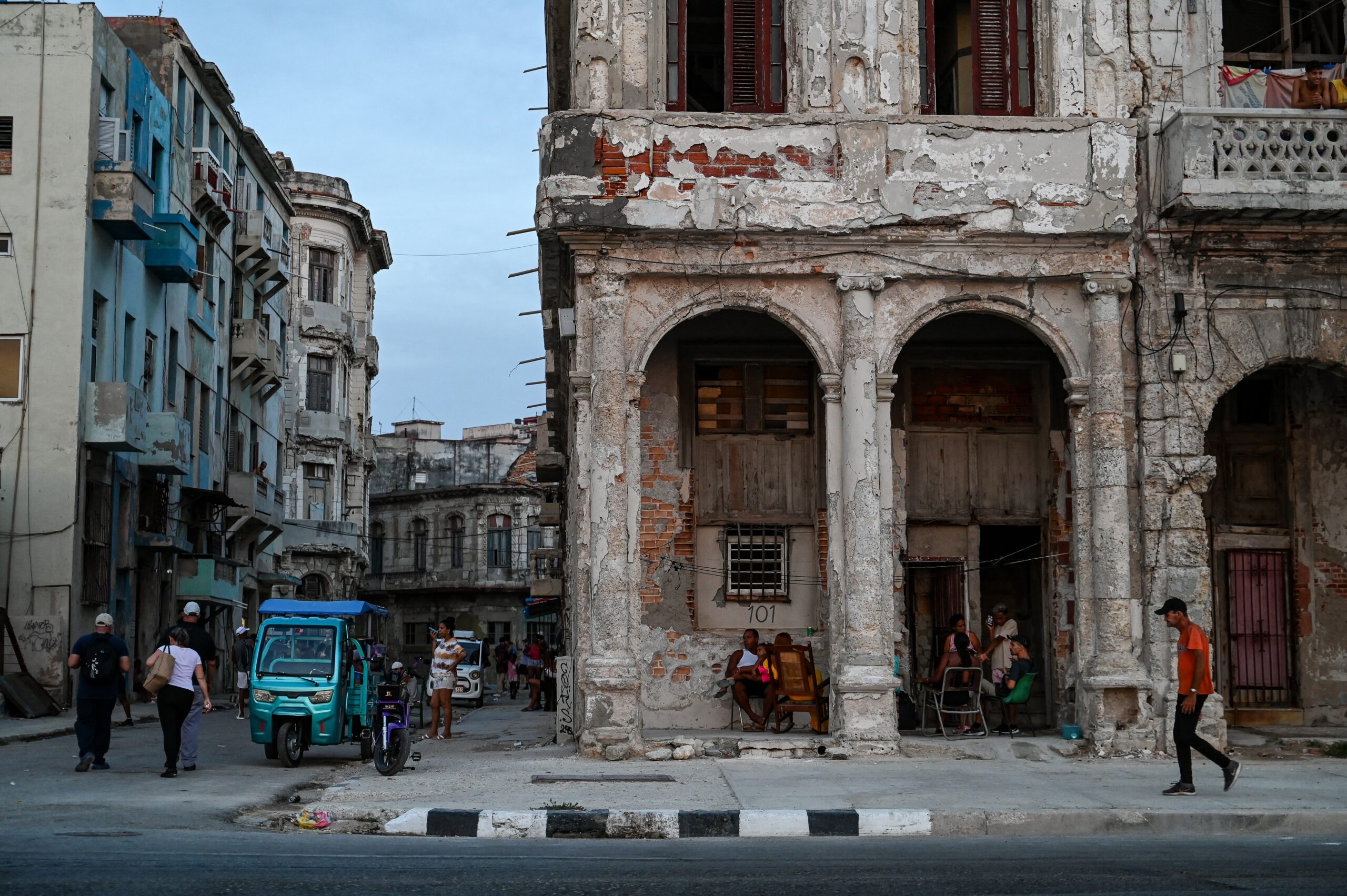
Cuba is in crisis. The energy grid is failing block by block. Venezuelan oil subsidies, which kept the lights on and the buses running for two decades, have been cut off. And the people who might have led a democratic opening — lawyers, journalists, and organizers — have spent the last several years exiting the country faster than anyone can replace them.
From outside the country, one might wonder: Is Cuba capable of making a democratic transition? From inside, however, the question is different, more complex: What does civil society actually look like when a closed system is collapsing? And is there a way to build momentum to help open it?
What Does Cuba’s Civil Society Look Like?
After the 1959 revolution, the Cuban government banned independent associations and built a rigid, one-party system that left no room for autonomous civic life. Roughly a half-century later, Cuban civil society reemerged, forcefully. Two things happened a decade apart to prompt the awakening: First, in 2008 the authoritarian state, which had always provided citizens with real social protections, cut social spending (raising the retirement aid, lowering investment in healthcare and education, and reducing food rations), foisting those costs onto individuals and families. And second, beginning in December 2018, mass internet access broke the government’s monopoly on information, communication, and public opinion.
Cuban civil society has no formal structure. Independent associations remain illegal, and repression is severe. But that hasn’t stopped it from existing. What distinguishes Cuban activism isn’t the range of causes it takes up so much as the fact that almost any demand can turn political.
Of course, the regime considers independent groups fighting for people’s rights, such as the Ladies in White or the Patriotic Union of Cuba, to represent a challenge to its authority. Groups that document abuses against political prisoners, oppose mandatory military service, demand electricity, defend animals’ rights, or simply help poor or sick families are each treated as enemies of the state. For the regime, each poses a challenge to its monopoly of power.
Outsiders often assume that the state’s motivation for repression is ideological. It isn’t. Progovernment slogans, patriotic references, and simple grief have all landed people in prison. For example, Leonardo Romero Negrín, a student, was arrested in 2021 for carrying a sign that read “Socialism Yes, Repression No”; he was arrested again this year for joining a cacerolazo (pot-banging protest) in his neighborhood. In 2023, I was tried for “disobedience” for carrying a poster that quoted independence hero Antonio Maceo: “Begging for rights is a thing for cowards.” And in 2026, Leonard Richard González received a seven-year prison sentence for “propaganda against the constitutional order” for putting up graffiti that read: “How long they are killing us.” So this is not a fight over ideology. It’s a fight over freedom of expression; a fight between dictatorship and democracy.
Repression in Cuba isn’t limited to punishing what people say. Any kind of leadership, formal or informal, will be suppressed in order to prevent citizens from coalescing around recognized figures and shared demands. This happens through pressure that forces dissidents, artists, and intellectuals to emigrate; bars them from reentering Cuba once they have left; and blocks freedom of movement, confining thousands of people still on the island, including myself, to their city or municipality. It’s a strategy with a cost beyond the people it targets: It keeps civil society scattered by isolating one activist at a time, making it impossible to unite and organize into something larger.
Things Are Changing — But How and Why?
Deepening poverty and inequality since the slashing of the welfare state in 2008, layered on top of endless violations of political and civil rights, have coincided with citizens discovering, via the internet, that they had voices of their own and the capacity to set their own agendas. Together, these conditions triggered a crisis that first peaked during the 11 July 2021 protests, when thousands of Cubans rose up in cities across the country, and hasn’t let up since. These troubles have escalated dramatically since last year due to the energy collapse, the end of Venezuelan oil, and government paralysis. Most notably, 1) dissent has moved outside the virtual sphere, 2) the regime has lost its primary benefactor in Venezuela, and 3) there is no longer an escape valve for citizens under pressure.
On 30 May 2025, the Cuban government sharply raised internet fees, pricing out anyone without dollars from abroad. The following day, protests broke out in universities across the island, led by the first generation of Cubans too young to remember life before the Berlin Wall fell, or before they had a phone in their hand. By restricting access to the virtual sphere, the government inadvertently pushed protest into the public space.
Compared to the July 2021 protests, one thing has changed: Back then, social media and WhatsApp groups let protesters coordinate nationally in real time. Now, prolonged blackouts and battered, outdated antennas knock out the internet for hours at a stretch, so protest has become more neighborhood-based, concentrated in specific blocks and municipalities. In the Zamora neighborhood of Havana’s Marianao municipality, a single mother named Zea Giselle documents near-daily protests on social media alongside the mutual-aid network she’s built for mothers, the elderly, and the homeless. Even offline, people can now rely on satellite links, homemade antennas, and journalists willing to relay their footage — none of which existed in 2021.
Meanwhile, the regime can no longer rely on Venezuela, its most important remaining ally, to keep it afloat. Fuel shipments from the country had long been shrinking, driving up power cuts and forcing transportation restrictions. But after the United States deposed Venezuelan leader Nicolás Maduro in January 2026 and imposed an oil blockade on Cuba, the situation on the island collapsed entirely: The future of its oil lifeline was thrown into doubt.
Finally, U.S. anti-immigration policies under Donald Trump have closed off the emigration route that used to relieve the building pressure from relentless economic despair and an authoritarian government that is failing to bring any relief. Cubans know they’ll have to deal with the crisis from inside their own country.
The shift (and rising courage) in Cuban civil society is palpable. Protests have become more explicitly political. For example, in March 2026, in Morón, Ciego de Ávila, citizens occupied a Communist Party headquarters for the first time, burning files and furniture. (Every party office in the country has since added guards.) Many protest actions now happen in broad daylight rather than at night: road closures, waste burning, demonstrations outside party and government buildings. Children and adolescents now protest alongside their parents, and the people’s demands are no longer only for electricity, water, food, and medicine, but for a growing list of freedoms. Graffiti has likewise spread uncontrollably, including into neighborhoods where it was once rare. And what used to be mostly insults aimed at the president now reads “Freedom,” “Homeland and Life,” and “Down with the dictatorship.”
All this runs alongside constant citizen reporting on social media and in the independent press, covering mounting repression, crumbling healthcare, education, and transportation systems, and rising crime and corruption.
People used to fear change; the status quo felt safer. That fear has largely lifted. It is now rare to find anyone who won’t admit, publicly or privately, that they urgently want change. The erosion of basic living standards and social protections that were once taken for granted, combined with the ongoing fight for the release of more than a thousand political prisoners, has shifted the public mood. Turning that shift into something durable, however, will require serious civic education and practice.
There is no lack of plans. Several organizations — the Council for Democratic Transition, D’Frente, Cuba Próxima, and CubaxCuba Laboratorio de Pensamiento Cívico — have drafted serious transition roadmaps. But beyond the Cuban government’s own intransigence, and its preference for negotiating with Washington instead of with its own citizens, real obstacles still stand between the current moment and an actual transition. For example, many opposition figures and activists are mired in personal rivalries and refuse to collaborate on a shared platform, and their ideas lose reach once they’re tagged as ideological instead of something that average citizens can get behind. There’s also a gap between activists and the people they’re meant to represent — repression isolates activists from their own communities, and international attention tends to gravitate toward the activists most visible from abroad, leaving people protesting inside the barrios with less support. And, despite successfully mobilizing thousands across the island, Cuban activists lack unity and the organizational infrastructure to turn localized outbursts of discontent into a sustained, nationwide movement.
But what matters most about Cuban activism isn’t how many organizations exist, or whether they can force regime change right now. It’s simpler than that: People are learning to stop waiting for permission — to make demands, produce information, organize, and claim the right to participate in public life.
There’s still a long way to go. Cuba needs people organizing on the inside and support from the outside. But the path has opened, and what happens next may depend less on how wide it is than how organized it becomes. A society starts to leave totalitarianism behind the moment it realizes it can think, organize, and act without asking anyone’s permission.
What the History Tells Us
Every authoritarian system that has come apart in the last half-century has posed the same challenge to the civil society living inside it: When the opening finally comes, will anyone be organized enough to walk through the door?
Poland and South Africa responded to the challenge one way. By the time the Round Table talks began in Warsaw in 1989, Solidarity wasn’t an anticommunist protest movement improvising in real time: It was nearly a decade old, built on illegal trade unions, an underground press that kept publishing under martial law, and local committees that never stopped meeting even with their leaders in prison. When the regime needed an interlocutor, one already existed, with its own legitimacy, its own discipline, and its own capacity to negotiate and then govern. In apartheid-era South Africa, the United Democratic Front and the Congress of South African Trade Unions built something similar: dense, overlapping township and workplace organizations that survived bannings and states of emergency because they never depended on one leader or headquarters. When Nelson Mandela walked out of prison in 1990, he joined a civil society that had spent a decade building the connective tissue a negotiated transition would require.
Libya and Syria answered the other way. Libya’s 2011 collapse happened faster than civil society could organize to meet it, so armed factions filled the vacuum instead. Syria’s local coordination committees, which emerged that same year, were real and courageous, but young and fragmented — built for protest, not negotiation. War, mass exile, and the sheer duration of repression kept them from ever consolidating into something that could sit across a table when an opening came.
Repression intensity does not explain the difference; Poland and South Africa were both brutally repressive. Nor does courage, which was comparable across cases. What mattered was that civil society in both countries had, before the crisis hit, built structures that could survive underground, hold together across time, and convert moral authority into real negotiating capacity — and that this capacity remained with the people it represented rather than draining into exile.
Analyzed through this lens, Cuba looks more like Libya and Syria than Poland and South Africa: Cuban civil society is plural and courageous, but fragmented, disconnected from its poorest members, and split between activists visible abroad and everyone left to face the consequences at home. Add to that the recent wave of emigration, which has stripped Cuba of the people a movement needs most — those with legal training, digital-security skills, media contacts, and public standing. None of this means Cuban civil society is failing. It means that it currently looks more like Syria’s coordination committees in 2011 than Poland’s Solidarity in 1988: real and active, but still short of the connective tissue that turns an opening into a transition.
Yet recent developments point to where that tissue might be forming: mutual-aid networks like the one in Zamora, protests that have moved from nighttime into daylight, and demands that have shifted from bread and electricity to explicit calls for freedom. This is the same raw material that Solidarity in communist Poland and the United Democratic Front in South Africa under apartheid were built from; before anyone called them movements, they were local, unglamorous, and unauthorized. Roadmaps for a transition already exist. What is missing are the connections between those roadmaps and the neighborhoods organizing right now.
Presented by

Copyright © 2026 JoD Productions
Image Credit: ADALBERTO ROQUE/AFP via Getty Images
Next month: a new column from the Frontline.
Join our mailing list to receive each month’s essay as soon as it is published. The Frontline is always free to read and share.