
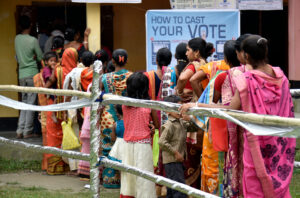
Why Don’t Voters Care About Local Government?
National politics is increasingly overshadowing everything else, even as local government does more and more. Here’s how to right the balance.
2036 Results
National politics is increasingly overshadowing everything else, even as local government does more and more. Here’s how to right the balance.
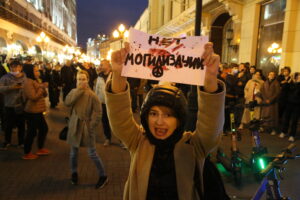
The Kremlin’s order to call up Russians to fight in Ukraine risks massive protests. It’s the riskiest decision of Putin’s rule, and it could lead to his undoing. | By Robert Person

April 2025, Volume 36, Issue 2
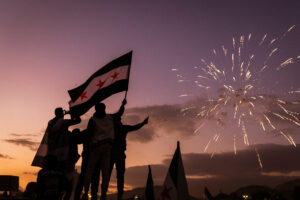
Syrians rejoiced when Bashar al-Assad’s regime fell. After decades of dictatorship and civil war, Syrians must now rebuild their country while seeking justice for the victims of authoritarian rule.
January 1992, Volume 3, Issue 1
Excerpts from: a UN Third Committee Resolution on the human rights situation in Burma; Organization of American States (OAS) Resolution 1080; an OAS resolution Haiti; the inaugural speech of Zambian president Chiluba ; Russian president Boris Yeltsin’s; the “Agreement on the Creation of the Commonwealth of Independent States; “Fundamental Principles for the Establishment of Peace in…

July 2024, Volume 35, Issue 3
The “crisis” of democracy is a crisis of representation. New parties, some of which are populist in troublingly illiberal ways, are arising from this moment. The danger that they pose is not that they are antidemocratic, but that they are antiliberal.
Online Exclusive by Andrei Kozyrev | The more determined democracies are to avoid war, the greater the risk that autocracies will wage it.
April 2020, Volume 31, Issue 2
A domestic pact may be needed to end a dictatorship, but what happens when that pact itself becomes one of the chief obstacles to deeper democratization?
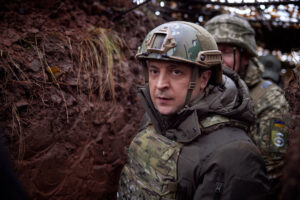
January 2025, Volume 36, Issue 1
Many pundits cry for a negotiated settlement to end the war between Russia and Ukraine. But they misunderstand Vladimir Putin’s motives. The only just end to the war will be in the trenches, not at the bargaining table.
April 2012, Volume 23, Issue 2
Excerpts from: Tawakkol Karman's acceptance speech for the 2011 Nobel Peace Prize; a statement issued by the Democratic Republic of Congo’s National Conference of Bishops on the DRC's disputed 2011 presidential election; the concluding statement of the February 22 extraordinary meeting of the Commonwealth Ministerial Action Group regarding the resignation of Maldives president Mohamed Nasheed.

January 2020, Volume 31, Issue 1
Democracies are grappling with an era of transformation: Identity is increasingly replacing economics as the major axis of world politics. Technological change has deepened social fragmentation, and trust in institutions is falling. As our most basic assumptions come under question, can liberal democracy rebuild itself?
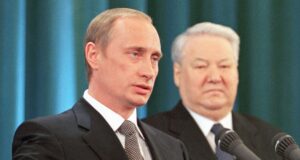
October 2021, Volume 32, Issue 4
Thirty years after the Soviet Union collapsed, Russia is firmly in the grip of an autocrat. Where did Russia’s path go wrong?
July 2010, Volume 21, Issue 3
Excerpts from remarks presented by newly elected Chilean president Sebastián Piñera upon signing a set of proposed laws for the strengthening of democracy to be submitted to the Congress.
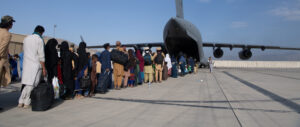
January 2022, Volume 33, Issue 1
The Afghan republic’s destruction was sewn into its founding. The international community’s missteps are more responsible for its failure than the country’s supposedly endemic corruption.
July 2021, Volume 32, Issue 3
Recent high-profile scandals have laid bare persistent shortcomings of Latin American democracy that, if unaddressed, could prove fatal.
April 2016, Volume 27, Issue 2
Even though Burma’s military seems to have accepted the NLD’s stunning election victory, it can still use an array of constitutional provisions to hamstring the incoming NLD government.
January 2014, Volume 25, Issue 1
After a half-century of brutal communist rule and two decades of troubled postcommunist life, this small Balkan state surprised many by achieving a successful turnover of power by means of the ballot.
January 2009, Volume 20, Issue 1
Change may be caused more by the frailty of the regime than the strength of the opposition, but in such cases the outcome is often less democratic.
July 2018, Volume 29, Issue 3
For countries emerging from communism, the post-1989 imperative to “be like the West” has generated discontent and even a “return of the repressed,” as the region feels old nationalist stirrings and new demographic pressures.
April 2024, Volume 35, Issue 2
The problem for democracy today is not capitalism; it is a decline in public honesty and civility. But there is an opportunity to revive our sense of national community, if we seize it.
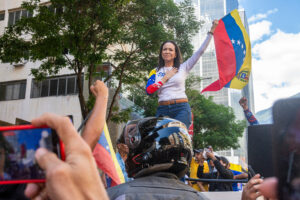
María Corina Machado’s Nobel Peace Prize has made her the face of the struggle for democracy in Venezuela. But throughout the opposition, women are the backbone of the fight against Nicolás Maduro’s corrupt authoritarian regime.