
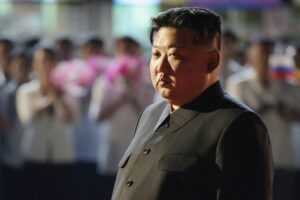
How South Korea’s Next Leader Should Handle Kim Jong-un
South Korea is about to elect a new president. North Korea has changed in recent years. Seoul’s approach to the Kim regime must change to reflect new risks — and Korea’s democratic strength.
3273 Results
South Korea is about to elect a new president. North Korea has changed in recent years. Seoul’s approach to the Kim regime must change to reflect new risks — and Korea’s democratic strength.
Despite the country’s steady progress fighting corruption, even in wartime, skeptics warn it’s not enough. But this is just an excuse. Their real concern is how Putin’s Russia would respond.
On new podcasts produced by NED’s International Forum for Democratic Studies, Larry Diamond discusses “China and the Global Challenge to Democracy,” and Marc F. Plattner explores “Democracy and the Illiberal Temptation.” And don’t miss conversations with recent JoD author Ronald J. Deibert on how social media may be fueling authoritarianism and with April-issue contributor Glenn Tiffert on digital censorship in China…
February 5, 2019
July 1993, Volume 4, Issue 3
A review of Freedom House’s Freedom in the World: The Annual Survey of Political Rights and Civil Liberties, 1992-1993.
July 2007, Volume 18, Issue 3
The Editors’ introduction to the first of two clusters on “The Democracy Barometers.”
October 2001, Volume 12, Issue 4
A review of Building the Rule of Law: Francis Nyalali and the Road to Judicial Independence in Africa By Jennifer A. Widner.
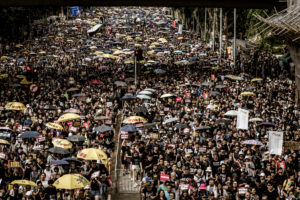
Dictators seem all-powerful—until they’re not. Those brave enough to challenge autocrats have scored some impressive victories in recent months. But how did they do it? And how could other opposition movements succeed where they once failed?
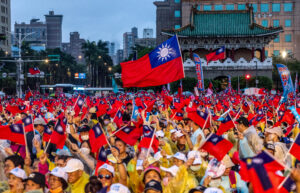
The drama of the country’s divided government just played out in a failed, high-stakes vote to recall two-dozen opposition legislators. How both sides respond could determine the fate of Taiwan’s democracy.
July 2003, Volume 14, Issue 3
If Iraq is successfully to democratize and an inclusive democratic culture is to emerge, the Iraqi state must be reconstituted as a federal and strongly liberal system and thoroughly demilitarized.
April 2017, Volume 28, Issue 2
In 2016, concerns about the administration of elections in the United States generated highly charged partisan debates. Are the worries justified?
October 2015, Volume 26, Issue 4
How did a potent Islamist movement come to accept a non-Islamist constitution? The answer lies in that movement’s self-protective reflexes.
October 2013, Volume 24, Issue 4
The phenomenon of the “interrupted presidency” remains a key source of democratic instability in Latin America, as was demonstrated once again by the 2012 impeachment of Paraguayan president Fernando Lugo.
April 2013, Volume 24, Issue 2
Latin America’s much-discussed political “left turn” has taken two very different forms. Why has the region’s commodities boom led some left-turn states to move toward “plebiscitarian superpresidentialism,” while others have resisted this temptation?
October 2004, Volume 15, Issue 4
Law-based rule means a set of basic conditions that make civic life possible. A democratic rule of law requires all that and more, however.
October 2009, Volume 20, Issue 4
Indian voters pulled off a surprise by allowing the Congress party to retain power at the head of a more coherent coalition that is far less dependent on a congeries of small regional parties.
January 2007, Volume 18, Issue 1
Mexico’s system of electoral governance and dispute settlement worked reasonably well, yet it created too much noise and too many needless invitations to distrust. The failures observed were less those of institutions than of actors. The loser reacted deplorably, but none of those involved acted in a manner beyond reproach.