
April 2003, Volume 14, Issue 2
Slovakia’s Second Transition
Slovakia’s 2002 elections indicate the waning of nationalist authoritarianism and augur well for the consolidation of democracy.
3273 Results
April 2003, Volume 14, Issue 2
Slovakia’s 2002 elections indicate the waning of nationalist authoritarianism and augur well for the consolidation of democracy.
January 2016, Volume 27, Issue 1
A review of Democratic Transitions: Conversations with World Leaders, edited by Sergio Bitar and Abraham F. Lowenthal.

July 2012, Volume 23, Issue 3
The electoral triumph of Islamist parties has dampened the enthusiasm of democrats for the “Arab Spring.”

January 2020, Volume 31, Issue 1
Democracies are grappling with an era of transformation: Identity is increasingly replacing economics as the major axis of world politics. Technological change has deepened social fragmentation, and trust in institutions is falling. As our most basic assumptions come under question, can liberal democracy rebuild itself?
January 2011, Volume 22, Issue 1
Hugo Chávez has been running a bounded competitive-authoritarian regime for some time, but its ability to compete is now slipping. Will this tend to make it less authoritarian—or even more so?
July 1993, Volume 4, Issue 3
Excerpts from: speeches from the three recipients of the National Endowment for Democracy’s biennial Democracy Award; the inaugural address of the New Civic Forum, an Egyptian NGO; “Enhancing the Effectiveness of the Principle of Periodic and Genuine Elections”, a UN resolution; the Conference on Security and Cooperation in Europe’s Moscow communiqué.
July 2013, Volume 24, Issue 3
The widely hailed writings of Singapore’s Kishore Mahbubani, including his latest book, The Great Convergence: Asia, the West, and the Logic of One World, reveal a remarkably narrow and Manichean worldview.

October 2020, Volume 31, Issue 4
By highlighting the deficiencies of authoritarian-populist president Jair Bolsonaro’s rule, the covid-19 pandemic is likely to leave Brazil’s democracy intact but even more brittle.
July 2023, Volume 34, Issue 3
Activist Xu Zhiyong on the Imperative for a Democratic China; Historian Timothy Snyder on “Russophobia”; Fadzayi Mahere on why Zimbabwe is a tragedy; a call for the release of the speaker of Tunisia’s parliament, Rached Ghannouchi; a Burmese student recounts her experience as a strike leader following the 2021 military coup.
July 2002, Volume 13, Issue 3
Excerpts from: Sierra Leonean president Ahmad Tejan Kabbah’s inaugural address; the Democracy Coalition Project’s “Call to Action to Build Open Democratic Societies”; the Varela Project, a petition circulated by Cuban dissidents; East Timorese president Xanana Gusmao’s inaugural address.
Winter 1990, Volume 1, Issue 1
A tribute in remembrance of Sidney Hook (1902–1989).

July 2024, Volume 35, Issue 3
The “crisis” of democracy is a crisis of representation. New parties, some of which are populist in troublingly illiberal ways, are arising from this moment. The danger that they pose is not that they are antidemocratic, but that they are antiliberal.
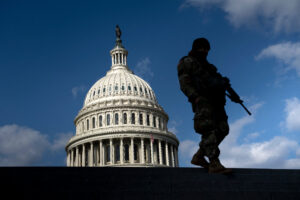
October 2024, Volume 35, Issue 4
Political violence is rising in wealthy democracies. Polarized societies and bitter party politics are putting candidates and election officials in serious peril. Political leaders, more than anyone, have the power to stoke or stamp out this dangerous cycle of violence.
July 2002, Volume 13, Issue 3
Middle Eastern autocracies rely ever more on repression of both their Islamist and secular critics, and therefore increasingly fear that any opening will be uncontrollable. Is there a way out?
October 2022, Volume 33, Issue 4
Excerpts from: Burma’s National Unity Government statement on execution of four prodemocracy activists by military junta; UN Human Rights Commission report on the treatment of Uyghurs in China’s Xinjiang region; international NGO statement on closure of Uganda’s leading LGBTQ rights advocacy organization; the Prague Manifesto for a Free Ukraine; Zov, a Russian soldier’s memoir.
January 2012, Volume 23, Issue 1
Morocco was not immune to the 2011 upheavals in the Arab world, but the country’s monarchy deftly managed the crisis through cosmetic constitutional reform.
July 2004, Volume 15, Issue 3
Excerpts from: the Alexandria Declaration, a document emanating from a March 2004 conference on Arab reform convened under the auspices of Egyptian president Hosni Mubarak; an initiative on political reform issued by the first Arab Civil Forum on March 22; the Tunis Declaration, issued at the end of the Arab Summit; a response from 34…
July 2023, Volume 34, Issue 3
In this symposium, the Journal of Democracy brings together leading scholars of India to perform a biopsy on the state of that country’s fragile democracy, and to offer us a prognosis for its future.
October 2012, Volume 23, Issue 4
The hardest work of the transition—negotiating political pacts—has not yet begun. Burma’s democrats must help to forge a system of mutual security that can allow democratization to proceed.