
January 2006, Volume 17, Issue 1
Burundi’s Transition: Training Leaders for Peace
Burundi's leaders are learning to embrace a culture of discussion and consensus that offers a way out of the abyss of civil war.
2772 Results
January 2006, Volume 17, Issue 1
Burundi's leaders are learning to embrace a culture of discussion and consensus that offers a way out of the abyss of civil war.
January 2006, Volume 17, Issue 1
Measurements that rely on perceptions of corruption can be misleading. What is needed is a method of gauging how well a country has set itself up to defend public integrity systematically and in all its dimensions.
October 2005, Volume 16, Issue 4
Recent works on regime types have led to confusion and a tendency to overstate the differences between established and newer democracies.
October 2004, Volume 15, Issue 4
Democracy requires robust political equality, but the persistence of social, economic and cultural inequality complicates its realization.
July 2004, Volume 15, Issue 3
Confucianism has had a long history of involvement with the state in East Asia, but today there are reasons to think that it can become a positive force in encouraging democracy.
April 2004, Volume 15, Issue 2
Weak or failed states are at the root of many serious global problems, from poverty and AIDS to drug trafficking and terrorism, to the failure of democratic government itself. State-building must become a priority for the world community.
January 2004, Volume 15, Issue 1
Since the fall of the Berlin Wall, the involvement of NATO and the EU with their prospective new members has worked strongly in favor of democratic governance in Central and Eastern Europe.
January 2004, Volume 15, Issue 1
Mexico’s 2003 congressional elections confirmed both the transition to fully competitive politics and the persistence of structural deficiencies associated with a multiparty presidential system.
October 2003, Volume 14, Issue 4
Building democracy at the supernational level is an unprecedented task, but so once was building democracy at the level of the modern state. And the progress of the EU in the last half-century has been remarkable.
October 2003, Volume 14, Issue 4
Europe faces a potentially dangerous “double bind”: The legitimacy of domestic democracy in the member states is waning, and citizens are increasingly unhappy with the EU’s lack of accountability—but the new draft Constitution fails to address the problem.
April 2003, Volume 14, Issue 2
Slovakia’s 2002 elections indicate the waning of nationalist authoritarianism and augur well for the consolidation of democracy.
January 2003, Volume 14, Issue 1
The Chinese state is much weaker than most people realize, which bodes ill for the country’s democratic prospects.
January 2003, Volume 14, Issue 1
The outward appearance of a powerful and confident Communist party-state masks a deep crisis.

October 2024, Volume 35, Issue 4
When an epidemic of Koran burnings swept Denmark and Sweden, the Danish government criminalized the practice. It is a misguided response that misses the opportunity to protect both minorities and the right to free speech.
April 1997, Volume 8, Issue 2
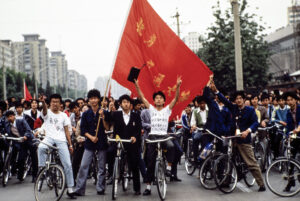
Excerpts from: the acceptance speech of José Ramos-Horta, recipient of the Nobel Peace Prize; Guatemalan president Alvaro Arzú’s speech on the occasion of the signing of a comprehensive peace accord.

July 1999, Volume 10, Issue 3
The recognition of democracy as a universally relevant system is a major revolution in thinking, and one of the main contributions of the twentieth century. While not yet universally practiced, democracy is now being taken as generally right.
October 2010, Volume 21, Issue 4
Are technologies giving greater voice to democratic activists in authoritarian societies, or more powerful tools to their oppressors?
July 1998, Volume 9, Issue 3
The early 1990s saw a wave of competitive multiparty elections in Africa. These contests can be described as "founding" elections in the sense that they marked for various countries a transition from an extended period of authoritarian rule to fledgling democratic government. By the middle of the 1990s, this wave had crested. Although founding elections…
January 2000, Volume 11, Issue 1
Excerpts from: a statement by Cuban dissidents entitled “All United”; a letter by former dissidents of the Soviet bloc to the so-called “Group of Four” critics of the Castro regime in Cuba; an address delivered by the Commonwealth’s outgoing secretary-general Chief Emeka Anayaoku; the “Seoul Statement” on human rights in North Korea; Abdurrahman Wahid’s speech…
July 2004, Volume 15, Issue 3
Reports on elections in Algeria, Dominican Republic, El Salvador, Equatorial Guinea, Georgia, Guinea-Bissau, India, Indonesia, Macedonia, Malawi, Malaysia, Panama, Philippines, Russia, Slovakia, South Africa, South Korea, Sri Lanka, and Taiwan.