
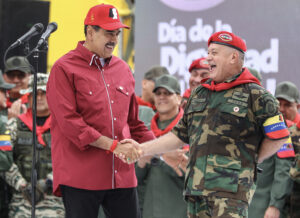
Fighting a Gangster-Style Autocracy
The newly aggressive U.S. policy toward Nicolás Maduro and his autocratic regime, including the recent sinking of alleged Venezuelan drug boats, did not come out of nowhere.
2779 Results
The newly aggressive U.S. policy toward Nicolás Maduro and his autocratic regime, including the recent sinking of alleged Venezuelan drug boats, did not come out of nowhere.
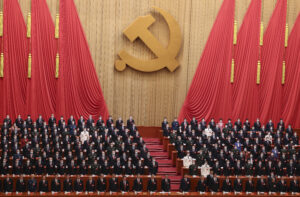
Most of the world’s democracies remain extremely vulnerable to sharp-power threats. The following Journal of Democracy essays explore how authoritarians weaponize universities, technologies, media, entertainment, and culture to attempt to crack democracy’s foundations.

Election observers are the first line of defense for democratic rights and freedoms. The essays below highlight the importance of election monitoring, especially in highly polarized, autocratic settings, the dangers that observers face, and the repercussions of rigged contests.
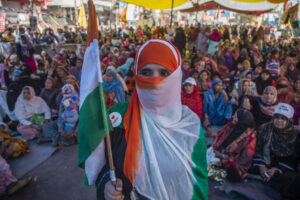
Prime Minister Narendra Modi and his Hindu-nationalist BJP explicitly exclude and routinely attack the country’s largest minority, but the political opposition is silent, too afraid to jeopardize its base of support. These essays explore India’s complex democratic history and its prospects for the future.
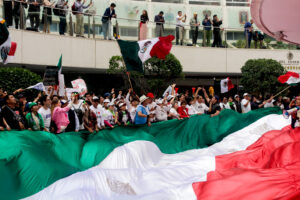
Mexico launched a radical overhaul of its judiciary on June 1 with its first-ever judicial election. The controversial plan risks weakening judicial independence, checks on presidential power, and democracy itself.

The following Journal of Democracy essays chronicle the rise, fall, and resurgence of illiberal populism in Poland, and what it means for the country’s democratic future.
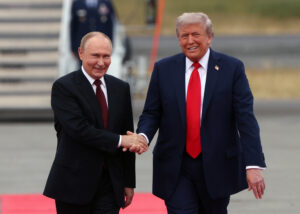
The Alaska summit between Presidents Donald Trump and Vladimir Putin struck an uncanny resemblance to the Washington-Moscow meetings of the Cold War. But 2025 is not 1985. Washington and Moscow cannot simply redraw the map without Ukraine and Europe at the table. How should the war in Ukraine end?

With democracy in trouble across the globe, it’s easy to forget how and why a steady succession of dictatorships fell in the last half of the twentieth century. Democracy’s strengths, and its record, should give cause for hope at a moment when autocracy appears ascendent.
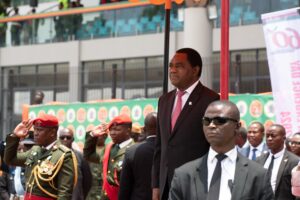
The hope was that President Hakainde Hichilema would bring much-needed reform and openness. Instead, he has ushered in new laws that are silencing dissent and free expression.
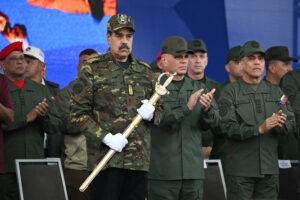
The South American country may be on the verge of real change. But it isn’t going to descend into civil-war chaos like Libya. It will be difficult, imperfect, and far better than what Venezuelans have had to endure.
In her recent piece for the Monkey Cage blog, Victoria Tin-bor Hui discusses what the sentencing of Umbrella Movement leaders means for those struggling for democracy in Hong Kong. Read her article on the Umbrella Movement protests from the April 2015 JoD, free of charge through May 24.
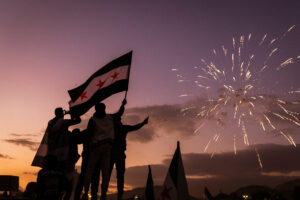
On Tuesday, May 13, the United States announced it would lift longstanding sanctions on Syria. Reintegrating into the global economy could lay the foundations for Syria’s stability and prosperity. In the Journal of Democracy’s latest issue, leading scholars unpack Assad’s unexpected fall, and the reasons for hope that Syria will flourish.

Why Emmanuel Macron’s reelection hangs on him winning support from the very people he has ignored most.
Reports on elections in Botswana, Bulgaria, Georgia, Ghana, Lithuania, Mauritius, Moldova, Mozambique, Namibia, Palau, Romania, Senegal, Sri Lanka, Uruguay, and Uzbekistan.

Marine Le Pen has remade her image to obscure her far-right populism. There is a real risk French voters won’t see through it.

The far-right Alternative for Germany is no longer a mere protest party. It’s tapping into widespread discontent and is surprisingly popular with young voters. Even more, it is reshaping the political future of Germany.
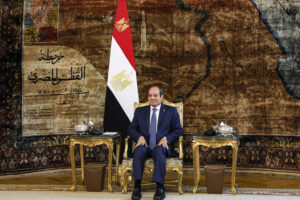
The pillars of Sisi’s regime are straining, and Assad’s collapse is raising the pressure. If Egypt is going to follow Syria’s path, these are signals to watch.
As political polarization deepens in the world’s democracies, political violence is on the rise. And in the wake of these acts, conspiracy theories often bloom. We offer three essays that look at these forces that threaten to upend democracy, and what must be done to overcome them.

Alexei Navalny was one of the bravest and most influential political leaders of our time. His assassination should be a wake-up call for Western democracies.

Bitcoin is an indispensable tool for political dissidents in the most repressive environments, argue Alex Gladstein and Félix Maradiaga in two recent Journal of Democracy online exclusives. When dictators weaponize the financial system and obstruct all avenues of dissent, digital currency helps activists keep their operations running.