3272 Results

black canary best of the beast read online reddit

April 2009, Volume 20, Issue 2

Reading Russia: The Wounds of Lost Empire

There is no consensus about the nature of the political system in Moscow today. Yet how one understands the motivations propelling Russian policy abroad depends on how one understands its regime at home.

April 2009, Volume 20, Issue 2

Reading Russia: Tools of Autocracy

Read the full essay here. Arguably a flawed democracy in the 1990s, Russia took a distinctly authoritarian turn under President Vladimir Putin from 2000 to 2008. The country now lives under a façade democracy that barely conceals the political and administrative dominance of a self-interested bureaucratic corporation. The regime manufactures consent by means of three…

July 2024, Volume 35, Issue 3

Democracy After Truth

A review of The Death of Truth, by Steven Brill, and Invisible Rulers: The People Who Turn Lies into Reality, by Renée DiResta.

How Autocrats Weaponize Cyberspace

There’s a fine line between genuine cybersecurity and digital authoritarianism. Many autocrats use the pretext of digital order to surveil, silence, and suppress their citizens. State cyber repression creates a climate of fear around social media and the internet, shrinking one of the last remaining spaces for free speech.

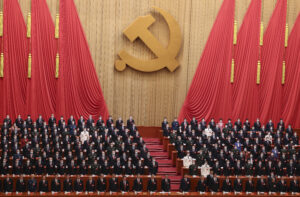
China’s Threat to Global Democracy

The Chinese Communist Party is deadly serious about its authoritarian designs, and it is bent on promoting them. It is time for the world’s democracies to get serious, too. | Michael Beckley and Hal Brands

January 2015, Volume 26, Issue 1

The Weight of Geopolitics

Can democracy prosper when democratic countries are in geopolitical retreat? History cautions against the notion that democracy will inevitably prevail.

April 2004, Volume 15, Issue 2

Change in Uganda: A New Opening?

The decision by Uganda’s leaders to abandon the country’s “movement” system and adopt multiparty pluralism creates a significant opportunity for democratic progress.

July 2003, Volume 14, Issue 3

Why Post-Settlement Settlements?

The decaying trajectory of democratization in South Africa represents a kind of settlement failure, resulting for the main parties in the transition having come to the table with incompatible cultural paradigms of negotiation.

Winter 1990, Volume 1, Issue 1

Tiananmen and Beyond: The Resurgence of Civil Society in China

The remarkable events of April and May 1989 revealed the degree to which civil society has reemerged in Communist China. The ruthless campaign of suppression that began on June 4 revealed in turn the degree to which the Chinese Communist Party (CCP) remains unwilling and unable to accept the reality of nascent civil society in…

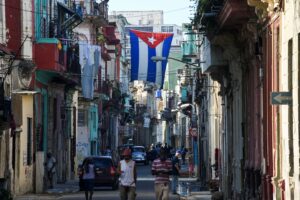
Why Cuba’s Student Movement Is Rising

Cuba’s dictatorship has kept student movements under its thumb for decades. But the regime’s repressive tactics have inadvertently breathed new life into a new generation of student activists. These young people are willing to fight for the island’s freedom.

July 2013, Volume 24, Issue 3

Algeria versus the Arab Spring

Not  only  did  the  Algerian  regime  survive  the  “Arab  Spring,”  it  hardly deviated from its normal methods of authoritarian governance—patronage, pseudodemocratization, and effective use of the security apparatus.

July 2006, Volume 17, Issue 3

Documents on Democracy

Excerpts from: Akbar Gangi’s acceptance speech of the Golden Pen Award; a speech by Nigerian president Olusegun Obasanjo; the “Manifesto for a European Democracy Foundation”; the “2006 Declaration on Freedom and Democracy for Vietnam.” 

April 2005, Volume 16, Issue 2

Challenge and Change in East Asia: Taiwan’s Year of Stress

Thanks to a disputed presidential election and a narrowly divided parliament, Taiwan's politics remains tense. Yet the worst of the conflicts that gripped the island seem to have eased, and the difficult political events of the last few years may have some beneficial effects after all.