1985 Results

Nayib Bukele self-deprecating slogan July 2019 article

July 2004, Volume 15, Issue 3

Crafting a Constitution for Afghanistan

As 2004 began, Afghanistan approved a new constitution that represents a key step forward in its political reconstruction. But it is not yet clear whether this new constitution will enable the country to surmount the many challenges that lie ahead.
July 2003, Volume 14, Issue 3

Why Post-Settlement Settlements?

The decaying trajectory of democratization in South Africa represents a kind of settlement failure, resulting for the main parties in the transition having come to the table with incompatible cultural paradigms of negotiation.

July 2019, Volume 30, Issue 3

Documents on Democracy

Excerpts from: a speech by Ukrainian President Volodymyr Zelensky; a speech by Indian Prime Minister Narendra Modi; a speech by Félix Tshisekedi, president of the Democratic Republic of the Congo (DRC); a statement by Reverend Chu Yiu-ming; and a speech by Jens Stoltenberg, secretary-general of the North Atlantic Treaty Organization (NATO).

July 2018, Volume 29, Issue 3

Election Watch

Reports on elections in Azerbaijan, Bhutan, Colombia, Hungary, Lebanon, Malaysia, Montenegro, Paraguay, Slovenia, Timor-Leste, Turkey, and Venezuela. 

October 2013, Volume 24, Issue 4

Documents on Democracy

Excerpts from: Russian anticorruption crusader and Moscow mayoral candidate Alexei Navalny’s speech; presidential contender Nana Akufo-Addo’s speech conceding the race to John Dramani Mahama and Mahama’s address; remarks by jailed Chinese human-rights activist Xu Zhiyong and essay dedicated to him by lawyer and human-rights activist Teng Biao.

July 2008, Volume 19, Issue 3

The Crisis in Kenya

For years Kenya was regarded as one of Africa’s sturdiest democracies. The fraudulent 2007 presidential election, however, exposed the fragility of Kenya’s democratic framework.

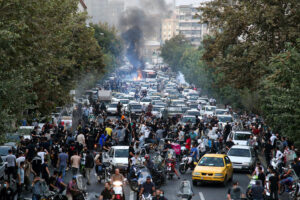
Iran Erupts

Iranians are protesting their regime. Why it will only get worse for the mullahs. | By Peyman Asadzade

October 2019, Volume 30, Issue 4

The 2019 EU Elections: Moving the Center

The results of the May 2019 elections to the European Parliament—and particularly the growing influence of the populist radical right—reflect a deep transformation of European politics that can largely be traced to the “refugee crisis” of 2015–16.

April 2007, Volume 18, Issue 2

Voting for Change in the DRC

The holding of competitive elections in this vast, strife-torn country must count as a significant achievement, even though voters signaled their disaffection with the entire array of political elites that had been ruling them.

Free

July 2013, Volume 24, Issue 3

Transforming the Arab World’s Protection-Racket Politics

The Arab world’s old autocracies survived by manipulating the sharp identity conflicts in their societies. The division and distrust that this style of rule generated is now making it especially difficult to carry out the kind of pact-making often crucial to successful democratic transitions.

Free

July 2009, Volume 20, Issue 3

Malaysia’s Electoral Upheaval

In March 2008, Malaysian voters dealt the long-ruling National Front coalition an enormous shock—pushing that party closer to losing power than it has ever been in Malaysia’s entire history as an independent country.  

Free

July 2008, Volume 19, Issue 3

The Real Causes of the Color Revolutions

The “color revolutions” in the postcommunist countries cannot be attributed to diffusion alone. Structural factors offer a better explanation of why such revolutions have succeeded in some countries and not in others.

Free

July 2004, Volume 15, Issue 3

South Africa After Apartheid: The First Decade

Over the ten years since its first nonracial elections in 1994, South Africa has seen its democratic order become more firmly institutionalized, even as the electoral dominance of the ANC has continued to grow.

July 2018, Volume 29, Issue 3

Explaining Eastern Europe: “Soft Decisionism” in Bulgaria

Bulgaria continues to enjoy free and fair elections, but over the last decade its politics has come to be dominated by Prime Minister Boyko Borisov, who practices a brand of discretionary rule that puts his own priorities above any commitment to legal or constitutional norms.