

January 2025, Volume 36, Issue 1
How to Confront No Ordinary Danger
Climate change is an urgent and unparalleled threat. Our best hope lies in radical, principled activism — at once more democratic and more authoritarian.
2024 Results
January 2025, Volume 36, Issue 1
Climate change is an urgent and unparalleled threat. Our best hope lies in radical, principled activism — at once more democratic and more authoritarian.

April 2025, Volume 36, Issue 2
After the collapse of the Assad regime, Syria stands at a crossroads. Nothing is assured, but the country’s civil society is its best hope for charting a democratic future.

April 2025, Volume 36, Issue 2
Despite a brutal thirteen-year civil war, Syrians are not building from scratch. In fact, Syria has a long and rich history of state-building to guide them.
April 2025, Volume 36, Issue 2
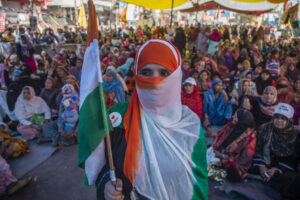
The ruling BJP has long sought to sideline Indian Muslims. But even the opposition is opting to exclude them politically. Muslims’ chances at greater representation remain dim.
April 2025, Volume 36, Issue 2
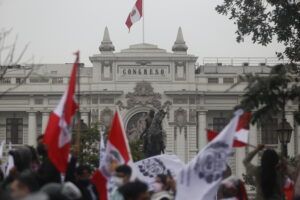
Democratic backsliding is usually seen as something driven by presidents, but under certain circumstances elected legislatures can cause it, too. Legislative hegemony is a growing danger.

January 2025, Volume 36, Issue 1
The student movement that toppled Bangladesh’s longtime autocratic ruler wants more than a return to the old order. These young revolutionaries are seizing a chance to start anew. How and by whom will the country’s future be decided?
July 2025, Volume 36, Issue 3
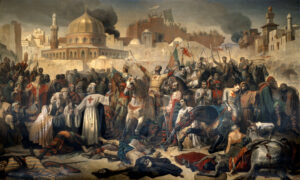
The most challenging type of diversity for democracy is religious diversity. This also helps explain why modern democracy first took root in Western Europe: Religiously homogenous populations went hand in hand with the early formation of parliaments.
October 2025, Volume 36, Issue 4
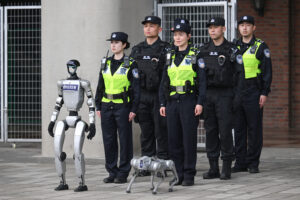
The Chinese Communist Party is dreaming an authoritarian techno-dream that is a democrat’s nightmare: ever more fine-grained state control made possible by using AI networks to pry and spy everywhere. But human unpredictability remains a force the party-state cannot tame.

October 2025, Volume 36, Issue 4
Artificial intelligence and its effects on democracy are a matter of choice, not fate. The concerns are longer term than the recent spate of worry about “generative” AI would suggest. The democratic conversation about AI has hardly begun.

October 2025, Volume 36, Issue 4
Latin America remains haunted by the specter of “strongman” rule. Term limits have been a way of guarding against this threat, but aspiring autocrats have now found a new avenue to bypass this barrier to power: courts of law.
July 2025, Volume 36, Issue 3
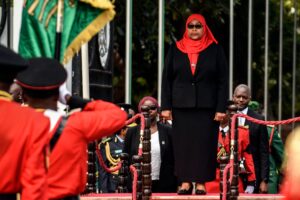
President Samia Suluhu Hassan came into office promising democratic reforms. Four years later, it is clear she is more of a performer than a reformer. Far from delivering on her promises to unwind Tanzania’s authoritarian machinery, she is relying on the repressive tools we know so well.
July 2021, Volume 32, Issue 3
Excerpts from: Maria Ressa’s comments on social media at the 2021 Copenhagen Democracy Summit; NGO statement on the arrest of Algerian human-rights defenders; statement denouncing the dismissal of Constitutional Court judges and the attorney general; letter on the sentencing of a Saudi man for allegedly running a satirical Twitter account.
July 2017, Volume 28, Issue 3
Reports on elections in Algeria, Armenia, the Bahamas, Bulgaria, the Gambia, Iran, Kosovo, Lesotho, Micronesia, Papua New Guinea, Serbia, South Korea, and Timor-Leste.
October 2007, Volume 18, Issue 4
Reports on elections in Cameroon, Congo-Brazzaville, Jamaica, Kazakhstan, Mali, Morocco, Papua New Guinea, Philippines, Senegal, Seychelles, Sierra Leone, Timor-Leste, and Turkey.
October 2011, Volume 22, Issue 4
Reports on elections in Cape Verde, Macedonia, São Tomé and Príncipe, Singapore, Thailand, and Turkey.

April 2012, Volume 23, Issue 2
The upheavals that have been shaking the Arab-Muslim world are revolutions in discourse as well as in the streets. Arabs are using not only traditional and religious vocabularies, but also a new set of expressions that are modern and represent popular aspirations.
July 2013, Volume 24, Issue 3
The Putin regime, having faced its first real challenge in the form of mass protests after the 2011 Duma elections, is responding with a series of laws intended to intimidate its civil society opposition, if not stamp it out altogether.
January 2009, Volume 20, Issue 1
Change may be caused more by the frailty of the regime than the strength of the opposition, but in such cases the outcome is often less democratic.
October 2025, Volume 36, Issue 4
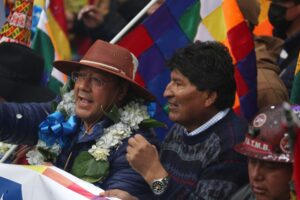
Evo Morales’s Movement Toward Socialism transformed Bolivian politics. But after almost two decades in power, the party is unraveling. No longer the country’s anchor, the MAS has become a major driver of instability and political decay.

Online Exclusive by Casey Cagley | Across Latin America, former leaders are keeping a chokehold on their countries’ politics. It’s time their successors break free.