
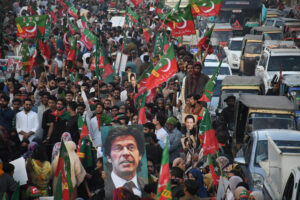
Does Democracy Have a Future in Pakistan?
The break between the military and former prime minister Imran Khan marks a new era of instability. Is this the rise of an autocratic deep state or the fall of authoritarian populism? | Ayesha Jalal
3264 Results
The break between the military and former prime minister Imran Khan marks a new era of instability. Is this the rise of an autocratic deep state or the fall of authoritarian populism? | Ayesha Jalal

April 2016, Volume 27, Issue 2
Aung San Suu Kyi’s National League for Democracy swept Burma’s November 2015 elections. Will the new NLD-led government be able to live up to high expectations that it will deliver better governance, national reconciliation, and some form of federalism?
July 2013, Volume 24, Issue 3
The Hashemite monarchy still fails to understand the challenges that threaten Jordan’s political order. The old playbook of limited, manipulated reform is no longer enough, but key players fail to realize it.
July 2012, Volume 23, Issue 3
Can outside actors help Hungarians to loosen Fidesz’s centralized grip on all of their country’s governing institutions?
January 2014, Volume 25, Issue 1
“New media” may generate a lot of buzz, but authoritarian regimes are proving disturbingly adept both at counteracting them and at using more traditional media to help themselves hang on to power.
January 2013, Volume 24, Issue 1
There are two sharply contrasting and controversial perspectives on China’s near- to medium-term future: top-level reform and bottom-up revolution.
July 2008, Volume 19, Issue 3
Read the full essay here. Political Islam is often cited as the key challenge to democratization in Muslim nations, but deep currents of authoritarianism may prove more of an obstacle. Traditions of monarchy, military rule, and weak civic institutions block the path of democratic transition throughout the Muslim world. Political Islam does of course present…
July 2008, Volume 19, Issue 3
For years Kenya was regarded as one of Africa’s sturdiest democracies. The fraudulent 2007 presidential election, however, exposed the fragility of Kenya’s democratic framework.
October 2024, Volume 35, Issue 4
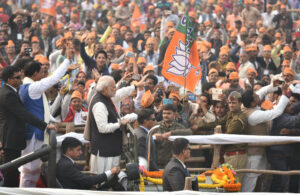
Majoritarian nationalism is a defining feature of our time. If we are to resist ethnonationalist leaders trying to recast our societies into imagined majorities, we must revise our conception of democracy and the exclusion inherent in majority rule.
October 2014, Volume 25, Issue 4
A review of The Confidence Trap: A History of Democracy in Crisis from World War I to the Present by David Runciman.
January 2016, Volume 27, Issue 1
China’s government looks to Singapore, the only country in the region to modernize without liberalizing, in hopes of finding the key to combining authoritarian rule with economic progress and “good governance.”
January 2013, Volume 24, Issue 1
Over the past decade, Chinese authorities have turned against many of the legal reforms they themselves had enacted in the late 20th century. Lawyers have come under increased pressure. Political campaigns warning against rule-of-law norms have rippled through the courts. And central authorities have massively increased funding for extralegal institutions aimed at curtailing and suppressing…
July 2009, Volume 20, Issue 3
Evidence suggests that under some circumstances repeated elections, even if flawed, can lead to democratization.
January 2005, Volume 16, Issue 1
By mid-2003, Afghanistan appeared in danger of reverting to “failed-state” status. Happily, the resilience of the Afghans plus some policy changes by the United States and its parners have put things on the right track, though daunting challenges remain.

October 2022, Volume 33, Issue 4
While a handful of democracies have responded effectively to this corrosive form of authoritarian influence, most societies are dangerously underequipped. New strategies are urgently needed.
October 2007, Volume 18, Issue 4
Where indigenous peoples constitute a smaller share of the electorate, their recent inclusion denotes a more generalized opening of the political system to excluded and vulnerable sectors of society.
October 2023, Volume 34, Issue 4
Turkey’s economic and political crises have only worsened, but the autocratic president remains in power. His secret? He uses the levers of the state to shield his supporters from harm, while punishing the rest.
January 2018, Volume 29, Issue 1
Russia’s ruling elite have used corruption not only to line their own pockets, but also as a tool of domestic political control and global power projection.
April 2010, Volume 21, Issue 2
Amid a climate of rising crime and insecurity as well as economic uncertainty produced by the global downturn, can the study of public opinion and attitudes reveal which Central American countries are most at risk of democratic reversals?
July 2025, Volume 36, Issue 3
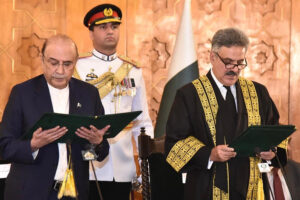
Authoritarian regimes are not lawless. Rather, autocrats take to the courtroom not only to enforce their will but to justify their rule. So how do they appeal to reason? How do they rationalize their undemocratic turn?