
Summer 1990, Volume 1, Issue 3
Technology and Freedom
A review of Power, Press, and the Technology of Freedom: The Coming Age of ISDN, by Leonard R. Sussman.
2893 Results
Summer 1990, Volume 1, Issue 3
A review of Power, Press, and the Technology of Freedom: The Coming Age of ISDN, by Leonard R. Sussman.
Spring 1990, Volume 1, Issue 2
A review of Islamic Liberalism: A Critique of Development Ideologies, by Leonard Binder.
Winter 1990, Volume 1, Issue 1
A review of Rethinking Military Politics: Brazil and the Southern Cone, by Alfred Stepan.
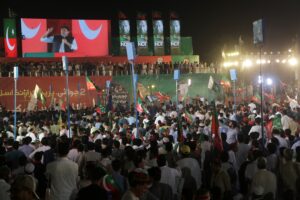
The military has spent decades trying to impose order on Pakistani politics. It has led to chaos. | By Ahsan I. Butt

April 2012, Volume 23, Issue 2
For much of its history, Nicaragua has shown a predilection for personalist and populist rule. What explains the persistence and allure of these phenomena, and what obstacles do they pose for democracy in Nicaragua?
October 2005, Volume 16, Issue 4
In the lines of suffering etched on the visage of this courageous dissident may be read the drama of Iran today.
January 2011, Volume 22, Issue 1
The left-right ideological divide has begun to narrow in Latin America as citizens and leaders increasingly choose a pragmatic approach to politics and embrace the rules of the democratic game.
April 2019, Volume 30, Issue 2
The historical record since 1945 gives us a picture of how populists operate once they hold political power. The record shows that populism is inimical to liberal democracy, and not a corrective to some of its failings.
July 2018, Volume 29, Issue 3
Bulgaria continues to enjoy free and fair elections, but over the last decade its politics has come to be dominated by Prime Minister Boyko Borisov, who practices a brand of discretionary rule that puts his own priorities above any commitment to legal or constitutional norms.
October 2017, Volume 28, Issue 4
Is pressing a troubled, intensely fragile “postconflict” country to hold elections a good idea? Somalia did so in late 2016 and early 2017, and the process was not pretty. But was it better than the alternative?
April 2017, Volume 28, Issue 2
In 2016, concerns about the administration of elections in the United States generated highly charged partisan debates. Are the worries justified?
January 2016, Volume 27, Issue 1
Bold leadership from people in key posts can effectively promote public integrity, but they must be ready to accept tenures that are stormy and short.
October 2014, Volume 25, Issue 4
Indonesia’s 2014 legislative elections went smoothly. Yet the “money politics” that featured so heavily in these contests suggests a grave need to reform the country’s electoral system.
July 2013, Volume 24, Issue 3
When this small island kingdom in the Gulf joined the wider Arab world’s political upheavals in March 2011, it was a reaction to regional events, but also a reflection of internal problems that had been festering for a decade.
January 2013, Volume 24, Issue 1
Egypt’s liberals, though they do not dominate political life and perhapsnever will, remain a crucial force in shaping the country’s politics.
October 2012, Volume 23, Issue 4
Although politics today is in critical condition—some even say it is dying—it is all the more important to revive it.
July 2012, Volume 23, Issue 3
The recent protests in Russia raise the question of whether the Putin regime could fall to a “color” or electoral revolution like those that have ousted other autocratic regimes in postcommunist Europe and Eurasia over the past decade and a half.
April 2011, Volume 22, Issue 2
Even before Argentina’s landmark gay-marriage law was passed in July 2010, a gay-rights revolution was well underway across Latin America. But do gay rights by law equal acceptance of gays in practice?
July 2009, Volume 20, Issue 3
Read the full essay here. Despite the suppression of the Tiananmen Uprising of 1989, popular protest in China has by all accounts escalated steadily over the ensuing two decades. These protests have spread to virtually every sector of Chinese society, prompting more than a few observers to proclaim the emergence of a “rising rights consciousness”…
July 2009, Volume 20, Issue 3
Due to weak opposition parties and presidential dominance, many African countries have not reaped the full benefits of regularly held elections.