
October 2012, Volume 23, Issue 4
The Opening in Burma: A Union for All of Us
Elections alone will not answer the question of how to build a lasting democracy. Minority rights also must be protected.
3264 Results
October 2012, Volume 23, Issue 4
Elections alone will not answer the question of how to build a lasting democracy. Minority rights also must be protected.
July 2002, Volume 13, Issue 3
The November elections were peaceful and competitive. For the third straight time, voters chose a conservative who embraced democratic liberties.
January 2002, Volume 13, Issue 1
Recent parliamentary elections showed the continuing strengths and weaknesses of Bangladeshi democracy. Although the country does have strong political parties and a decade of democratic elections, the intense antipathy between government and opposition will continue to cause problems well into the future.
January 2001, Volume 12, Issue 1
The stunning defeat of a draft constitution backed by President Robert Mugabe and the opposition’s unexpectedly strong showing in the June 2000 parliamentary elections may have marked the beginning of the end of ruling-party hegemony in Zimbabwe.
October 2000, Volume 11, Issue 4
Vicente Fox’s victory in Mexico’s July 2000 presidential election revealed the fundamental changes that had been taking place under the veil of governmental continuity.
October 2000, Volume 11, Issue 4
Although Fox’s National Action Party (PAN) is frequently portrayed as a reactionary party, it is better understood as a liberal-democratic alternative to the former ruling party’s authoritarianism.
July 2000, Volume 11, Issue 3
The promotion of democracy in Africa has become the dominant theme of South Africa’s foreign policy. Yet the dilemmas this policy has confronted in practice have forced the government to alter its approach.
July 2000, Volume 11, Issue 3
The (Un)Rule of Law and the Underprivileged in Latin America, edited by Juan E. Méndez, Guillermo O’Donnell, and Paulo Sérgio Pinheiro, offers a harsh appraisal of the region’s legal and justice systems.
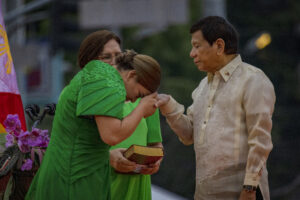
July 2025, Volume 36, Issue 3
Midterm elections saw unprecedented voter participation, especially among the young, but the country’s politics are being held hostage by the bitter struggle between the Marcos and Duterte clans. The polarizing fight is taking a toll on the Philippines’ democracy, with no end in sight.
October 1993, Volume 4, Issue 4
Excerpts from: documents issued by Guatemala’s Court of Constitutionality and leaders of civil society; “The Vienna Declaration and Program of Action”; statement of Nigeria’s Civil Liberties Organisation; address of Dr. Sein Winn, leader of the exiled National Coalition Government of the Union of Burma; speeches by the South African recipients of the 1993 Liberty Medal.
April 2016, Volume 27, Issue 2
The long-ruling PRI staged a comeback in 2012 behind a young president touting a reformist agenda, but Enrique Peña Nieto’s early successes have been eclipsed by government underperformance and a continued failure to restore public security.

April 2015, Volume 26, Issue 2
Why do some hybrid regimes remain stable over time, while others become more authoritarian? Venezuela’s autocratic turn has been driven by the ruling party’s declining electoral fortunes and by a foreign policy that has shielded it from international scrutiny.
July 2022, Volume 33, Issue 3
The first two months of the war alone turned the Russian clock back decades, undoing thirty years of post-Soviet economic gains and reducing the country to an international pariah state.
April 2020, Volume 31, Issue 2
Algeria’s massive wave of protesters wanted to put an end to sham elections. While the leaderless movement succeeded for a time, its failure showcased the lengths to which a country’s ruling elite will go to maintain its hold on power.
April 2018, Volume 29, Issue 2
In 2017, the state of political rights and civil liberties around the world sunk to its lowest point in more than a decade. While the democratic powers grappled with their own internal problems, leading autocrats expanded their global efforts to undermine democratic institutions.
October 2016, Volume 27, Issue 4
Peru’s economic boom is over and newly elected president Pedro Pablo Kuczynski faces a Congress dominated by opposition parties, putting him in a more precarious position than his predecessors.
July 2016, Volume 27, Issue 3
Latin America’s largest country has managed vastly to enlarge the share of its citizens who can take part in politics and need no longer live in poverty, and has robust horizontal accountability to boot. Vertical accountability, however, has suffered.
January 2015, Volume 26, Issue 1
In the aftermath of the Arab Spring, democracy in the Arab world seems farther away today than at any point in the last 25 years. If it is to ever arrive, it will likely be through a more evolutionary and elite-driven process.
July 2014, Volume 25, Issue 3
Regime change will always be a feature of political life, but we are unlikely to see again transitions to democracy on the scale of the “third wave.”
April 2014, Volume 25, Issue 2
After two decades of elections that produced a number of alternations in power, an impasse over “caretaker government” crippled the 2014 contest and has made single-party rule all too real a prospect.