
October 2016, Volume 27, Issue 4
The Specter Haunting Europe: The Lost Left
Post-1945 Western Europe benefited greatly from center-left parties offering real solutions to real problems. Where has that left gone?
3081 Results
October 2016, Volume 27, Issue 4
Post-1945 Western Europe benefited greatly from center-left parties offering real solutions to real problems. Where has that left gone?
July 2010, Volume 21, Issue 3
Reports on elections in Colombia, Czech Republic, Dominican Republic, Hungary, Iraq, Mauritius, Philippines, Sri Lanka, Sudan, Suriname, Togo, and Trinidad and Tobago.
October 1993, Volume 4, Issue 4
Reports on elections in Belize, Bolivia, Burundi, Central African Republic, Iran, Madagascar, Morocco, Nigeria, Singapore, Togo.
April 2017, Volume 28, Issue 2
Since the 1970s, the U.S. presidential-nomination system has become more democratic, making primary elections crucial, reducing the influence of political parties, and making it easier for outsiders to win.

October 2025, Volume 36, Issue 4
Conventional wisdom says that, once in power, opposition parties will return backsliding countries to the democratic path. In reality, not only is this not true, but it is not uncommon for the opposition to adopt the autocratic habits of the regime they replaced.
July 2021, Volume 32, Issue 3
To stop surveillance capitalism, take aim at the targeted advertising that fuels it.
April 2007, Volume 18, Issue 2
Tiny Montenegro gained its independence in a referendum in May 2006. What forces lay behind its completely peaceful break from its much larger neighbor, Serbia?
April 1996, Volume 7, Issue 2
Reports on elections in Bangladesh, Benin, Cape Verde, Equatorial Guinea, Haiti, Kyrgyzstan, Sierra Leone, Turkey, West Bank and Gaza.
July 2014, Volume 25, Issue 3
The hegemonic-party systems of Taiwan and Mexico began to loosen in the 1980s, eventually yielding to democracy. Malaysia’s ruling party, by contrast, has tightened the reins of power in the face of increasing opposition.
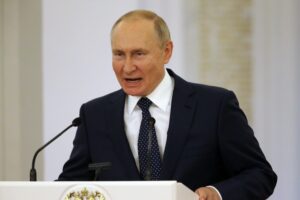
Yevgeny Prigozhin’s rebellion has exposed the fundamental instability of Putinism.
October 2020, Volume 31, Issue 4
The People’s Republic of China uses massive amounts of propaganda to influence how it is perceived beyond its borders. “Big data” reveal how that image is carefully and deliberately shaped for different audiences in different places.
July 1998, Volume 9, Issue 3
The early 1990s saw a wave of competitive multiparty elections in Africa. These contests can be described as "founding" elections in the sense that they marked for various countries a transition from an extended period of authoritarian rule to fledgling democratic government. By the middle of the 1990s, this wave had crested. Although founding elections…
January 1992, Volume 3, Issue 1
Reports on elections in Argentina, Bulgaria, Burkina Faso, Colombia, India, Kazakhstan, Mauritius, Poland, Tadzhikistan, Trinidad and Tobago, Turkey, Ukraine, Vanuatu, Zambia.
October 2010, Volume 21, Issue 4
Efforts to do comparative research on political attitudes have been complicated by varying understandings of “democracy.” The Afrobarometer is exploring new techniques to overcome this difficulty.
October 2004, Volume 15, Issue 4
Reports on elections in Indonesia, Lithuania, Mongolia, Philippines, and Serbia.

October 2025, Volume 36, Issue 4
Artificial intelligence and its effects on democracy are a matter of choice, not fate. The concerns are longer term than the recent spate of worry about “generative” AI would suggest. The democratic conversation about AI has hardly begun.
October 2014, Volume 25, Issue 4
Indonesia’s 2014 legislative elections went smoothly. Yet the “money politics” that featured so heavily in these contests suggests a grave need to reform the country’s electoral system.
October 2006, Volume 17, Issue 4
In reelecting President Alvaro Uribe by a landslide, Colombia's voters opted for continuity. But they chose continuity with an administration that has carried out a major series of policy innovations.
October 2008, Volume 19, Issue 4
"The Latin American Experience” argues that democratic stability requires policies that limit the society’s degree of substantive economic and social inequality.
January 2011, Volume 22, Issue 1
Striking the right balance between freedom and security is hard, especially in Latin America. Hybrid forces combining military and police elements may be the best means for meeting security challenges without imperiling freedom.