
Nationalism, Ethnic Conflict, and Democracy
"Presents thought-provoking notions of the ways in which we view both nationalism and democracy and provides some valuable ideas for working toward a more stable world."—Journal of International Affairs
3081 Results
"Presents thought-provoking notions of the ways in which we view both nationalism and democracy and provides some valuable ideas for working toward a more stable world."—Journal of International Affairs
This book addresses such broad issues as whether democracy promotes inequality, the socioeconomic factors that drive democratic failure, and the basic choices that societies must make as they decide how to deal with inequality.
In a special exchange appearing only on our website, distinguished scholars Amy C. Alexander and Christian Welzel; Pippa Norris; and Erik Voeten offer critiques of the July 2016 and January 2017 articles by Roberto Stefan Foa and Yascha Mounk. A reply from Foa and Mounk follows.
August 8, 2017
Deo Pondu Maheshe, director of the Centre d'Etudes et d'Encadrement pour la Participation au Developpement Endogene, comments on David Peterson's essay, "Burundi's Transition: A Beacon for Central Africa," which appeared in the January 2006 issue of the Journal of Democracy.
January 30, 2006
The April issue of the JoD is now available and has topped Democracy Lab's list of recommended reads this week.
April 16, 2013
In December 2024, South Korean president Yoon Suk Yeol declared martial law, shocking the world and plunging the country into political turmoil. As Joan Cho and Aram Hur argue in the new issue of the Journal of Democracy, the political chaos has revealed deep-seated divisions within South Korean society and politics.
The Atlantic online featured Larry Diamond's January 2012 Journal of Democracy article, "China and East Asian Democracy: The Coming Wave."
February 24, 2012
TheAtlantic.com is featuring a version of NED Democracy Award recipient Hkun Htun Oo's forthcoming JoD essay.
September 25, 2012
Should Ukraine end the war with Russia at the bargaining table or in the trenches? Can democratic institutions survive when they empower minorities over the majority? Is democracy better suited than authoritarianism to confront climate change? The new issue of the Journal of Democracy provides key insights and answers to some of today’s most pressing…
In a year marked by high political drama, economic unrest, and rising assaults on democracy, we at the Journal of Democracy sought to provide insight and analysis of the forces that imperil freedom. Here are our 10 most-read essays of 2021.
With such influential contributors as Francis Fukuyama, Robert Putnam, His Holiness the Dalai Lama, and Anwar Ibrahim, this is an indispensable resource for students of democracy and instructors at the undergraduate and graduate levels.
Although China has achieved extraordinary economic success without the CCP regime loosening its authoritarian grip, can the country continue its growth without political reform?
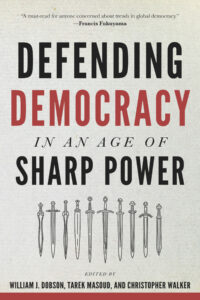
Explores how authoritarian regimes are deploying “sharp power” to undermine democracies from within by weaponizing universities, institutions, media, technology, and entertainment industries.
ForeignPolicy.com's Democracy Lab includes Abdou Filali-Ansary's essay "The Languages of the Arab Revolutions" among its recommended reads for the week.
April 24, 2012
Marc Plattner tackles this question in an interview with the Levada Center's Denis Volkov.
April 6, 2015