

January 2003, Volume 14, Issue 1
Afghanistan’s Long Road to Reconstruction
To forestall a worst-case scenario, the U.S. and the world must make a deeper commitment to peacekeeping and decentralized government.
3292 Results
January 2003, Volume 14, Issue 1
To forestall a worst-case scenario, the U.S. and the world must make a deeper commitment to peacekeeping and decentralized government.
January 2023, Volume 34, Issue 1
After long condemning gay rights, much of Europe’s political right now champions them. They have made welcoming gay voters a sign of modernity and openness—and a tool for stirring opposition to Muslim immigrants.
April 2021, Volume 32, Issue 2
With brutal resolve, the ruling party sought not merely to win an election, but to annihilate the opposition. Now, with President John Magufuli gone, that strategic rationale will likely only grow stronger.
April 2019, Volume 30, Issue 2
The Chinese Communist Party wields highly effective means to quash dissent, but Chinese intellectuals and interest groups continue to push for change.
July 2017, Volume 28, Issue 3
Read the full essay here. While the Constitution of India has not been amended after the rise of the Bharatiya Janata Party (BJP) to power in 2014, BJP-ruled states have passed laws which have reflected the Hindu-nationalist ideology of this party, including those known as “beef bans.” These laws and the activities of Hindu nationalist…
April 2007, Volume 18, Issue 2
By most theoretical accounts, Indian democracy should not even exist. Yet, despite serious challenges, it shows signs of enduring and even deepening.
April 2007, Volume 18, Issue 2
So far, economic liberalization and globalization have not served to undermine India's democracy. Indeed, they may even be strengthening it.
July 1998, Volume 9, Issue 3
Indians appear to love the practice of democracy so much that they are in danger of overdoing it. In February and March of 1998, the world's largest democracy held its twelfth general election since gaining its independence a half-century ago. The voting was largely fair and peaceful. New, right-of-center rulers led by the Bharatiya Janata…
April 2009, Volume 20, Issue 2
A fan of Mario Puzo’s Godfather novels will see the Putin government for what it is: a mafia.
January 2004, Volume 15, Issue 1
The fall of the Berlin Wall gave East Europeans a euphoric sense that they were about to give European democacy a new direction. But as many of their countries prepare to join the EU, little has worked out as expected in those heady days.
October 2015, Volume 26, Issue 4
A close look at secular parties in the Middle East today raises doubts about whether they are ready for prime time.
January 2019, Volume 30, Issue 1
Since their transitions, the democracies of the “third wave” have followed a range of trajectories beyond simple survival or breakdown. Many have stagnated at low levels of democracy and some have suffered democratic erosion, but there also have been cases of democratic deepening against the odds.
October 2008, Volume 19, Issue 4
After the ethnic violence that marred its 2007 presidential election, Kenya must reform its institutions to better represent its diverse polity.
October 2024, Volume 35, Issue 4
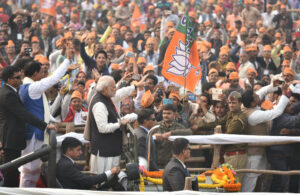
Majoritarian nationalism is a defining feature of our time. If we are to resist ethnonationalist leaders trying to recast our societies into imagined majorities, we must revise our conception of democracy and the exclusion inherent in majority rule.
July 2013, Volume 24, Issue 3
President Rafael Correa, now entering his third term, has built a curious form of populist-authoritarian regime. He champions redistributionism and a kind of technocratic leftism while assaulting the traditional left along with such mainstays of a liberal society as the freedom of the press.
October 2007, Volume 18, Issue 4
The populist backlash against corruption, the CEE transition-era elites, and the liberal consensus has led to a democratic crisis, but does not portend systemic change.

January 2020, Volume 31, Issue 1
Anticorruption has become universally accepted as a norm; that may tell us something about why it struggles in practice.
April 2003, Volume 14, Issue 2
The strains of economic reform have not increased support for antidemocratic populism in Latin America, but they have led to acute dissatisfaction with democratic governments.
January 2009, Volume 20, Issue 1
While the belief in democracy has spread around the world, it has begun to crumble in some of the West’s finest academic institutions.
July 2010, Volume 21, Issue 3
After almost ten years of complex and costly efforts to build democracy in these two countries, where do things stand? What lay behind the critical choices that shaped events in these places, and what are their current prospects for success?