3291 Results
🐬 Stromectol 6mg Uk ☑️ www.Ivermectin-OTC.com ☑️ Buy Ivermectin Over The Counter For Humans Uk 🌠 Ivermectin In Humans Canada . Ivermectin 3mg
April 2009, Volume 20, Issue 2
NATO at Sixty
The North Atlantic Treaty Organization played a key role in safeguarding Western democracy during the Cold War. With that conflict over, NATO must continually adapt and evolve in a fast-changing world.
October 2019, Volume 30, Issue 4
The Failure of Europe’s Mainstream Parties
Beyond the commonly cited economic and cultural anxieties afflicting many Europeans, a key factor enabling the rise of populism across Europe has been the failure of mainstream parties on both the left and the right to offer clear and credible policy alternatives.
October 2017, Volume 28, Issue 4
Iran’s 2017 Election: The Opposition Inches Forward
Despite all its flaws, Iran’s May 2017 presidential balloting amounted to another small but genuine advance for the cause of democracy.
July 2012, Volume 23, Issue 3
Senegal: What Will Turnover Bring?
Although Senegal has often been regarded as a democracy, its regime should more properly have been classified as competitive authoritarian. Will the 2012 election of a new president prove to be a turning point?
October 2007, Volume 18, Issue 4
Nigeria’s Muddled Elections
The failure of the elections has been partly mitigated by the hope of judicial review of electoral malfeasance, the stabilizing ingenuity of ethno-regional power-sharing, and renewed national discussions of electoral reforms.
April 2007, Volume 18, Issue 2
Venezuela: Crowding Out the Opposition
President Hugo Cháez's regime demonstrates how a public desire for change plus state resources can be exploited to undermine democracy.
April 2005, Volume 16, Issue 2
The Rise of “Muslim Democracy”
The incentives created by competitive elections in a number of Muslim-majority countries are fueling a political trend that roughly resembles the rise of Christian Democracy in twentieth-century Europe
Fall 1991, Volume 2, Issue 4
Election Watch
Reports on elections in Hong Kong, India, Kiribati, Mauritius, Mexico, and Singapore.
January 2004, Volume 15, Issue 1
Europe Moves Eastward: Challenges of EU Enlargement
As it prepares to go from 15 to 25 member states, the EU has improved the prospects for democracy in the East, but nothing about enlargement promises to resolve the vexing issue of democracy within the EU structure itself.
April 2016, Volume 27, Issue 2
Latin America’s New Turbulence: Crisis and Integrity in Brazil
Public anger at revelations of widespread corruption, along with the rising cost of coalition politics, has brought Brazilian president Dilma Rousseff to the brink of impeachment. Yet the crisis has also revealed the strength of the country’s law-enforcement and judicial institutions.
October 2025, Volume 36, Issue 4
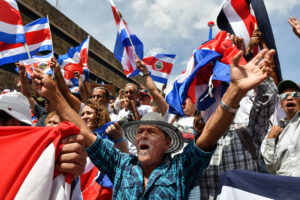
Is Costa Rica’s Democracy Failing?
Although an island of stability and democracy in a region often short of both, Costa Ricans’ faith in government is declining as the challenge of financing its costly welfare state grows. This democratic stalwart is no longer immune to the appeal of populism.
April 2007, Volume 18, Issue 2
Voting for Change in the DRC
The holding of competitive elections in this vast, strife-torn country must count as a significant achievement, even though voters signaled their disaffection with the entire array of political elites that had been ruling them.
July 2024, Volume 35, Issue 3
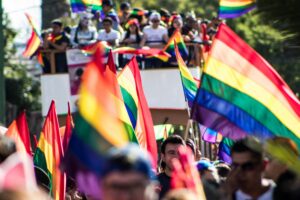
Is Democracy Bad for LGBT+ Rights?
LGBT+ rights are under threat across the globe. Populist leaders stirring fear and animosity for political gain understand how democratic institutions can be harnessed and manipulated to curtail these rights, not enshrine them.
July 2007, Volume 18, Issue 3
When Will the Chinese People Be Free?
Rising levels of wealth and schooling make it highly likely that China will be a "Partly Free" country by 2015 and a "Free" one ten years after that.
April 2015, Volume 26, Issue 2
Millennials and East Asia’s Democratic Future
East Asia’s millennials have grown up in an age of rapid socioeconomic progress, allowing them to become better educated, more urbanized, and more technologically connected than previous generations. Will they use their collective power to become agents of democratic change?
Why Have People Stopped Trusting Democracy?
Citizens have lost faith in democracy. Misinformation, disinformation, hyperpolarization, and conspiracies, exacerbated by the modern media environment, have heightened distrust and anger. The following Journal of Democracy essays explore these dynamics and the important role ordinary citizens can play in countering democratic erosion.
July 2004, Volume 15, Issue 3
South Africa After Apartheid: The First Decade
Over the ten years since its first nonracial elections in 1994, South Africa has seen its democratic order become more firmly institutionalized, even as the electoral dominance of the ANC has continued to grow.
April 2009, Volume 20, Issue 2
Reading Russia: Tools of Autocracy
Read the full essay here. Arguably a flawed democracy in the 1990s, Russia took a distinctly authoritarian turn under President Vladimir Putin from 2000 to 2008. The country now lives under a façade democracy that barely conceals the political and administrative dominance of a self-interested bureaucratic corporation. The regime manufactures consent by means of three…
July 2014, Volume 25, Issue 3
The Maidan and Beyond: Oligarchs, Corruption, and European Integration
Controlling corruption is a huge challenge for Ukraine, especially in the natural-gas industry. The steps needed are well understood, if only the political will to take them can be summoned.