
July 2003, Volume 14, Issue 3
Political Freedom, Economic Liberty, and Prosperity
Liberty and self-government are not only good in themselves, but also have powerful and beneficial effects on a nation’s level of economic development and prosperity.
3291 Results
July 2003, Volume 14, Issue 3
Liberty and self-government are not only good in themselves, but also have powerful and beneficial effects on a nation’s level of economic development and prosperity.
April 2004, Volume 15, Issue 2
Constitution writers in ethnically or otherwise divided countries should focus on designing a system of power-sharing rules and institutions. Studies by political scientists point to a set of basic recommendations that should form a starting point for constitutional negotiations.
January 2018, Volume 29, Issue 1
In July 2017, Timor-Leste held its third parliamentary elections since independence. The party-centered campaign featured both enduring legacies of the revolutionary struggle and a distinct form of political patronage.
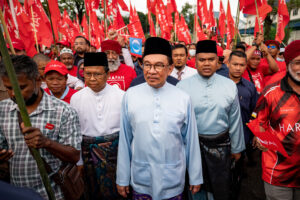
The democratic icon’s path to prime minister has been tortuous and long. But is Malaysia’s pluralism slipping away precisely when Anwar is getting his shot to lead the nation? | Sophie Lemière

January 2015, Volume 26, Issue 1
In contrast to the conventional wisdom that democracy is in retreat worldwide, the evidence tells a different story: The state of global democracy has been stable over the last decade and is actually better than it was in the 1990s.
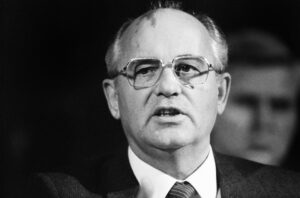
Mikhail Gorbachev risked everything. Neither Russia nor the West could live up to his vision. | By Lilia Shevtsova

July 2012, Volume 23, Issue 3
In Hungary’s 2010 general elections, Fidesz won 68 percent of the seats in parliament—allowing it to impose a wholly new constitutional order.
January 2013, Volume 24, Issue 1
How should we define the stages of democracy and their sequencing? Although some scholars argue that the rule of law should come first, today it should be viewed as the final piece of the liberal-democratic puzzle.
July 2010, Volume 21, Issue 3
Reports on elections in Colombia, Czech Republic, Dominican Republic, Hungary, Iraq, Mauritius, Philippines, Sri Lanka, Sudan, Suriname, Togo, and Trinidad and Tobago.
Can democratic institutions be turned to exclusionary ends? ~ Why has the ongoing refugee crisis transformed the politics of Central and Eastern European states—despite the fact that these countries host virtually no migrants? ~ And what do demographic and generational changes mean for the liberal consensus that emerged in the wake of communism’s fall? In this thought-provoking…
July 2019, Volume 30, Issue 3
Three decades after sub-Saharan Africa joined the “third wave,” democracy’s ability to endure has been established in many countries, but its quality remains a grave concern.
July 2016, Volume 27, Issue 3
There is strong empirical evidence to support the correlation between effective term limits and the quality of democracy.

October 2025, Volume 36, Issue 4
Artificial intelligence and its effects on democracy are a matter of choice, not fate. The concerns are longer term than the recent spate of worry about “generative” AI would suggest. The democratic conversation about AI has hardly begun.
January 2011, Volume 22, Issue 1
Why are peacebuilding operations rarely able to establish postconflict democracies, and are there other strategies that would yield more successes?
January 2016, Volume 27, Issue 1
Much can be done to uproot graft when a major event such as the Rose Revolution sweeps in a determined new team on a wave of massive public support.
July 2003, Volume 14, Issue 3
Gauging electoral competitiveness relative to economic development reveals not only that Arab countries “underperform” but, strikingly, that non-Arab Muslim-majority countries tend to “overperform.”
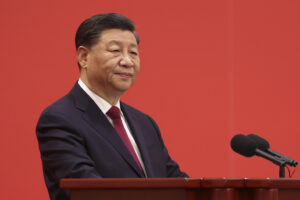
April 2018, Volume 29, Issue 2
After Mao, Deng Xiaoping tried to institutionalize collective leadership, but this did not stop Xi Jinping from grasping all the levers of power.
April 2009, Volume 20, Issue 2
Although 2008 was marked by democratic setbacks as well as authoritarian “pushback” against reformers, democracy remains the only system of government that commands global respect.
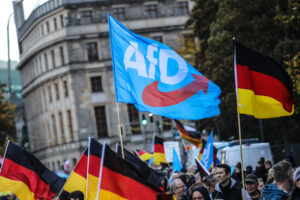
For years, they were a fringe vote. Now they are broadening their agenda, tapping into voter frustration, and getting Germans to favor them once again. | Michael Bröning
January 2021, Volume 32, Issue 1
Around the world, polarizing political strategies are pushing societies into a vicious cycle of zero-sum politics and eroding democratic norms. If democracies are to escape this trap, wise choices and innovation by prodemocratic politicians will be needed.