
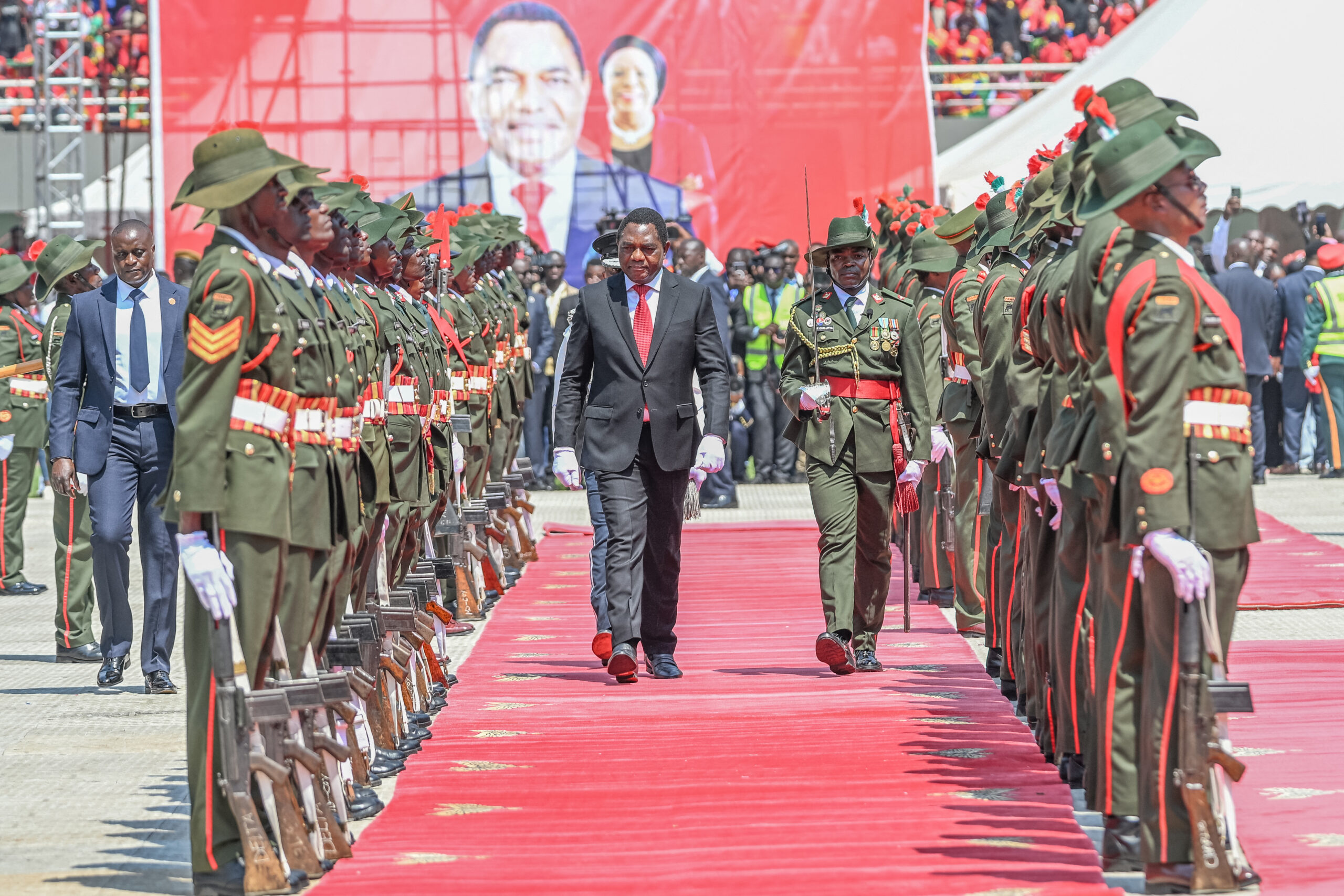
Hakainde Hichilema came to power five years ago promising to restore Zambia’s democracy. But his government now commits the very abuses he once railed against.
September 2026
Nine years ago, Hakainde Hichilema, then an opposition leader, was detained on a treason charge. Now his main opponent faces similar accusations. On 29 August 2026, authorities formally charged Brian Mundubile, the opposition candidate who finished second in Zambia’s August 13 presidential election, and his running mate, Makebi Zulu, with treason. In total, eighteen opposition leaders have been charged. The specific facts underlying the case against Mundubile and others have not yet been disclosed.
This charge is not isolated. On August 14, the day after the election, authorities raided an opposition-linked property in Kabulonga, arresting several opposition leaders and fatally shooting Mutotwe Kafwaya, a former cabinet minister. The circumstances of Kafwaya’s death remain unclear. Authorities allege that those targeted had been plotting an insurrection plot and that military-grade weapons had been discovered during the raid. Opposition figures dispute these claims.
Subsequently, Mundubile announced his intention to petition the presidential result. Under Zambia’s constitution, he had seven days after the declaration to file. On August 24, the final day, Zambia’s highest courts, including the Constitutional Court, were closed by authorities. A memorandum from the judiciary’s chief administrator cited unspecified security concerns. The gates to the court complex were shut, and heavily armed police and military personnel cordoned off the area.
The next day, the Cabinet Office announced President Hichilema’s September 1 swearing-in, stating that the petition period had expired without a challenge being received by the judiciary. The courts subsequently acknowledged that Chief Justice Mumba Malila had received an emailed copy of a presidential petition and referred it to the Constitutional Court to determine its validity. Yet a day later, the judiciary reversed its position, declaring there was “no Presidential Petition before the Constitutional Court.”
There is no need to claim that Hichilema personally instructed the judiciary to close its doors. The State House has denied that he ordered the closure. The deeper problem is structural. In a functioning constitutional democracy, it should be almost unthinkable for the court charged with adjudicating a presidential-election dispute to become physically inaccessible precisely as the deadline for challenging that election expires.
Taken individually, each of these developments invites a qualification. Perhaps the security allegations will prove compelling. Perhaps the court closure stemmed from a genuine threat. Perhaps Kafwaya’s death will turn out to have taken place under circumstances that authorities can lawfully explain. The case for Hichilema’s authoritarian turn does not depend on handling any of those questions prematurely.
Instead, it rests on a more disturbing fact. That is, each episode has landed on top of an already substantial record of restricting political competition, chilling dissent, expanding surveillance powers, interfering with democratic institutions, and weakening democratic checks in a country already classified as “hybrid authoritarian” by the Human Rights Foundation’s Tyranny Tracker. The accumulation of authoritarian practices is concerning not because it reveals a new Hichilema, but because it aligns with the political order his regime has been building.
Aspects of the 2026 election, including the campaign environment, the election itself, and the postelection crackdown, have further highlighted the compounding catalogue that now defines Hichilema’s authoritarian turn.
A Tainted Election
A serious assessment of Zambia’s 2026 election requires resisting two temptations: the regime’s inclination to treat an official victory as proof of a clean process, and the opposition’s tendency to view evidence of manipulation as proof that Mundubile actually won.
The available evidence supports neither conclusion.
The Electoral Commission of Zambia declared Hichilema victorious with 2,965,326 votes (60.5 percent) against Mundubile’s 1,856,217 votes (37.9 percent). However, strong independent evidence suggests Hichilema’s official total was inflated. The Christian Churches Monitoring Group (CCMG), using data from 1,500 polling stations, found the 2026 election was tarnished by inflated vote counts in thirty constituencies, artificially raising turnout, and undermining voting integrity. Importantly, the CCMG also concluded that Hichilema still received the most votes and surpassed 50 percent. This distinction is essential.
These irregularities are more concerning when considered alongside events during the vote tabulation. On August 14, the Electoral Commission of Zambia (ECZ) abruptly suspended the counting and the announcement of results nationwide for six hours, citing violence against election staff and alleged ballot-box theft. The ECZ provided little detail about the incidents or their scope. Before the suspension, EU observers rated tabulation “very good” in 43 percent of observations; after the suspension, this fell to 27 percent, with 12 percent of centers rated as “bad” or “very bad.”
There were also violent disruptions. An armed group attacked the Makeni tallying center in Lusaka and seized nearly all its polling-station result forms. In Kabwe, a politically competitive district, alleged cadres of Hichilema’s United Party for National Development (UPND) raided two of the city’s three tallying centers, fundamentally disrupting tabulation. Meanwhile, the ECZ declined to publish disaggregated polling-station results, depriving parties, observers, and citizens of the most direct means to independently audit the national totals.
However, none of this proves that the six-hour suspension was intended to facilitate manipulation, nor does it overturn the CCMG’s findings that Hichilema genuinely crossed the constitutional threshold for victory. What it does establish is that the official 60.5 percent cannot be considered beyond question. This matters because it affects the allocation of the forty reserved National Assembly seats distributed through proportional representation.
Therefore, an honest assessment of the election is inconvenient for both sides. Winning an election is not the same as administering it fairly, and a legitimate majority does not justify an inflated tally.
An Election Fought on Unequal Ground
Focusing solely on postelection numbers can obscure preelection conditions. The key question is whether all candidates had a reasonably fair opportunity to compete. By that standard, Zambia’s 2026 general election was significantly distorted.
EU observers described the contest as competitive but conducted on an “uneven playing field” shaped by significant incumbency advantages. A notable change was the campaign timetable for presidential candidates, which in principle aimed to reduce clashes but in practice applied only to the opposition, excluding the president and vice-president. Other candidates were limited to a five-day campaign period in each province. Nine candidates found their own events being blocked, canceled, or suspended by police due to unscheduled visits by Hichilema or his vice-president, sometimes resulting in lost campaign opportunities.
The imbalance extended beyond time and movement to include misuse of state resources at campaign events in eight provinces. Government platforms were used to promote UPND messaging. Hichilema announced the recruitment of health workers at rallies and, on several occasions, stated that volunteer nurses and teachers present would be employed, instructing local officials to record their names. Observers found evidence of voter inducement in about a third of monitored campaign events across nine provinces, mainly involving the UPND, including direct cash handouts.
The media imbalance was even more pronounced. Between July 15 and August 12, EU observers found that UPND received 96.2 percent of election-related news airtime on ZNBC TV1 and 90.5 percent on ZNBC Radio 1. Mundubile received only 0.1 percent on television and 1.1 percent on radio. Hichilema accounted for 98.3 percent of direct speech on ZNBC TV1 news and 98.4 percent on Radio 1. Mundubile received no direct-speech time on either. The state-owned Zambia Daily Mail devoted 90.7 percent of its election-related news to the president and 5 percent to Mundubile.
Law enforcement further deepened the asymmetry. Opposition members were targeted, and police intervention was disproportionate. In one incident, observers witnessed a person being seized by armed personnel shortly before the polling. Preelection litigation and excessive prosecutorial power, combined with limited judicial oversight, demonstrated how prosecutorial authority influenced candidacy decisions. For example, the presidential candidate Xavier Chungu was detained and ultimately forced to withdraw.
These concerns and statistics do not reflect an even contest. They unfortunately describe an election in which the incumbent remained free to move through the country wearing, as circumstances required, either the hat of president or the colors of candidate. At the same time, opponents operated inside a far narrower administrative corridor.
Opposition activity was not impossible. Mundubile held rallies, private media covered the opposition, fourteen presidential candidates were nominated, and voters had a real and competitive choice. Notably, the mainstream opposition’s performance was remarkable, given that Mundubile ran under a party that had barely existed three months before the election.
The point is that authoritarians need not eliminate elections. They can hold the vote while manipulating their institutional advantages — that is, more airtime for the incumbent, unrestricted campaigning, access to public resources, legal vulnerability for critics, administrative obstacles for challengers, and selective enforcement of ostensibly neutral rules. By August 2026, Zambia had accumulated too many of these traits to dismiss them as isolated disputes.
The Backsliding Before the Election
It may be tempting to explain the unequal campaign and postelection arrests as an election-season aberration. That would be a mistake. They arose from a democratic deterioration already well underway.
That deterioration is especially striking because Hichilema’s presidency did not begin this way. His 2021 victory ended an era in which Edgar Lungu’s regime had become associated with restrictions on opposition rallies, attacks on independent media, and politically charged arrests that included Hichilema’s own treason detention. Once in office, Hichilema delivered significant reforms. His administration abolished the death penalty and repealed the offense of criminal defamation of the president, and later enacted the long-awaited access-to-information legislation. These were important gains.
But his subsequent reversal was consequential. The clearest expression of this came in April 2025 with the Cyber Security Act and Cyber Crimes Act. The Cyber Security Act expanded the regime’s interception architecture, while the Cyber Crimes Act established broadly worded offenses capable of stifling forms of online expression. Watchdogs warned that the legislation contained overbroad surveillance and speech provisions. The Law Association of Zambia subsequently challenged parts of the Cyber Crimes Act as unconstitutional, arguing that they would infringe on freedoms of expression, conscience, association and the media.
By the 2026 campaign, this was no longer hypothetical. Election observers noted that online freedom of expression was being “unduly curtailed,” with arrests for speech offenses coming predominantly from criticism of the president, while police and military warnings against supposedly unlawful online posts encouraged growing self-censorship. The arrest of Zambia National Broadcasting Corporation (ZNBC) journalist MacPherson Mukuka in July over allegations of recording a private conversation among Hichilema campaign members and posting it on social media, and the arrest of Socialist Party leader Fred M’membe in March 2026 for criticizing Hichilema’s handling of Lungu’s burial.
Ahead of the 2026 vote, authorities increasingly used the restrictive, colonial-era Public Order Act to stop and disrupt opposition rallies and peaceful protests. The problem had been visible earlier. In 2024, the inspector-general of police drew criticism after saying opposition rallies would not be allowed. That same year, police blocked an opposition rally in Kafue, forcing organizers to address supporters virtually instead, and police disrupted a meeting between Lungu and Kabwe’s Catholic bishop on grounds that the gathering was unlawful.
By August 2026, these could no longer be considered unrelated human-rights cases. The preelection assessment showed a growing pattern of authoritarian practices, including an intensified crackdown on peaceful assembly, association, expression, and media freedom through vague and repressive laws.
Weakening Democratic Checks
The same pattern is visible in the institutions meant to limit executive power. Consider the Constitutional Court. In September 2024, Hichilema suspended three of its judges just 48 hours before they were due to participate in a politically consequential case concerning Lungu’s eligibility to contest the 2026 election. The judges had also been members of the court that rejected Hichilema’s challenge to Lungu’s disputed 2016 election victory. They were subsequently fired in October. The Law Association of Zambia warned of the implications of these acts for constitutionally protected judicial independence. In December 2024, the Court deemed Lungu constitutionally ineligible to seek the presidency again, holding that his 2015–16 period in office counted toward the two-term limit and that, together with his 2016–21 tenure, he had twice been elected and twice held office.
This was followed by the heavily criticized and polarizing Constitution of Zambia (Amendment) Bill No. 7 of 2025. Bill 7, as it is known, proposed substantial changes to the architecture of political representation, including increasing constituency seats from 156 to 211, introducing a mixed-member proportional system, changing nominated seats, and revising election and by-election rules. The Constitutional Court intervened in June 2025, after which the legislative process was deferred, and a broader consultation exercise was undertaken through a presidentially appointed technical committee.
By the time Zambia voted, the National Assembly’s electoral structure had been transformed. There were 226 first-past-the-post constituencies and forty reserved proportional-representation seats linked to the national presidential vote. The president could nominate up to eleven MPs, and seventy new constituencies had been created. Beyond the lack of transparency and the marginal improvement in vote quality, the process was enacted extraordinarily close to polling. Contrary to international and regional best practice on making substantive electoral changes so near a vote, parliament approved the amended electoral law in its final days before dissolution, with Hichilema assenting to it on 15 May 2026, just three months before the election.
The Electoral Commission itself reveals a longer-standing structural vulnerability. The president appoints its five commissioners, subject to National Assembly ratification. The ECZ’s independence was already in question heading into the vote. Its chairperson, Mwangala Zaloumis, appointed by Hichilema in 2022, had previously served as his personal lawyer. Again, the argument should not outrun the evidence. Presidential appointment does not prove ECZ capture.
However, institutions must be judged cumulatively too, and taken together, the pattern is difficult to ignore. A president appoints the electoral commission; constitutional rules are substantially redesigned on an incumbent-led timetable close to an election; judges in a politically consequential eligibility case are suspended and later removed; opposition access to campaigning is constrained; state media overwhelmingly favor the incumbent; tabulation is interrupted and later deteriorates; independent monitors identify added votes; the election commission withholds polling-station-level results; the courts close when the losing candidate is expected to petition; and that candidate is subsequently arrested and charged with treason. At some point, treating each episode as institutionally unrelated becomes less plausible than recognizing the pattern they collectively form.
The Compounding Catalog
No single item in Hichilema’s record is sufficient to describe his presidency as fully authoritarian: not the cyber laws on their own; not the arrests of journalists; not the restrictions on rallies; not the extraordinary imbalance in state-media coverage; not the removal of Constitutional Court judges; not the contentious constitutional reform; not the electoral-law changes passed three months before voting; not the six-hour interruption of tabulation; not the thirty constituencies in which an independent monitor found evidence that votes had been added; not the refusal to publish polling-station-level results; not the fatal shooting of an opposition figure in circumstances still demanding independent investigation; not the closure of the Constitutional Court as the presidential-petition deadline expired; Not even, by itself, the treason prosecution of the main opposition candidate.
It is the accumulation that makes the case.
Indeed, the temptation to ask whether Zambia has “become a dictatorship” misses the more useful question. Zambia remains politically competitive. Opposition parties exist. Private media continue to operate. Civil society organizations carried out sophisticated election monitoring. International observers were present across the country. Polling-station voting and counting were, in many places, transparent. And the best independent statistical evidence indicates that Hichilema probably did win the 2026 presidential election.
But democracies do not cease to be democracies only when the last opposition party is banned, and the last newspaper is closed. Contemporary authoritarian turns are often more incremental. The ballot remains, but the field around it tilts. Opposition survives, but its operating space narrows. Courts remain open until, on one particularly consequential day, they are not. Journalists still publish, but they know that a cybercrime investigation may follow. Rallies remain legal, but police and campaign timetables determine whether they can actually occur. Electoral commissions continue to count votes, but citizens are denied the disaggregated figures necessary to verify the results. Judges continue to sit, but politically sensitive changes to the bench raise doubts about where judicial autonomy ends and presidential influence begins.
This is why the most consequential development in Zambia under Hichilema has not been the creation of one spectacular instrument of dictatorship but the gradual assembly of a catalog of control.
The irony is difficult to escape. Many of the instruments now producing anxiety are variations of instruments once deployed against Hichilema himself. Under Lungu, opposition rallies were constrained through public-order law, state media favored the incumbent, critics faced arrest, and Hichilema himself spent months incarcerated under a treason prosecution.
Hichilema came to power because Zambians rejected that model of politics. His victory in 2021 was therefore more than an alternation of governing parties. It carried the promise that the coercive architecture of the old order would finally be dismantled.
Five years later, Brian Mundubile is in detention on a treason charge. Consequently, the great danger for Hichilema is not that history will judge him identical to Lungu. Political histories are rarely so neat. It is that his presidency may be remembered as the one that demonstrated how quickly yesterday’s instruments of persecution can become today’s instruments of government once the victim acquires the state.
That is the greater significance of Zambia’s accumulating record. The democratic deterioration has not occurred through one decisive rupture. It has been assembled piece by piece: a law, an arrest, a canceled meeting, an imbalanced broadcaster, a suspended judge, a redesigned electoral rule, an opaque tally, a closed court, another arrest. Each addition can be explained away in isolation. It is getting harder to explain away the truth.
Wiriranai Brilliant Masara, Ph.D., is a research fellow with the Human Rights Foundation.
Copyright © 2026 JoD Productions Inc
Image Credit: Noel SICHALWE / AFP via Getty Images
|
FURTHER READING |
||
How Oppositions Turn Authoritarian |
How Zambia’s Cyber Laws Rebrand Repression |
How Zambia’s Opposition WonHalting a decade of democratic backsliding, Haikainde Hichilema defeated an increasingly iron-fisted incumbent president. How did he do it and can others learn from his example? |