
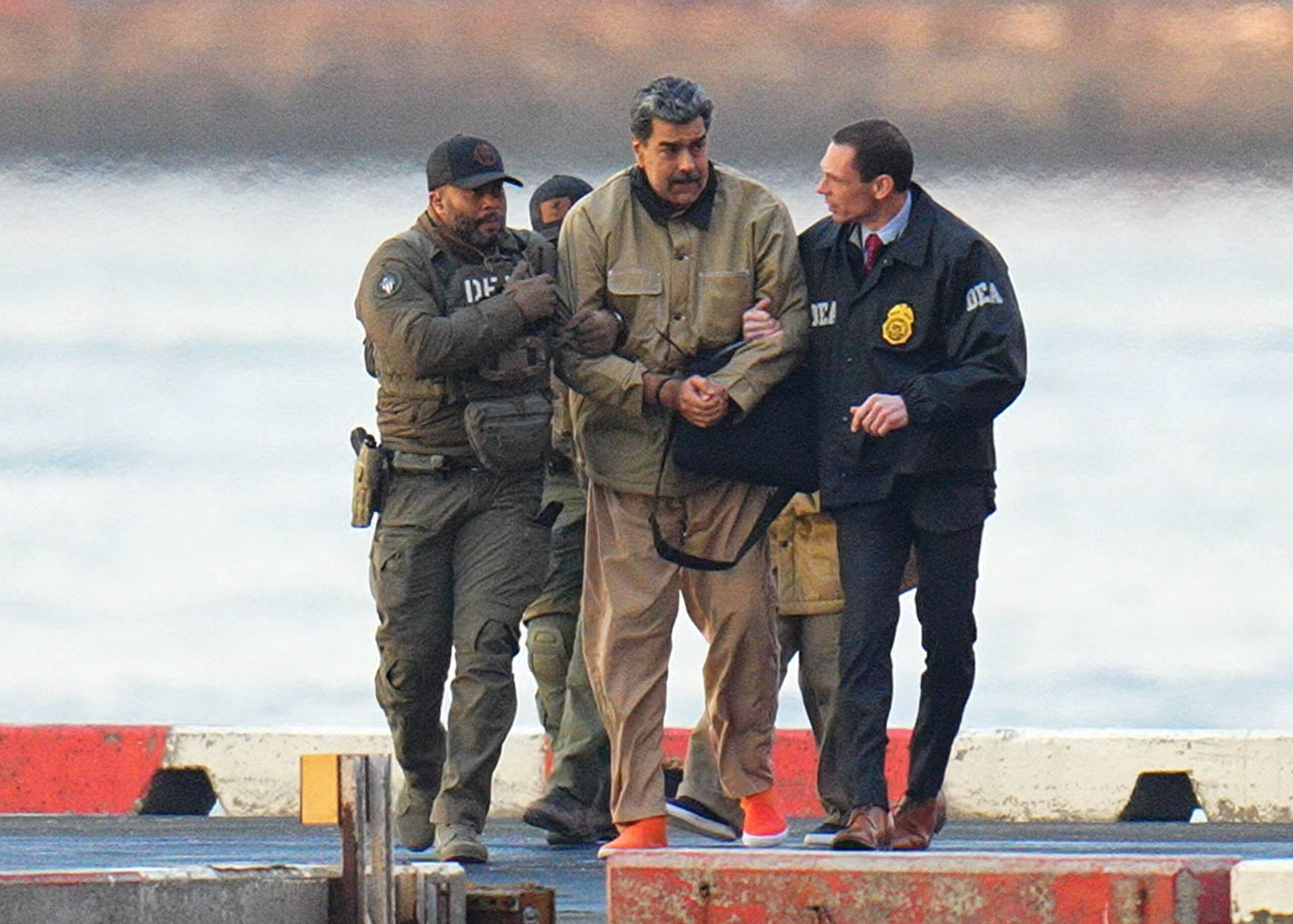
Nicolás Maduro has been removed, but the dictatorship he led remains. If this period of American tutelage drags too long, it will be a recipe for disaster for Venezuela and the United States.
January 2026
Leer en español aquí.
Venezuela’s current political moment is a paradox of tutelage: a partial rupture with authoritarian rule that has not translated into democratic control. The removal of Nicolás Maduro marks the end of a long and suffocating autocratic cycle centered on a single ruler. Yet, the way in which that rupture has occurred—through external intervention and in coordination with remnants of the old regime—has produced a political landscape that is at once post-Maduro and still undemocratic. Liberation has begun, but it remains partial, contested, and insufficient to restore Venezuelan self-government.
The regime of Chavismo or “Bolivarian socialism” has not been destroyed but merely decapitated: Its head has been removed while its body remains largely intact. The U.S. military operation whisked away the dictator but did not dismantle the dictatorship. Instead, it seems that democratic forces may be marginalized amid a tight focus on stability, strategic necessity, and economic reconstruction (meaning especially the resuscitation of the oil industry). The “solution” that appears to be in the making and to have the backing of coercive power is the exercise of a U.S. tutelage over Venezuela that will seek to exert an occupier’s sway, that will be justified by appeals to pragmatism, and that will shift concerns about democracy to the back burner.
The situation is fluid, and some of what I write may be overtaken by events. Democratic strategizing, however, dare not wait for certainty. In moments of rupture and possibility, the best that political analysis can do is to point out principles that should be defended and limits that should be respected before it is too late.
In the early hours of 3 January 2026, Venezuela entered one of the most consequential and unsettling moments in its history. Military and law-enforcement personnel of the United States captured Nicolás Maduro and his wife and extracted them from Venezuelan territory. They were flown to a warship and then transferred to New York City, there to face trial on charges listed in a federal grand jury indictment. The operation was impeccable in its execution, under the logic of the Responsibility to Protect—understood in public international law as an exceptional justification for action aimed at ending large-scale criminal rule. It encountered some desperate resistance (55 Cuban and Venezuelan troops died trying to defend the Maduros) but none that was effective. And it unfolded with a precision that left little doubt about the Venezuelan state’s military incapacity. Whatever coercive power the regime claimed domestically, it proved unable to deter—or even meaningfully contest—a decisive external intervention. There was not chaos.
In isolation, Maduro’s removal might have appeared to mark the long-awaited collapse of one of the Western Hemisphere’s most entrenched autocracies. Yet from its very first hours, the political aftermath of the operation complicated—indeed, distorted—any straightforward storyline featuring democratic liberation.
After Maduro’s extraction, the sequence of events went as follows:
President Donald Trump told the press on live television that the United States would “run” Venezuela and publicly praised Acting President (formerly Vice-President) Delcy Rodríguez—with whom Secretary of State Marco Rubio had spoken by phone—as a pragmatic and cooperative interlocutor who would be “willing to do what we think is necessary to make Venezuela great again.” He virtually imposed her—a longtime Chavista official and at least nominally the regime’s number two—as the face of change. At the same time, he treated Venezuela’s opposition leader and Nobel Peace Prize laureate María Corina Machado with disregard.
This contrast was neither incidental nor merely rhetorical. Machado is not only the undisputed leader of Venezuela’s democratic opposition; she is the political figure who commands the broadest and most consistent popular support inside the country. Although Maduro had barred her from running and a colleague won in her stead, she embodies the democratic mandate expressed in the 28 July 2024 election whose result Maduro denied. Trump’s initial posture thus produced a striking inversion of democratic legitimacy: Autocratic “regime holdovers” were elevated as governing partners, while legitimate democratic leadership was pushed to the margins.
The moral and political implications of this inversion, if its stands, are profound. Rodríguez’s elevation rests on the cynical premise that her familiarity with the oil sector and her presumed capacity to exercise control over Venezuela’s fractured state apparatus are sufficient to justify entrusting her with power. This reasoning mistakes managerial convenience for political legitimacy. Knowledge of the oil business (Rodríguez has been petroleum minister), or even the ability to impose order, cannot justify cutting off Venezuelans—and the legitimate opposition—from democratic liberation and democratization. Administrative efficiency cannot take the place of sovereignty.
Shortly after President Trump endorsed her leadership, Rodríguez (who had become vice-president in 2018 by Maduro’s appointment, as is the practice in Venezuela) publicly declared that Nicolás Maduro had been “kidnapped,” demanded his “immediate release,” and insisted that he remained the only legitimate president of Venezuela.
Trump in his original press conference had already said that Rodríguez “really doesn’t have a choice” about cooperating with U.S. plans. Now, a day later, he made an explicit threat, warning that if Rodríguez “doesn’t do what’s right, she is going to pay a very big price, probably bigger than Maduro.” He was candid about the coercive logic behind the new arrangement: Authority to govern would flow not from popular sovereignty or constitutional consensus, but from external enforcement backed by threats of punishment.
Rodríguez then responded in a tone that contrasted strikingly with her defiant “kidnapping” speech of just a day prior, writing in English on Instagram: “We invite the U.S. government to collaborate with us on an agenda of cooperation oriented towards shared development within the framework of international law to strengthen lasting community coexistence.”
On January 6, Trump wrote on social media that the “Interim Authorities” in Venezuela would be handing over thirty- to fifty-million barrels of U.S.-sanctioned oil to be sold at market prices, with proceeds that Trump would administer to benefit the people of Venezuela and the United States. The People’s Republic of China had been the biggest buyer of Venezuelan oil, which is pumped at a volume about a quarter of what it was before Hugo Chávez rose to power in 1998 and began hollowing out PDVSA (the state oil company) to pay for his “Bolivarian socialist” schemes and give no-show jobs to his political followers, but that is going to change.
The four U.S. demands that Trump reportedly put to Rodríguez are to: 1) stop allowing drug flows across Venezuelan territory, 2) expel all agents of hostile powers such as Cuba and Iran; 3) cease the sale of sanctioned oil to U.S. adversaries; and 4) eventually hold free elections and be ready to step aside based on their results.
It is worth pausing to note that during all this, Venezuela’s supreme court issued a written ruling authorizing Rodríguez to become acting president. This gesture of institutional continuity requires scrutiny. The Tribunal itself is a fully subordinated organ of the dictatorship, long stripped of independence and repurposed as a tool of political control. Rodríguez, moreover, is not a legitimate vice-president of the Republic, but a purported officeholder designated by an illegitimate ruler who stole the results of the 2024 election and thereby kidnapped popular sovereignty. She does not wield authority rooted in a constitutional mandate or genuine democratic consent, but is the appointee of an autocratic system that severed legality from legitimacy years ago.
These early developments clarified the nature of Venezuela’s post-Maduro moment. What had begun was not a Venezuelan-led democratic transition supported by international partners, but an externally supervised interim order—a form of tutelage—exercised in coordination with elements of the old authoritarian apparatus, and justified first in terms of oil supplies and regional security. Democratic forces were neither incorporated into decisionmaking nor recognized as legitimate political counterparties.
This reality presents Venezuela’s democratic opposition with a historic dilemma. Maduro’s removal may mark the opening of a path toward democratic liberation, but currently the opening is merely partial and subject to external management. It risks leading not to democracy, but to a new and more cynical form of autocratization in which autocrats hang on by acting as stewards of outside economic and strategic interests.
The Chavista elite will no longer be permitted to let China, Cuba, Russia, Hezbollah and its sponsor Iran, or drug cartels use Venezuela and its state as a nexus. But will the Chavistas, assuming they stay within Trump administration redlines, allow free democratic competition for power? That is the final item on the U.S. list of demands (as relayed to the press by unnamed “U.S. officials”) but it comes with no hard deadline, and the opposition is being kept at arm’s length. Maduro is gone, but will the corrupt regime that sustained him be dismantled?
Into the Unknown
Venezuela’s present moment does not fit the model of democratic transition made familiar by the third wave. It is neither a negotiated pact between authoritarian incumbents and democratic challengers, nor a clean electoral alternation, nor a revolutionary rupture. It is instead a unique conjuncture produced by the intersection of extreme autocratic entrenchment, external intervention, institutional collapse, and the displacement—rather than the empowerment—of democratic initiative.
What Venezuela is experiencing is not a postliberation order, but a partial liberation. Maduro has been removed, but the regime has not been defeated. This incomplete rupture sustains an expectation of further liberation—one that could still give rise to democratic inauguration and, eventually, consolidation, if and only if the authoritarian apparatus as a whole is dismantled.
For more than a decade, Venezuela evolved from competitive authoritarianism into a closed and resilient autocracy. This evolution was not accidental. It was driven by deliberate strategies of institutional hollowing, gangsterized governance, and selective repression. Formal institutions were preserved but repurposed. Courts became tools for imposing political discipline. Electoral authorities supported not competition but exclusion. Public administration enforced dependence rather than neutrality. Law did not disappear; it was weaponized.
Over time, the regime consolidated what can only be described as a gangster state. Illicit economies, organized crime, and political power fused into a single system of mutual protection. Security forces, intelligence agencies, and judicial bodies were integrated into networks of rent extraction and coercive control. This fusion fundamentally alters the logic of transition. The challenge is no longer limited to reopening political competition, but extends to dismantling entrenched systems of coercion and illegality without precipitating further collapse.
Repression in Venezuela took on a structural quality. Arbitrary detention, enforced disappearance, torture, and targeted persecution ceased to be exceptional responses to crisis and became routine instruments of governance. Fear was institutionalized. Social trust eroded.
Political expectations dropped. These dynamics produced not merely political apathy, but adaptive survival strategies that complicate the task of mobilizing for democracy to take advantage of the authoritarian regime’s decapitation.
Before her elevation to de facto president, the 56-year-old Rodríguez in her long career as a Chavista apparatchik oversaw the Bolivarian National Intelligence Service, the General Directorate of Military Counterintelligence, the Bolivarian National Police, the Special Action Forces, and the Territorial Defense System. These bodies have all been identified by the United Nations Fact-Finding Mission as perpetrators of human-rights violations. Rodríguez has for years been under sanctions imposed by Canada, the European Union, Mexico, and the United States for her major role in the excesses of the “Bolivarian socialist” regime founded by Hugo Chávez and overseen since his death in 2013 by his handpicked successor, Nicolás Maduro.
The presence of transnational criminal and terrorist networks further complicates the picture. Sovereignty under Maduro was not exercised as a public responsibility but traded as a transactional asset. Hezbollah as well as leftwing guerrilla groups from Colombia embedded themselves in Venezuela with the help of the Chavista state, bringing flows of illicit money and cross-border criminal economies. Isla Margarita has gone from being a tourist draw to being a hub for drug trafficking and a base for Hezbollah. Private armed groups are potential veto players. If left alone, they could spoil any transition that they deem a threat to their interests, whatever the formal political arrangements might be.
External alliances compounded these internal dynamics. Authoritarian powers provided security and intelligence help, diplomatic cover, and financial aid. Venezuela became integrated into a broader authoritarian ecosystem resistant to democratic norms. Any transition must therefore navigate not only domestic resistance but also a contested geopolitical environment in which democracy is no longer the default aspiration.
The addition of external tutelage to this already complex configuration produces something qualitatively new. Venezuela is no longer simply an entrenched autocracy confronting democratic challenge. It is an entrenched autocracy partly displaced by foreign power, without democratic forces controlling the process. This is not mere uncertainty about outcomes. It is a state of things scarcely dreamt of in existing theories about democratic transition.
At the core of this difficulty lies the nature of the state that a transition would be moving away from. Classical transition theory presupposes states which, while authoritarian, retain a modicum of institutional coherence and a functional monopoly on coercion. Venezuela does not meet this baseline. The gangster state is not merely authoritarian; it is organizationally fragmented, economically criminalized, and normatively hollowed out. Authority is dispersed across formal and informal actors whose interests are aligned not merely with political survival, but with the preservation of illicit rents and impunity.
This distinction matters. In such contexts, regime collapse does not automatically generate a democratic opening. It generates a vacuum. And politics, like nature, abhors a vacuum. Groups and people keen not on ideas but on survival, profit, and power will strive to fill them. The presence of external tutelage in this vacuum does not solve but only reshapes the problem. Power is not reconstructed along liberal-democratic lines, but only displaced.
What is happening in Venezuela is not—or at least not yet—a transition from authoritarianism to democracy. At this point, it is a struggle over who will assert sway in the postauthoritarian void. Democratic forces enter this struggle with built-in disadvantages. They lack coercive leverage or control over resources. They are committed to norms that their adversaries do not share. To impose tutelage, rather than level the playing field, is to risk locking these democracy-unfriendly asymmetries into place. This is not a situation that Venezuelans will want, and the United States should not want it either: The changes that Washington wants—malign foreign state and nonstate actors out, the huge investments needed to revive the vital oil industry in—can only be made lasting and secure if the free consent of the Venezuelan people is given. Democracy is not a luxury here; it is a necessity.
Can democratic theory help? It lacks any robust account of transitions from gangsterized states under external supervision. Neither postconflict reconstruction nor classic democratization frameworks fully apply. What emerges instead is a hybrid condition in which sovereignty is fragmented, legality is not reestablished, and democratic initiative remains contingent. This is “the unknown.”
Recognizing the transition as unknown has practical implications. It cautions against institutional audacity and political impatience. Where autocracy has reached this level of entrenchment, the primary democratic task is not reinvention, but reconstruction—of authority, legality, and minimal trust. Prudence, in this context, is not timidity. It is a requirement imposed by reality.
The Democratic Opposition’s Strategic Pillars
Under conditions of partial liberation and external supervision, the role of Venezuela’s democratic opposition becomes decisive. The opposition must confront a process that presents itself as stabilizing and temporary, yet excludes democratic participation and risks entrenching a new form of domination. The democratic goal is not merely the removal of a dictator, but the defeat of the dictatorship. The main challenges are to push forward the dictatorship’s dismantling and to create as quickly as possible the political and institutional conditions that promote democracy’s restoration.
It is crucial to take down the authoritarian apparatus that sustained Maduro—its control over coercion, institutions, resources, and impunity. This apparatus cannot be trusted, and its continuing presence will threaten to turn elections into procedural gestures rather than acts of sovereignty. The opening for a transition cannot be allowed to collapse into a managed continuity honeycombed with corrupt Chavista holdovers.
Democracy backers should choose conditional engagement, not withdrawal or acquiescence. The method is to interact with powerholders while preserving democratic voice, political authorship, and the capacity to impose limits.
Five strategic pillars will support this posture.
The first pillar is the 1999 Constitution. Restoring the rule of law matters. The Constitution is the only legitimate framework capable of anchoring authority during a period of partial liberation. It reestablishes legality after prolonged arbitrariness, puts boundaries on power, and provides the normative basis of popular sovereignty. No transition can claim democratic legitimacy if constitutional order is treated as optional or selectively enforced. The Constitution binds all actors—domestic and external alike—and serves simultaneously as the framework of popular sovereignty and the foundation of national and territorial sovereignty.
The second pillar is popular sovereignty expressed through elections. Democratic legitimacy flows from the people, not from managerial competence or geopolitical convenience. This requires either respecting the results of the 2024 election (in which case Edmundo González must be sworn in as president) or calling new general elections to fill the presidency, national legislature, and governorships. To put off a free vote indefinitely on grounds of keeping things stable is to surrender to authoritarian logic and also self-defeating, since lasting stability can never grow out of such a situation. Without free and honest elections, tutelage will never end but can only be administered.
The third pillar is a definite schedule. The close of tutelage must not recede like the horizon before an ever hopeful but deluded traveler. Instead, a democratic conclusion to the story must be kept in view. General elections should happen within a year or less. There are currently about eight-million Venezuelans who have gone abroad to escape the Chavista dictatorship that has been misruling their country for decades. This will give those who want to return (presumably that is most of them) months that they can use to come back home and take part in democratic political organizing and mobilization inside Venezuela. “Setting a date certain” will anchor expectations, discipline the interim officeholders, and establish the installation of a democratic government as a visible and enforceable endpoint rather than a deferred promise.
The fourth pillar is the full vindication of human rights. No democratic transition can proceed while systematic violations remain unaddressed. Freeing political prisoners, stopping persecution, and restoring basic civil and political freedoms are not humanitarian add-ons; they are key to democratic reconstruction. The sustained presence of international human-rights mechanisms, monitoring bodies, and multilateral organizations is indispensable—not as substitutes for sovereignty, but as guarantees against relapse, retaliation, and impunity during a period of institutional fragility.
The fifth pillar concerns territorial sovereignty and security. No democratic order can be inaugurated without effective control over territory and coercion. Venezuela must dismantle the criminal and terrorist networks that flourished under the dictatorship and expel foreign authoritarian powers operating within its borders. Sovereignty cannot be selectively invoked to exclude citizens from political decisionmaking while accommodating illicit actors and external enforcers. Democratic authority cannot be rebuilt on fragmented or privatized coercion.
But operating under tutelage imposes cumulative strategic costs on democratic opposition movements—costs that are rarely visible at the outset, but that deepen over time. The most immediate effect is the displacement of political initiative. When core decisions are taken outside the national arena, domestic actors are pushed into reactive roles. Politics becomes a sequence of responses to external demands rather than a process of authorship. This erosion of agenda-setting capacity does not merely weaken leadership; it gradually normalizes exclusion as a condition of political life.
If tutelage persists, this loss of initiative will be compounded by a subtler distortion: the reordering of incentives within the opposition itself. Proximity to external power will threaten to displace domestic legitimacy as the wellspring of political relevance. Access to foreign power will replace domestic popular mandate. Acting as that power’s go-between will replace representing Venezuelans. Leadership will become transactional, accountability will thin, and the opposition’s representative function will erode. Such dynamics will not prepare the ground for democratic consolidation. On the contrary, they will produce dependent elites and institutions whose authority will be not rooted, but borrowed.
Time is of the essence. Tutelage shortens political time horizons while postponing democratic decisions. Urgent stability concerns may be invoked to justify delay, but “let us not dare rock the boat” can become a standing argument against elections. Each postponement will recalibrate expectations downward. Each exception will set a precedent. Democracy is rarely denied outright; it is deferred incrementally, until deferral itself becomes the norm. What was first imposed as temporary supervision will start adding up to an alternative mode of governance—one that might govern efficiently (though this remains to be seen) but without consent to give it a firm basis.
These dynamics threaten to prove particularly corrosive in societies emerging from prolonged authoritarian rule. After years of repression, exile, and organizational fragmentation, democratic forces must make do with depleted resources and weakened social ties. Tutelage can exacerbate these vulnerabilities by encouraging individual accommodation rather than collective reconstruction. Political pluralism can give way to decisionmaking informed by little more than a narrow circle of acceptable interlocutors, while broader democratic forces are rendered left out of the picture.
For this reason, democratic opposition strategy under tutelage must prioritize the preservation of democratic time and constitutional meaning. Engagement with tutelary power can never substitute for engagement with society. Nor should such engagement dilute the opposition’s capacity to give voice to disagreement, demand accountability, and sustain popular expectations that democracy is indeed on its way. The goal is not to govern under supervision, but to navigate the period of supervision without surrendering the principles that make self-government possible.
This framework also clarifies the distinction between loyal and dissident opposition. Democratic maturity consists neither in unconditional support for any process that claims to be postauthoritarian, nor in reflexive rejection of all engagement. It consists in conditional cooperation: support where constitutional order, electoral timelines, and human-rights guarantees are respected; nonviolent pushback where they are not. This posture is not obstructionist. It is preservative. It seeks to keep democratic inauguration within sight in a context that otherwise threatens to push it indefinitely out of reach.
The Future of Democratic Agency
Venezuela’s present moment forces a reconsideration of some of the most settled assumptions of the third wave of democratization. Classical transition theory assumed that domestic actors would mostly drive democratic openings, that external influence would be supportive not central, and that the removal of an autocratic ruler would tend—however imperfectly—to expand the space for popular sovereignty. None of these assumptions holds comfortably in the Venezuelan case—the country is off the normal democratization “map.”
The temptation, in such circumstances, is to normalize tutelage as a necessary corrective—to argue that, given the depth of institutional decay and the gangsterized nature of the state, external control is the only realistic path to stabilization. Yet this logic, if left unchecked, risks transforming means into ends. Tutelage justified as temporary can become permanent. Substitution justified as pragmatic can become exclusionary. Democracy deferred in the name of realism can quietly be replaced by a managed order that is stable, functional, and fundamentally postdemocratic.
This raises a broader normative dilemma. If democracy is reduced to an outcome to be delivered rather than a practice to be exercised, its content becomes negotiable. Elections become optional. Sovereignty becomes conditional. Democratic initiative becomes residual. At that point, democracy ceases to function as a limit on power and becomes a label attached to governance arrangements deemed acceptable by external actors.
The Venezuelan case also invites reflection on the evolving relationship between democracy and power in the international system. At the height of the third wave, democratic transitions were often framed as expressions of historical momentum. Today, they are increasingly treated as management problems. This shift reflects not only changes in global politics, but a deeper unease with democratic uncertainty. Where democracy once symbolized resolution, it now appears as risk.
Tutelage emerges in this context as a response to fear—fear of instability, of migration, of economic disruption, of geopolitical spillover. Yet fear is a poor architect of democratic order. When transitions are designed primarily to minimize external costs rather than to restore internal legitimacy, they may achieve short-term calm, but at the cost of inducing fragility over the longer term. In other words, if you want “stable stability” rather than “stability only when the tutelary power is watching,” you need to introduce the principle of democratic consent.
Against this backdrop, the insistence on limits—constitutional, temporal, and political—acquires renewed significance. Limits are not obstacles to effectiveness; they are safeguards against the quiet erosion of democratic meaning. They ensure that tutelage, if it exists, remains a bridge rather than an obstacle.
This is why time and popular sovereignty matter so much in the Venezuelan case. They are not abstract principles. They are the only available limits on a process that otherwise lacks internal restraint. Time functions not as delay, but as safeguard—against normalization, against habituation, against the erosion of democratic expectations. Elections are not a procedural fetish, but the only mechanism through which tutelage can be definitively ended.
The distinction between loyal and dissident opposition acquires particular relevance here. Democratic maturity does not consist in gratitude for liberation, but in vigilance about its terms. Conditional cooperation is not betrayal; unconditional acquiescence is. The task of democratic leadership is to preserve democratic initiative under conditions designed to dissolve it.
Venezuela thus becomes more than a national case. It becomes a stress test for democracy in an era of resilient autocracies and assertive geopolitics. It asks whether democracies are willing to accept outcomes that are maybe efficient but surely illegitimate, possibly orderly but certainly exclusionary, and temporarily stable but politically hollow. It asks whether democratic actors are expected to be grateful for liberation even when it comes at the price of self-government.
How these questions are answered will affect not only Venezuela’s future but the credibility of democracy as a global project. If democracy can be suspended whenever it is inconvenient or sovereignty displaced whenever it complicates strategy, then the language of democratic commitment collapses into “sound and fury, signifying nothing.”
Venezuela would then become an ill-omened template: Remove the dictator but keep his machine going, manage the country, postpone elections, and call the result “stability.” That template would travel—because it seems efficient, because it is tempting, because it lowers the cost to the intervening power or powers. But it would also plant the seeds of the next crisis.
Tutelage without a clock, without elections, and without the democratic opposition will not produce democratic inauguration, and still less democratic consolidation, because it leaves the authoritarian regime intact beneath a post-Maduro façade. It will produce dependency, resentment, and a politics of humiliation. This is—let me say it again—not going to prove a recipe for stability.
The only defensible exit is therefore explicit and enforceable: If prudence dictates an interim of supervision, let its duration be as short as possible with a clear end date. Let that timetable be public not secret. And embrace free competitive elections held without undue delay so that Venezuelans can once again act as authors of their own political order. Constitutional democracy is the best and surest path to national stability and recovery. Venezuela should be placed upon that path sooner rather than later. Without the endpoint of democratic consent made real at the ballot box, tutelage will become a mere euphemism for rule by the strong.
Juan Miguel Matheus is a Venezuelan politician in exile. He is the Bowden Fellow at the Bech-Loughlin First Amendment Center at the University of Texas at Austin. His work focuses on democratic erosion, authoritarian resilience, and constitutional transitions in Latin America.
Copyright © 2026 National Endowment for Democracy
Image credit: XNY/Star Max/GC Images
|
FURTHER READING |
||
How Maduro Stole Venezuela’s VoteJavier Corrales and Dorothy Kronick |
How Venezuela Became a Gangster StateNicolás Maduro is a mafia boss, not a president, and the Venezuelan government is now a criminal enterprise with the power of a state. It poses a threat to democracies everywhere. |
Venezuela’s Lost YearA year ago Nicolás Maduro stole Venezuela’s election and entrenched his power by jailing and killing those who opposed him. But the world’s democracies don’t need to sit on the sidelines. Here is how they can raise the costs for Maduro. |