
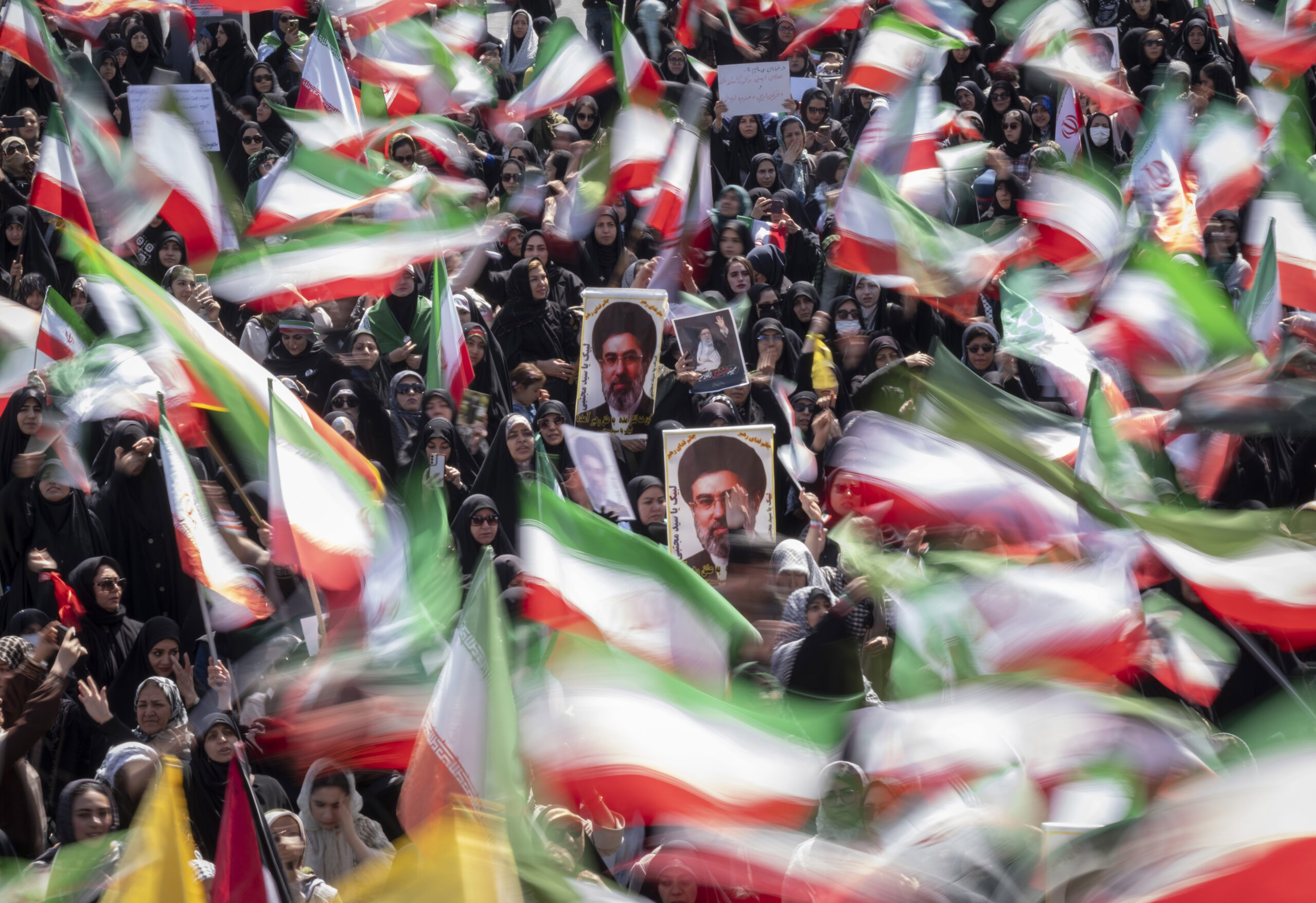
The progovernment rallies that crowd Iran’s streets are no accident. They are a critical and underappreciated pillar of the regime’s strength, and they are shaping Iran’s response to the war.
April 2026
When the United States and Israel launched their joint military campaign against Iran on 28 February 2026, many observers expected the war to trigger a political rupture within the Islamic Republic. After months of mass protest and a brutal crackdown, Iran appeared to some to be on the verge of renewed upheaval. External pressure, in this view, might provide the spark that internal dissent had been unable to achieve. Yet that expectation has not materialized.
Instead, attention has focused primarily on two arenas: the battlefield and the corridors of power. How would Iran’s armed forces respond? Would the leadership survive the shock of decapitation? These questions have dominated coverage of the war. But they leave out a third arena that Iranian officials themselves have treated as equally consequential: the street.
Iran’s capacity for progovernment mobilization constitutes an underappreciated pillar of its resilience. While recent work has highlighted institutional durability and the growing role of coercive organizations, less attention has been paid to how the Islamic Republic actively occupies public space through organized civilian presence. Drawing on research on state-led mobilization in Iran, I examine how the regime’s organizational infrastructure — built over decades through mosques, universities, state bureaucracy, and war commemoration — has shaped its response to its gravest crisis since the revolution.
What Happened in the Streets
Within hours of supreme leader Ayatollah Ali Khamenei’s killing being confirmed on March 1, government supporters began filling streets and squares in Tehran and across the country: Crowds assembled at Enghelab Square in Tehran, with mourners wearing black and carrying portraits of Khamenei. Thousands gathered near the Imam Reza shrine in Mashhad. Similar scenes were reported in Yasuj, Isfahan, Shiraz, and the province of Lorestan. At the Jamkaran Mosque in Qom, a red Shia flag of revenge was raised — a potent symbol in Shia political culture signaling that the community’s honor demanded retaliation. The gatherings continued and have accumulated throughout the war: On April 9, state media reported millions participating in nationwide ceremonies marking the fortieth day of Khamenei’s death.
Foreign observers largely ignored these events. Iranian officials did not share this assessment. On the thirtieth night of the war, Mohammad Bagher Ghalibaf, the speaker of Parliament, issued a formal message to the Iranian people placing street presence on precisely the same footing as military performance: “Just as the soldiers are not abandoning the missiles and the Strait of Hormuz, you should not abandon the streets either.” Missiles, the Strait, and the street — named together as the three fronts of Iran’s resistance.
Why the Street Presence Matters
Sustained loyalist presence in the public space already mattered in at least two distinct ways, even before the war itself introduced a third dimension.
The first concerns the lack of an uprising. A central element of the U.S.-Israeli war plan was to combine military pressure from outside with political unrest from within. The New York Times reported extensively on this plan and its failure. The expected uprising never materialized. Its failure had multiple causes: the bloody crackdown of January 2026, which left thousands dead and shattered the opposition’s organizational capacity; the dangers of the street under active bombardment; and the heavy security presence throughout urban areas. But the already-present loyalist crowds also played a role. Iranian photojournalist Yalda Moaiery, speaking to CNN from inside Iran, noted that the visible presence of government supporters constituted a practical obstacle to protest formation: The public space was not empty and waiting to be claimed; it was already occupied.
The second concerns elite cohesion. On March 31, Foreign Minister Abbas Araghchi joined a rally in the streets of Tehran without visible security. When asked why he had come, he replied: “I came to be among them, to draw energy from the movement on the ground and to enjoy this unity and popular cohesion.” Scholars of social movements have long observed that public gatherings do not merely signal to external audiences; they reinforce solidarity among participants, sustain emotional commitment, and recharge the collective symbols around which a community organizes itself. For officials watching colleagues being killed and infrastructure destroyed, the sight and sound of thousands of supporters in the streets provides exactly this kind of sustenance.
The war then introduced a third dimension. As U.S. president Donald Trump threatened to destroy all of Iran’s power plants and bridges, the state’s youth coordinator announced that young people, university students, artists, and athletes had proposed forming human chains around power plants nationwide, and that the state would coordinate and sponsor the effort at a national level. Thousands responded across multiple cities. Among them was Ali Ghamsari, a musician known as a critic of the Islamic Republic, who played the tar in front of the Damavand power plant. His presence signaled something important: Threats against civilian infrastructure had broadened the base of street defiance beyond committed regime loyalists. The gatherings had become a refusal to be erased — and on that moral front, participants were no longer spectators but combatants.
How Iran Sustains the Street
The capacity for sustained progovernment mobilization under wartime conditions does not emerge spontaneously. It rests on two foundations that my research with Saber Khani has documented in detail.
The first is a social base. The Islamic Republic emerged from a revolution that was genuinely anticolonial, antiimperialist, and Islamic in character — one that built real popular support alongside the repression and dissent that have coexisted with it ever since. This base is not a majority, but it is large, organized, and consistently mobilizable. Electoral data provide a rough floor: Hardliner candidates received between 13 and 18 million votes in recent presidential elections. This base has both social and ideological foundations. Survey evidence shows that religiosity is among the strongest predictors of regime support, and our subnational analysis finds higher support in districts with lower education levels and among Persian-speaking populations — a base that combines lower class position with higher ethnic standing within Iran’s social hierarchy.
The second is organizational infrastructure. The Islamic Republic does not mobilize in an ad hoc manner. Throughout the year, it sustains progovernment events through a dense institutional web: More than 25,000 mosque centers nationwide with more than two-million members, university-based student Basij organizations, and public-sector employee networks organized through Basij administrative offices embedded in every state bureau, alongside the Basij militia and the Organization of Islamic Propaganda. Our statistical analysis of progovernment events across Iranian districts from 2015 to 2019 found that districts with denser mosque networks, larger student populations, and more state employees all showed significantly higher rates of progovernment mobilization. The organizational infrastructure is not activated in moments of crisis — it is always running, and crisis simply intensifies what is already there.
The Power of War Commemoration
One of the most consequential forms of this ongoing mobilization is war commemoration. Roughly three decades after the end of the Iran-Iraq War, the Islamic Republic continues to hold commemoration events throughout the country — ceremonies, funerals for the recovered remains of soldiers, and pilgrimage programs bringing students to former battlefields. These are emotionally intense events that do specific political work: converting loss into loyalty, framing individual death as collective sacrifice, and anchoring the legitimacy of the Islamic Republic in a moral vocabulary of endurance and martyrdom.
That vocabulary predates the revolution, but the Iran-Iraq War gave it new blood — one hundred and ninety thousand dead, whose sacrifice could be framed as the founding blood of the Islamic Republic. After the war, the regime built dedicated institutions for commemoration and battlefield pilgrimage, overseen by Khamenei personally throughout his time as supreme leader.
Our research shows that war commemoration follows the same organizational logic as other forms of progovernment mobilization, but with an additional driver unique to commemoration: Districts with higher concentrations of veterans, martyrs’ families, and wartime fatalities show significantly higher rates of commemorative activity.
When Khamenei was killed on the first day of the 2026 war, he became the most consequential subject that apparatus had ever had to process. The man who had presided over forty years of martyrdom discourse was now himself declared a martyr. The institutions he had built to convert the deaths of others into political capital were now mobilized for him. The preacher of martyrdom had become a martyr for his supporters. Wartime mobilization thus brought together and intensified every prior form of state-led commemorative practice at exactly the moment the regime needed them most.
Iran is not alone in deploying this form of power. Progovernment mobilization has become a recognizable feature of authoritarian politics worldwide — and has begun to appear in democracies experiencing backsliding. As a growing body of research on state-led movements and their strategic use in authoritarian regimes has shown, regimes deploy this tool for multiple purposes: intimidating the opposition, deterring elite defection, displaying legitimacy, and sustaining organizational networks for future mobilization.
Cross-national research shows that higher levels of autocratic mobilization correlate with lower probabilities of democratic transition — meaning this is not merely a tool of repression but a mechanism of authoritarian durability. Iran’s wartime mobilization is a particularly developed instance of this general pattern: States that invest in this capacity over time are harder to dislodge when crises come. Russia, China, and Syria under the Assad regime and its successors provide prime examples of how authoritarian mobilization has been an integral part of authoritarian rule.
A Pillar of Resistance
Some of the narratives that circulated in the lead-up to this war portrayed the Islamic Republic as fundamentally weak and fragile — a regime so corroded by economic failure and popular discontent that the right external shock would cause it to collapse. Those narratives were not entirely wrong. The Islamic Republic was genuinely challenged and weakened in the prewar period.
But weakness in one dimension does not equal fragility across all dimensions. At the strategic-military level, at the level of political institutions, and at the level of state-led mobilization, the system has held. And in the streets, the progovernment presence has been sustained throughout — mourning the dead, occupying public space, standing in front of power plants — disproving the predictions of revolution that was central to the war’s political logic.
Progovernment mobilization is not a sideshow to these other forms of resilience. It is a pillar of them. This capacity was not improvised in response to the crisis. It was built over four decades, through mosques and universities and state offices and war commemoration, district by district, year by year. Any serious strategy of political change in Iran — whether pursued from inside or outside — must account for it. The street is not simply terrain to be seized in a moment of crisis. It is a resource that has been systematically cultivated, and the Islamic Republic has been building its capacity to contest it for a very long time.
Mohammad Ali Kadivar is the 2025-2026 Maury Green Fellow at Harvard Radcliffe Institute and an associate professor of Sociology and International Studies at Boston College. He is the author of Popular Politics and the Path to Durable Democracy (Princeton University Press, 2022).
Copyright © 2026 National Endowment for Democracy
Image credit: Morteza Nikoubazl/NurPhoto via Getty Images
|
FURTHER READING |
||
Iran’s Democratic Hopes Amid the Smoke of War |
Why the Islamic Republic Still StandsAfter January’s mass protests, Iran seemed on the verge of revolutionary upheaval. How is it weathering the U.S.-Israeli assault? |
Iran’s Massacres Will Haunt the RegimeEhsan Habibpour, Sharan Grewal Iran’s hardline government responded to nationwide protests with horrific violence, killing thousands of Iranians in a matter of days. There is nothing the regime can offer its people to regain their support. |