
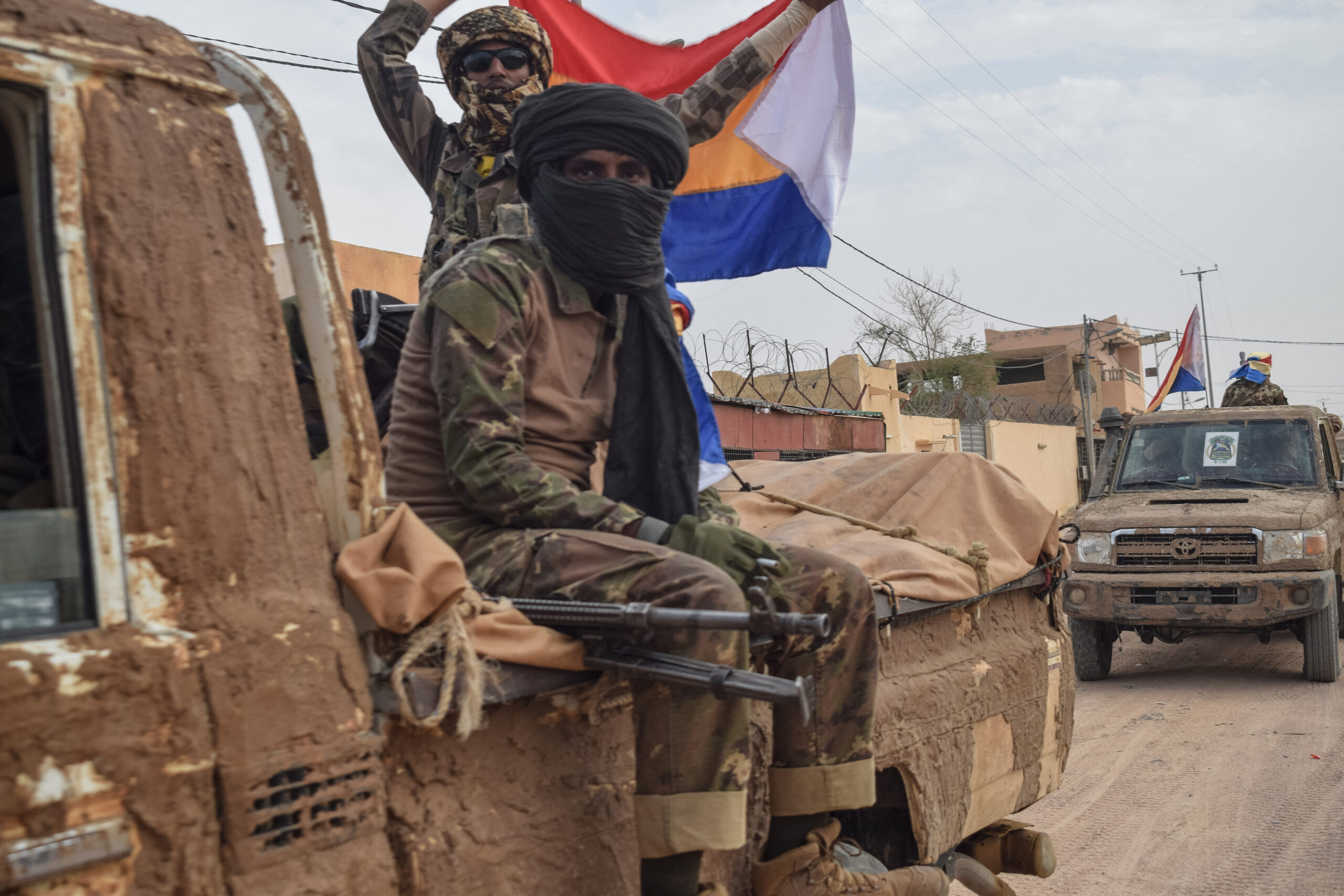
Mali’s spiraling security crisis puts its entire region at risk. A return to democracy will be key to preventing the country from becoming a terrorist safe haven in West Africa.
By Chidi Blyden and Alexander Noyes
June 2026
The security situation in Mali has reached a critical turning point, and a return to democracy must be part of any lasting solution. Before dawn on 25 April 2026, jihadist and Tuareg separatist militants launched a series of coordinated attacks across the country. The scale, geographic spread, and operational sophistication of the offensive sent shockwaves across West Africa. Fighters affiliated with Jama’at Nusrat al-Islam wal-Muslimin (JNIM) launched attacks in the capital city, Bamako, as well as in Bourem, Kati, Mopti, Senou, and Sévaré in southern Mali, while the Tuareg-dominated Azawad Liberation Front (FLA) claimed control of Kidal and parts of Gao in the northeast. Mali’s defense minister, General Sadio Camara — a key figure in the ruling junta who had been widely viewed as a potential successor to junta leader Colonel Assimi Goïta — was killed when a suicide bomber targeted Camara’s residence in Kati. He died alongside members of his family.
These attacks did not emerge in isolation. Rather, they represent the culmination of years of deteriorating security conditions that have defied successive domestic and outside strategies aimed at improving the situation. According to the Armed Conflict Location and Event Data Project (ACLED), civilian fatalities linked to militant Islamist violence across the Sahel increased significantly between 2021 and 2024, with Mali accounting for a disproportionate share of the violence. The principal actors, the al-Qaeda-affiliated JNIM and the Islamic State Sahel Province (ISSP), continue to exploit weak state presence, political instability, declining institutional legitimacy, and intensifying intercommunal tensions.
For the international community, Mali now represents both a strategic warning and a policy challenge. The Sahel risks evolving into a more deeply entrenched zone of instability capable of threatening regional governments, undermining economic development, and providing permissive operating environments for transnational extremist organizations. Military-led approaches have simply not worked, whether supported by the West or by Russia. A durable solution in Mali will therefore require not only counterterrorism cooperation from outside partners, but also the restoration of democratic governance, institutional legitimacy, effective civilian oversight, and a stabilization model grounded in local cultural legitimacy rather than exclusively external security paradigms.
Coups, Shifting Partnerships, and Eroding Governance
Mali’s current crisis cannot be separated from the political instability that has defined the country for the past several years. In August 2020, a military junta led by Goïta ousted President Ibrahim Boubacar Keïta (elected in 2013) amid widespread protests over corruption and the government’s failure to address growing insecurity. Less than a year later, in May 2021, Goïta executed a second coup, removing the transitional civilian leadership that had been installed following the first military takeover. These successive seizures of power disrupted institutional continuity and severely strained Mali’s relations with traditional international partners, including France, the United States, and the Economic Community of West African States (ECOWAS).
For much of the last decade, international engagement in Mali focused heavily on counterterrorism operations and partner-force development. France’s Operation Barkhane (2014–22), which at its height deployed approximately 5,000 troops across the Sahel, succeeded in disrupting some militant networks. However, tactical gains failed to translate into durable political or security outcomes. The operation was increasingly undermined by anti-French sentiment — fueled by perceptions of neocolonialism — as well as frustration with deteriorating security conditions and disinformation campaigns that amplified public distrust of Western involvement.
A major turning point occurred between 2022 and 2023 when the Malian junta expelled French forces, suspended participation in the G5 Sahel security and development framework (founded in 2014 by the governments of Burkina Faso, Chad, Mali, Mauritania, and Niger), and facilitated the withdrawal of the UN Multidimensional Integrated Stabilization Mission in Mali (MINUSMA). The departure of the 15,000-strong peacekeeping mission created significant security vacuums across northern and central Mali. In place of these partnerships, the junta turned increasingly toward Russian support through the Wagner Group, later restructured as the Africa Corps.
The presence of Russian mercenary forces has been accompanied by credible allegations of severe human-rights abuses. A 2022 investigation by Human Rights Watch and United Nations experts found evidence that Malian forces and Wagner-affiliated personnel were responsible for the killing of approximately 500 civilians in Moura, one of the deadliest documented atrocities of the conflict.
Unsurprisingly, the Russian partnership has failed to produce durable strategic stabilization outcomes. According to ACLED data, battles involving Russian personnel in Mali declined substantially between 2024 and early 2026, while extremist groups continued expanding their operational reach. The broader lesson remains clear: Military partnerships alone, regardless of the outside actor involved — whether France, the UN, or Russia — cannot substitute for legitimate political institutions, accountable governance, or effective state-society relations.
The geopolitical landscape shifted further in January 2025 when Mali, Burkina Faso, and Niger formally withdrew from ECOWAS and consolidated their alliance through the Alliance of Sahel States (AES), a mutual-defense and political framework that explicitly rejects Western conditionality-based engagement. The emergence of the AES presents a significant challenge to established regional-governance mechanisms and complicates future stabilization efforts in the Sahel.
What Should Be Done?
The attacks of 25–26 April 2026 represent the most significant rupture in Mali’s security environment since the 2012 military coup.
The scale and coordination of the offensive were unprecedented. JNIM has progressively expanded beyond its traditional strongholds in northern and central Mali into southern and western regions closer to Bamako, effectively collapsing previously distinct conflict zones into a unified operational theater. The April offensive targeted Bamako’s international airport, the military garrison at Kati, just 15 km northwest of Bamako, and strategic locations in Mopti, Gao, and Kidal simultaneously. These strikes targeted Mali’s primary international gateway, its central military command headquarters, and the key regional airbases and transit hubs that connect the southern capital to the volatile northern territories. This simultaneous assault demonstrated a command-and-control capability that exceeded earlier assessments of JNIM’s operational capacity.
Counterterrorism challenges in Mali are not solely military problems. They are equally governance, justice, development, and political-inclusion challenges. A whole-of-government framework is therefore necessary to integrate defense cooperation with institution-building, civilian governance support, economic development, local conflict mitigation, and public-service delivery.
This approach must extend to the community level. In areas where the Malian state has historically failed to provide basic services or dispute-resolution mechanisms, extremist groups have often filled the vacuum by offering protection, economic opportunities, and rudimentary governance structures.
Recent conflict data suggest that Malian security forces and their Russian partners have been linked to a substantial share of civilian fatalities associated with targeted attacks in Mali. During military operations in early 2024, for example, Malian army forces and allied Russian mercenaries engaged in a pattern of targeted killings and summary executions of civilians. Eyewitness accounts and evidence from incidents in the Gao and Mopti regions suggest a deliberate campaign of atrocities against noncombatants, including the killing of women and children. The attacks over the last two years have further eroded public trust and facilitated extremist recruitment. Effective stabilization must therefore include support for traditional authorities, local peacebuilding mechanisms, and intercommunal-dialogue initiatives capable of reducing grievances before they are exploited by extremist organizations.
Likewise, a sustainable stabilization strategy must recognize that effective counterterrorism and security assistance depends not only on operational capacity, but also on accountable institutions, credible civilian oversight, and broader state resilience. Studies have repeatedly shown that abuses at the hands of security forces are a primary cause of extremism in Africa. Research on security-sector reform also consistently demonstrates that professional and effective partner forces are more likely to emerge where institutional governance structures are functional and civilian authority remains respected.
In the least, future international security cooperation with Mali should be explicitly conditioned on measurable political and governance benchmarks. These should include a credible and time-bound democratic-transition process, including constitutional reforms and scheduled elections; the establishment of a civilian-led transitional cabinet with genuine authority over nonsecurity portfolios; and measurable reductions in extrajudicial violence and credible accountability mechanisms for documented abuses at the hands of the Malian state.
The United States should avoid returning to an assistance model that prioritizes short-term operational outcomes over institutional development. Limited indirect military assistance, intelligence-sharing, and counterterrorism coordination may remain necessary to prevent further territorial deterioration, but such engagement should be strictly conditioned on governance benchmarks and civilian accountability mechanisms.
France and European partners face the challenge of recalibrating their role in the Sahel following years of deteriorating relations and growing anti-French sentiment. The European Union Training Mission in Mali, despite training thousands of soldiers over the course of a decade, failed to prevent the politicization of the military or repeated coups. Future European engagement should emphasize local legitimacy, African-led initiatives, and civilian-governance support rather than externally driven stabilization frameworks detached from domestic political realities.
ECOWAS faces a major credibility challenge following the formation of the AES and the withdrawal of Mali, Niger, and Burkina Faso from the regional bloc. Previous sanctions regimes had limited strategic effect and, in some cases, reinforced anti-ECOWAS sentiment within affected states. Rebuilding regional legitimacy will require a shift away from purely punitive approaches toward incentive-based engagement that offers concrete diplomatic and economic benefits tied to democratic restoration and governance reform.
Any comprehensive policy framework for Mali must also account for China’s expanding economic presence across the Sahel. Chinese investment in infrastructure, telecommunications, mining, and extractive industries has grown substantially in recent years. Beijing has consistently positioned itself as a nonconditionality partner, an approach that remains attractive to military-led governments seeking to minimize external accountability pressures. Western and regional actors must therefore compete not only in the security domain, but also in the economic and governance space by offering credible long-term partnerships that link investment, development, and institutional reform.
The April 2026 offensive removed any remaining ambiguity about Mali’s trajectory: The country is dangerously close to becoming a failed state, and could well end up as a terrorists’ safe haven in West Africa. This outcome would be incredibly dangerous for Malian citizens, the region, and the international community. The junta has failed to deliver meaningful improvements in security despite expanded military-centered strategies and alternative external partnerships. It’s time for new approach. Without a credible return to democratic governance and a broader whole-of-government stabilization strategy, outside military assistance alone is unlikely to work. Sustainable security in Mali will ultimately depend not only on a more effective and responsible military effort, but on rebuilding legitimate and resilient state institutions capable of delivering public goods, maintaining public trust, and ensuring durable stability.
Chidi Blyden is a former U.S. deputy assistant secretary of defense for Africa. Alexander Noyes is a fellow at the Brookings Institution, a visiting scholar at the University of Pennsylvania’s Penn Washington, and author of Compromised Coalitions: The Paradox of Post-Conflict Power Sharing in Africa, forthcoming in July.
Copyright © 2026 JoD Productions
Image credit: AFP via Getty Images
|
FURTHER READING |
||
Why African Publics Turn to Military CoupsBy Michael Yekple and Zlatin Mitkov Africans don’t want military rule. They want generals to rid them of bad leaders, and then return to the barracks. But once in power, military leaders often have other ideas. |
African Coups and the Elite-Forces Trap |
The Truth About Africa’s CoupsPraetorian politics are not making a comeback. Africa’s recent putsches have more to do with democracy’s failure to deliver than any fondness for military rule. |