
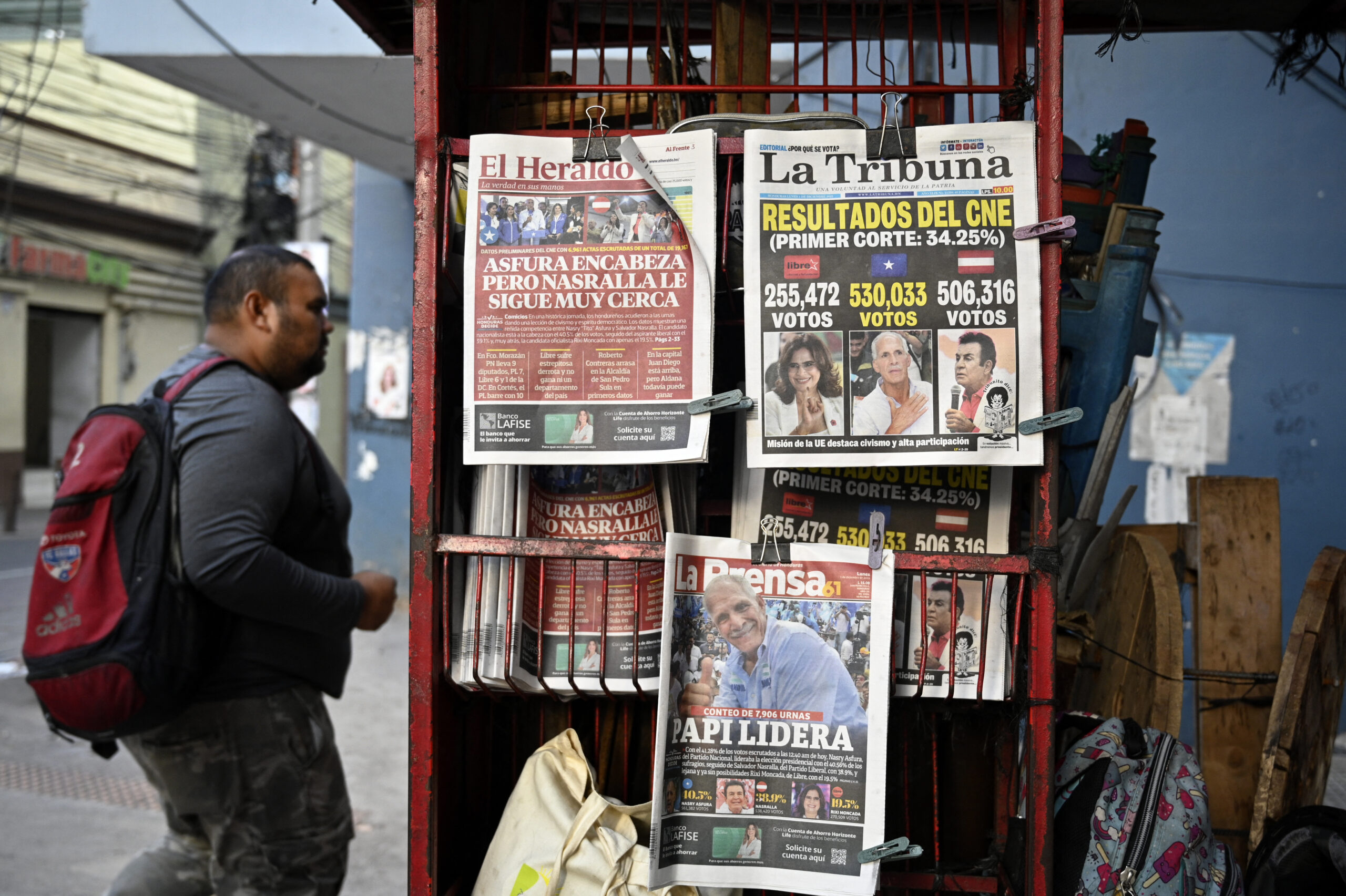
Days after the election and still no one knows who the next president will be. Even worse, none of the likely winners offer much hope for the country’s democracy.
December 2025
On November 30, Hondurans voted for the country’s next president and vice-president, all 128 seats in the unicameral National Congress, and 298 municipal mayors.
The contest to replace President Xiomara Castro of the leftist Liberty and Refoundation party (Libre) was primarily between three contenders: Libre candidate Rixi Moncada, who served as Castro’s finance minister and later defense minister; former Tegucigalpa mayor Nasry “Tito” Asfura of the conservative National Party (PN), who was endorsed by U.S. president Donald Trump; and sports commentator Salvador Nasralla of the right-leaning Liberal Party’s (PL), who joined Castro’s coalition ticket in 2021 and served as her vice-president until 2024.
Twenty-four hours after polls closed, the National Electoral Council (CNE) issued preliminary results accounting for just 57 percent of precincts. But the early returns made one outcome clear: The anti-incumbent rebuke handed down by voters across most of Latin America in 2025 had struck Honduras. With less than 20 percent of the vote, Libre’s Moncada was out of contention, and the future president would again thrust the country rightward.
But, as of this writing, it is completely unknown who that president will be. When the preliminary count ground to a halt, Asfura and Nasralla were separated by a mere 515 votes. On December 2, the CNE announced that its vote-tally system had failed and that it would provide a temporary platform so that the political parties and media could follow the count. Since then, Asfura and Nasralla have traded the lead multiple times. The difference between the candidates has hovered around half a percentage point.
All three parties — and the American president — moved to fill the informational void with self-serving narratives and conspiracy theories. Both opposition candidates claimed that they would prevail based on their parties’ internal counts. Meanwhile, the PL has accused Asfura of secretly meeting with Libre party coordinator and husband of President Castro, Manuel “Mel” Zelaya, to negotiate the PN’s victory. Zelaya himself served as president before being ousted in the 2009 military coup. PN supporters have claimed that the PL is colluding with Libre as well.
In a Truth Social post, President Trump accused Honduran officials of “trying to change the results of their Presidential Election,” warning that there would be “hell to pay” if they do.
Shortly thereafter, Libre candidate Moncada broke her day-long silence to decry U.S. interference, allege that the PN and PL had manipulated election results, and vow to continue the fight — this despite multiple Libre leaders having admitted defeat.
What a Difference Four Years Makes
The current electoral turmoil contrasts sharply with the aftermath of the previous contest in 2021. Many anticipated then that the opposition forces aligned under the Libre banner would triumph and put an end to Honduras’s “narco-dictatorship”; however, there were questions about whether the incumbent PN regime would concede. After all, fraud allegations had marred the 2017 contest, which saw sitting president Juan Orlando Hernández prevail over Nasralla despite a constitutional ban on reelection. (In mid-2024, Hernández was sentenced to 45 years in prison in the United States for drug trafficking; President Trump pardoned him on 28 November 2025).
Though observers feared the worst, the 2021–22 presidential transition was seamless. PN candidate Asfura not only quickly recognized Castro’s victory but met with her one-on-one — a rare show of goodwill despite the country’s hyperpolarized landscape.
The opposition victory and the smooth alternation of power were seen as promising signs of democratic renewal following years of high-level corruption, institutional cooptation, and violent repression. Libre had, moreover, achieved the democratic breakthrough the “right” way. As the PN tilted the electoral playing field in its favor, the opposition continued to compete via the ballot box, strengthen party organization, and forge pragmatic alliances.
How then do we explain the current turmoil?
Short-Lived Democratic Renewal
Libre’s resounding defeat and the electoral upheaval reflect processes of democratic deterioration that advanced steadily under the Castro government, whose early moves fomented doubts about its democratic commitments.
Crisis erupted even before the 2022 presidential inauguration when Libre fractured over the vote for legislative leadership, leading to fistfights in the chamber and the swearing-in of two different presidents of Congress. Eventually, the party’s dissident wing stood down, ending the stalemate.
But the legislative fiasco was a sign of things to come. Upon taking office, Castro signed into law an amnesty that benefited public officials accused of corruption during her husband’s presidency (2006–2009). Though Castro’s administration later repealed and reformed PN-era laws that served as barriers to prosecuting official graft, the amnesty was seen as a new “impunity pact” that contradicted the anticorruption promises of the president’s campaign.
Other antidemocratic practices also continued. Significant nepotism under Castro not only mirrored the practices of her predecessor, Hernández, but also drew comparisons to Nicaragua’s authoritarian dynasty under Daniel Ortega and Rosario Murrillo.
Following the state of exception imposed by El Salvador’s Nayib Bukele, Castro issued her own emergency declaration in the name of fighting crime. The decree suspended constitutional rights and expanded military and police powers. And though it remains in effect, the government has little to show for it beyond alleged human-rights abuses and corruption. Although Honduras’s national homicide rate has declined, violence in rural areas has spiked.
Patterns of institutional cooptation also threatened the rule of law. In late 2023, lawmakers maneuvered around the two-thirds majority needed to name the next attorney-general, instead relying on a rule allowing the president of Congress to convene a permanent commission authorized to make an interim recess appointment. With Libre lawmakers comprising a majority, the commission named loyalist Johel Zelaya (no relation to Manuel) to the post. Amid opposition outcry, Libre mobilized its most ardent supporters — base organizations known as colectivos — who stormed the steps of Congress on 31 October 2023 to strongarm Zelaya’s appointment, even committing acts of violence.
Revelations of high-level organized-crime connections have also ensnared Libre, demonstrating what many Hondurans already knew: that the “narco-state” nexus was not confined to past PN governments. In September 2024, the investigative outlet InSight Crime published a video of a 2013 meeting between Secretary of Congress Carlos Zelaya, President Castro’s brother-in-law, and leaders of the Cachiros drug-trafficking group. Zelaya can be heard discussing previous contributions to the campaign of his brother, former president Mel Zelaya, and soliciting money and vehicles to support Castro’s presidential bid that year. Although Carlos Zelaya voluntarily stepped down, the scandal undermined the ruling party’s professed commitment to severing the state–organized-crime ties that have long distorted Honduran democracy.
As government missteps and popular discontent mounted, incumbent officials increasingly lashed out at critics, further illustrating the fragility of liberal-democratic norms. Harassment and intimidation of independent media escalated. According to the Honduran NGO C-Libre, there were a reported 199 violations of free expression between the beginning of 2023 and July 2024 — two-thirds of which entailed violence or threats of violence. Public officials were the top “aggressors,” responsible for roughly a third of reported incidents.
Ingredients for an Explosive Election
These signs of democratic decline fomented the toxic electoral environment of 2025. In the leadup to the November 30 contest, the harbingers of impending crisis were numerous.
The logistical failures of the March 9 primary elections were an early indication of the troubles to come. The delayed delivery of materials to voting centers in the country’s two largest cities, Tegucigalpa and San Pedro Sula, forced some Hondurans to vote through the night or prevented them from casting ballots altogether.
The disastrous primaries further discredited the CNE, whose partisan character has hampered decisionmaking. Amid infighting between the body’s three councilors, each representing one of the three major parties, the CNE delayed its contracting process for the new Preliminary Results Transmission System (TREP).
Initially, government critics seized on the debacle to sow doubts about election integrity. Liberal Party president and San Pedro Sula mayor Roberto Contreras, for example, alleged that the new TREP would privilege the early reporting of results from Libre strongholds and be used by Moncada to declare victory. The TREP, however, later became the focus of Libre accusations against the opposition when Attorney-General Zelaya announced an investigation into audio recordings in which an unidentified military member and two National Party officials — CNE representative Cossette López and Congressman Tomás Zambrano — allegedly discussed a plot to alter the popular vote. López claimed that the recordings were fabricated. Yet President Castro cited them as evidence of a planned “electoral coup.” And after the new TREP transmitted only a third of the results in a November 9 test-run, the CNE’s Libre official declared that its failure illustrated “the existence of a conspiracy against the electoral process orchestrated from within the heart of the electoral organ.” Following suit, Libre candidate Moncada vowed not to accept any election-day results — a position she has maintained since.
As electoral mistrust deepened, there were also worrying signs of possible military overreach. In October, General Roosevelt Hernández, the head of the Honduran Joint Chiefs of Staff, requested that the CNE provide the military the official vote tallies of each precinct so that it could carry out a separate count. Constitutional lawyers roundly denounced the petition as a violation of the armed forces’ constitutional duties, which are confined to logistical tasks.
Troubling moves in Congress also led to opposition charges that Libre planned to remain in power. As evidence of the plot, critics pointed to the president of Congress’s decision to name a permanent commission to carry out legislative functions during the recess period — the same maneuver that allowed the ruling party to appoint Attorney General Zelaya. Opponents claim that the permanent commission not only violates the constitutional order, but could ultimately be responsible for certifying the election outcome, should the hyperpolarized CNE fail to do so.
Add to these events two other factors shown to contribute to election turmoil: razor-thin margins and extreme foreign pressures.
In the run-up to the election, the three major candidates were in a virtual tie, according to polls. And unlike the presidential contests in Bolivia and Chile earlier this year, Honduras’s has only a single round of voting, with the plurality winner becoming president. This feature of the Honduran system not only raises the stakes of the contest but often gives the victor a weak electoral mandate.
Also looming over the contest was the United States, which made its pro-PN position clearly known despite the State Department’s vow to refrain from commenting on foreign elections. On November 26, President Trump strongly endorsed PN candidate Asfura, warning that he “cannot work with Moncada and the Communists, and Nasralla is not a reliable partner for Freedom.” Days later, Trump asserted that the United States “will not be throwing away good money” should Hondurans elect “a wrong Leader.” He then announced that he was granting a full pardon to former PN president Hernández, who had, in Trump’s words, “been treated very harshly and unfairly.”
Given the close contest and the outsized influence of the United States, many experts argued that this kind of foreign interference could sway Hondurans’ decisions.
What’s on the Horizon?
Notwithstanding some irregularities, the consensus among international and domestic election observers in Honduras is that voting-day procedures were above board and peaceful. Yet the tight race, stalled vote count, preelection fraud conspiracies, and foreign meddling have nevertheless generated a postelection powder keg. Whether Honduras’s fragile democratic defenses can withstand the political turmoil remains to be seen.
On the bright side, Honduras has a long history of intraparty accords to defuse political crisis, which may again become relevant here. Such agreements ended the Congressional standoff that started Castro’s tenure and reformed the CNE ahead of the 2021 elections to ensure equal partisan representation.
Yet few would argue that this deal making has ultimately been good for Honduran democracy. After all, CNE divisions have had a significant hand in creating the electoral chaos unfolding now. Historically, the negotiated selection of Supreme Court nominees has facilitated the politicization of judicial decisionmaking, while legislative pacts have been used to guarantee impunity for public officials regardless of partisanship.
The viable contenders — Asfura and Nasralla — do not inspire hope for progress either. As the pillars of Honduras’s previous bipartisan consensus, their respective parties, the PN and PL, have their own sordid pasts. In addition to the PN’s high-profile corruption scandals and narco-connections, Asfura himself was accused of embezzlement while serving as Tegucigalpa’s mayor. And even though Nasralla portrays himself as an anticorruption champion, the head of the PL’s executive council, Yani Rosenthal, spent nearly three years in a U.S. prison after pleading guilty to money laundering for the Cachiros.
Even if the electoral crisis subsides, the fight for Honduran democracy will remain a steep uphill battle.
Rachel A. Schwartz is assistant professor of international and area studies at the University of Oklahoma and author of Undermining the State from Within: The Institutional Legacies of Civil War in Central America (2023).
Copyright © 2025 National Endowment for Democracy
Image credit: Orlando SIERRA / AFP via Getty Images
|
FURTHER READING |
||
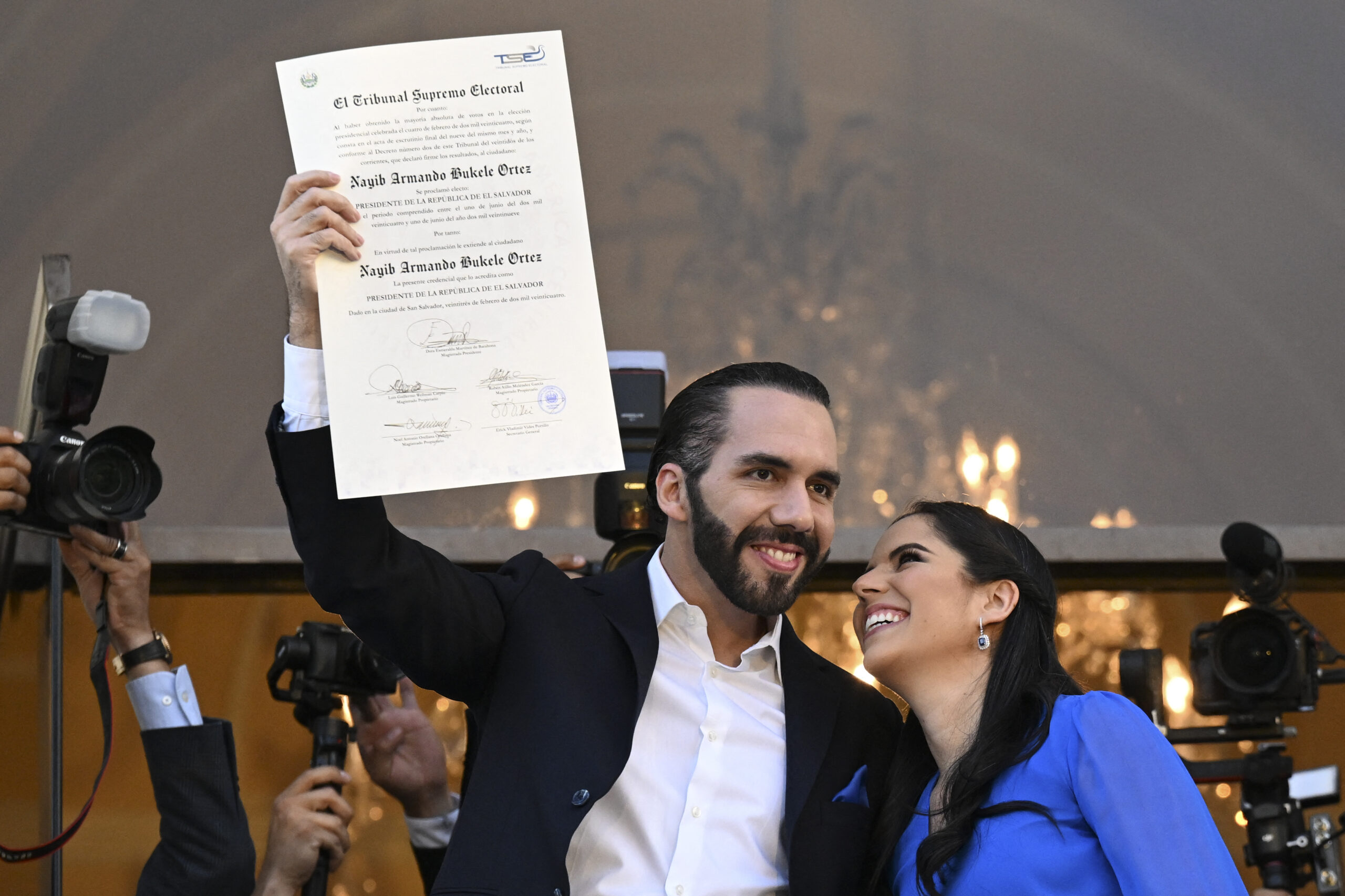
The Threat to Latin American Term Limits |
The Bukele Model: Will It Spread?Manuel Meléndez-Sánchez and Alberto Vergara The Salvadoran president’s “iron fist” policies have become one of the most popular political brands in Latin America. But the very reasons that explain his success in El Salvador point to why his repressive approach will not succeed elsewhere. |
Is Central America Doomed?Mateo Jarquín, Rachel A. Schwartz, and Kai M. Thaler Of course not. But the region’s democratic hopes are fighting an uphill battle against corruption, crime, and a violent past. |