
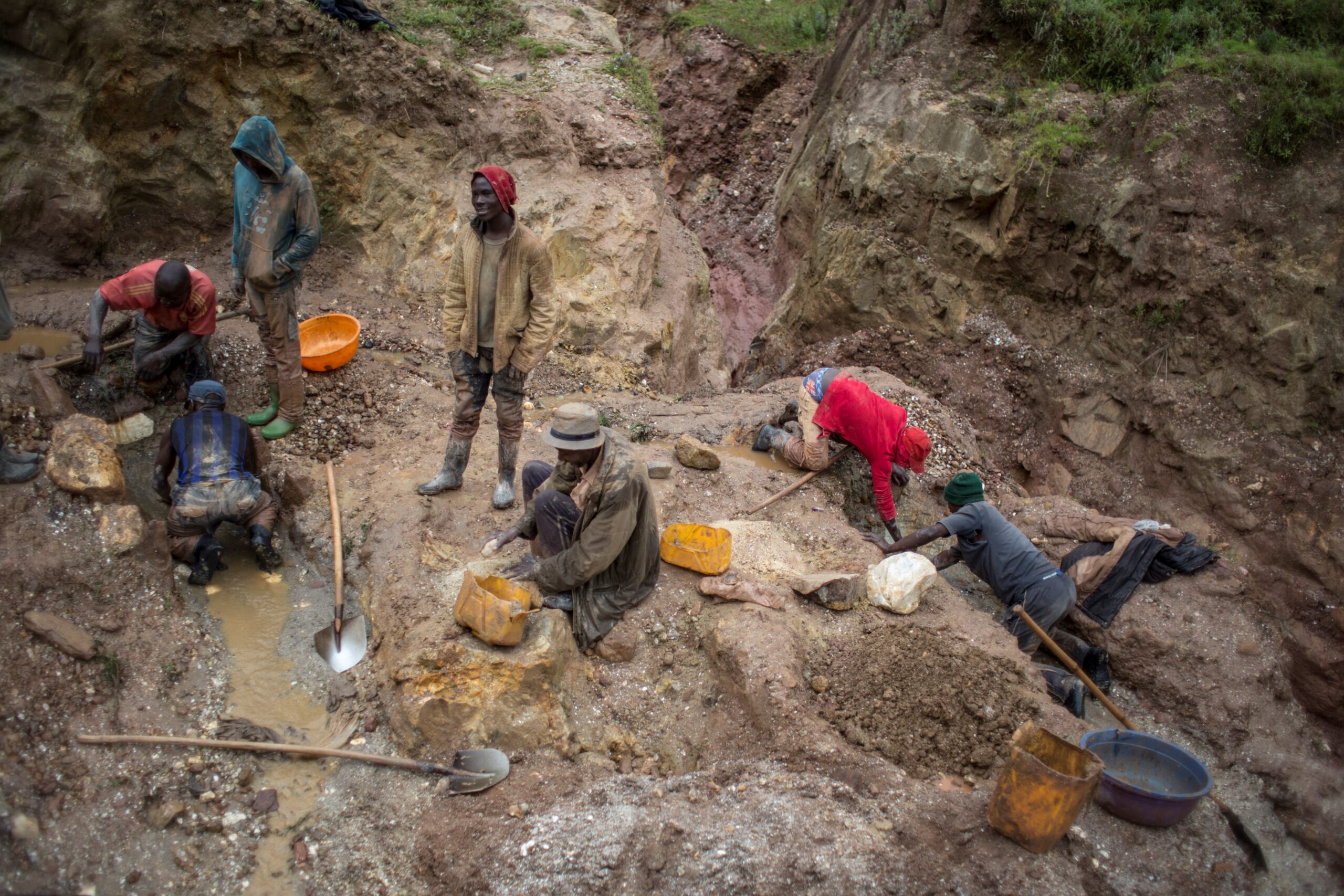
In Africa, the race for critical minerals isn’t just about supply chains and industrial strategy. It underscores the need to build democratic institutions to govern the new mineral rush while protecting citizens’ rights.
By Issa Souare
March 2026
The global race for critical minerals is usually framed as a story about supply chains, industrial strategy, and climate urgency. In Africa, it is also a story about democracy. The continent’s mineral wealth gives governments a new chance to finance development, strengthen regional manufacturing, and bargain for better terms in a changing world economy. But it also creates familiar dangers: concentrated rents, opaque contracting, weakened local consent, and executive decisionmaking that outruns public scrutiny.
That is why the most important question is not whether African states can attract more mining investment. Many already can. The harder question is whether they can build democratic institutions strong enough to govern the new mineral rush before political habits harden around it. If they cannot, the energy transition may bring Africa more strategic attention without bringing citizens more voice.
This challenge is not hypothetical. The International Energy Agency has shown that demand for several minerals used in batteries, electricity networks, and clean-energy technologies is set to rise sharply under transition scenarios. At the same time, the African Union’s Africa Mining Vision has for years argued that the continent should move beyond extraction toward transparent, equitable, and development-oriented mineral governance. Yet the gap between that vision and actual practice remains wide in many countries.
The democratic stakes are especially high because critical minerals are arriving with a language of necessity. Governments and investors can now say that projects must move quickly because the world needs them for decarbonization. That argument may be economically persuasive, but politically it can become dangerous. Urgency can be used to compress debate, narrow oversight, and treat local consultation as a delay rather than a democratic requirement.
This is where Africa’s mineral future will be decided: not only in geology, but in institutions.
Why This Boom Is Democratically Different
Africa has experienced resource booms before. Oil, gas, diamonds, and metals have all shaped the region’s political life. What makes the current moment different is that critical minerals are being tied to a morally ambitious global project. Extraction is increasingly presented not only as profitable, but as necessary for a greener future. That gives governments, companies, and external partners a stronger rhetorical shield than earlier commodity booms enjoyed.
But a cleaner global economy does not automatically produce cleaner politics. In fact, the opposite can happen. When mineral corridors are treated as strategic assets, decisions about contracts, infrastructure, electricity allocation, tax concessions, and security arrangements can move into narrower circles. Legislatures are bypassed. Local authorities are informed late. Citizens are told that technical complexity makes close scrutiny unrealistic. Civil society is welcomed in principle but excluded in practice.
The result is a familiar democratic pattern wrapped in new language: high-stakes decisions taken in the name of national progress, while the people most affected have the weakest influence over timing, terms, and trade-offs.
Transparency Must Come First
The first democratic guardrail is early transparency. Once large mining deals, rail corridors, refinery commitments, and power allocations are locked in, public oversight becomes much harder. Citizens may know that a project exists, but not on what terms. By then, governments are reluctant to reopen agreements, companies resist new disclosure, and the political cost of correction rises.
Africa does not need to start from zero. The Extractive Industries Transparency Initiative now works with more than fifty countries, including 28 in Africa, and requires the disclosure of key information on licensing, contracts, production, revenues, state participation, and beneficial ownership. These are not technical details for specialists alone. They are the minimum democratic infrastructure needed to know who has been granted access to national resources, under what conditions, and with what public obligations.
There are practical openings as well. In Guinea, for example, the government published two sets of Simandou project agreements at the end of 2025 after years of public interest in the mega–mining project’s terms. That does not resolve every governance question, but it shows the right sequence: disclosure before political mythology takes over. The same principle should apply across the continent. Contract publication, beneficial-ownership disclosure, open and publicly available mining-license registries, and accessible subnational revenue reporting should be treated as baseline democratic practice, not reformist ambition.
This matters for one simple reason: Secrecy turns mineral policy into executive property. Transparency turns it into a public argument.
Community Voice Is not a Box to Tick
The second guardrail is meaningful participation for affected communities and local governments. In many mineral jurisdictions, consultation exists on paper but arrives too late, with too little information, and under highly unequal bargaining conditions. Communities are often asked to respond to projects whose basic architecture has already been decided elsewhere. The language of participation is present, but the substance of influence is thin.
The Africa Mining Vision anticipated this problem. It called for new legal instruments to increase the participation of local communities and other stakeholders, and for fairer mechanisms to share mineral revenues at the local level. That remains sound advice. Democratic legitimacy in mining areas cannot rest on occasional meetings, compensation packages, or ad hoc corporate social investments. It requires structured voice: accessible project information, credible grievance channels, public monitoring of community commitments, and formal roles for local institutions that continue after the initial project announcement.
This is also where democracy becomes tangible. For citizens living near mines, the most relevant democratic questions are rarely abstract. They concern land access, water, dust, jobs, compensation, roads, and whether promises survive changes in political leadership. If public institutions cannot mediate these questions fairly, national claims about democratic progress will ring hollow.
Legislatures Must Govern the Industrial Bargain
The third guardrail is legislative oversight over the wider industrial bargain. Too often, mineral policy is reduced to royalties, taxes, and foreign-exchange earnings. Those questions matter, but they are not enough. The central issue is whether countries can use mineral wealth to build capabilities beyond extraction. That means asking who decides on local processing, domestic procurement, skills development, shared infrastructure, and the use of development finance.
These are not merely economic choices. They are constitutional choices about who shapes the national development path. If they remain concentrated in ministries, presidential offices, or opaque negotiations with investors, then industrial policy will sit outside democratic accountability. Legislatures, audit institutions, and independent media should therefore treat critical-mineral strategy as a matter for sustained oversight rather than episodic controversy.
This is where comparative evidence from mineral governance across Africa is useful. A recent International IDEA study on eight African countries found recurring governance problems tied to legal ambiguity, weak enforcement, jurisdictional conflict, unequal revenue distribution, and weak community engagement. Those are not side issues. They are the political conditions that determine whether mineral wealth strengthens institutions or corrodes them.
The democratic question, then, is not whether states should pursue value addition. They should. The real question is whether the push for refineries, industrial zones, sovereign funds, and strategic corridors will be governed through accountable institutions or through elite bargains insulated from public debate.
Regional Coordination Can Widen Accountability
The fourth guardrail is regional. No single African country can easily maximize value, bargaining power, and standards on its own. Critical minerals cross borders through corridors, electricity systems, processing networks, and export routes. That makes regional coordination an economic necessity. It should also be seen as a democratic opportunity.
Regional bodies can help reduce the race to the bottom in fiscal concessions, local-content promises such as commitments on local hiring, domestic procurement, and in-country processing, and environmental shortcuts. They can support common disclosure rules, comparable local-benefit standards, and more credible bargaining positions with large external buyers and strategic partners. Just as important, regional frameworks can widen the audience for accountability. When national institutions are weak, regional norms can give reformers additional leverage.
This is not a call for supranational technocracy. It is a call for democratic scaling. If mineral governance is becoming more regional and geopolitical, accountability must scale with it.
Africa Still Has Agency
A dangerous assumption runs through many discussions of critical minerals: that African countries must choose between speed and scrutiny. That is the wrong choice. Deliberation does not have to mean paralysis, and oversight does not have to mean hostility to investment. The real trade-off is between democratic state-building now and political fragility later.
Africa’s leaders still have agency in this moment. They can treat critical minerals as another enclave industry, justified by the language of transition but governed by closed bargains. Or they can use the boom to strengthen the institutions that democracy requires: open contracts, legislative oversight, local voice, regional standards, and credible public monitoring.
The world has good reason to care about where it will get the minerals needed for a lower-carbon future. Africans have even better reason to care about how the rules of extraction are written. If those rules are democratic, critical minerals can support development and institutional deepening at the same time. If they are not, the green transition will reproduce an old African story under a new global banner.
Issa Souare is founder and executive director of Sustainable Development Africa and an international-development consultant. He has worked with the United Nations Global Compact, Delivery Associates, and Guinea’s investment-promotion agency on governance, responsible business, and development delivery in West Africa.
Copyright © 2026 National Endowment for Democracy
Image credit: GRIFF TAPPER/AFP via Getty Images
|
FURTHER READING |
||
Why African Publics Turn to Military Coups |
Oil, Politics, and Ghana’s DemocracyE. Gyimah-Boadi and H. Kwasi Prempeh Ghana has won praise for its steady progress toward democratic consolidation. In late 2010 it joined the ranks of the world’s oil producers. Will the democratic institutions be able to resist the “resource curse”? |
Political Corruption: Nigeria’s Perennial StruggleRead the full essay here. |