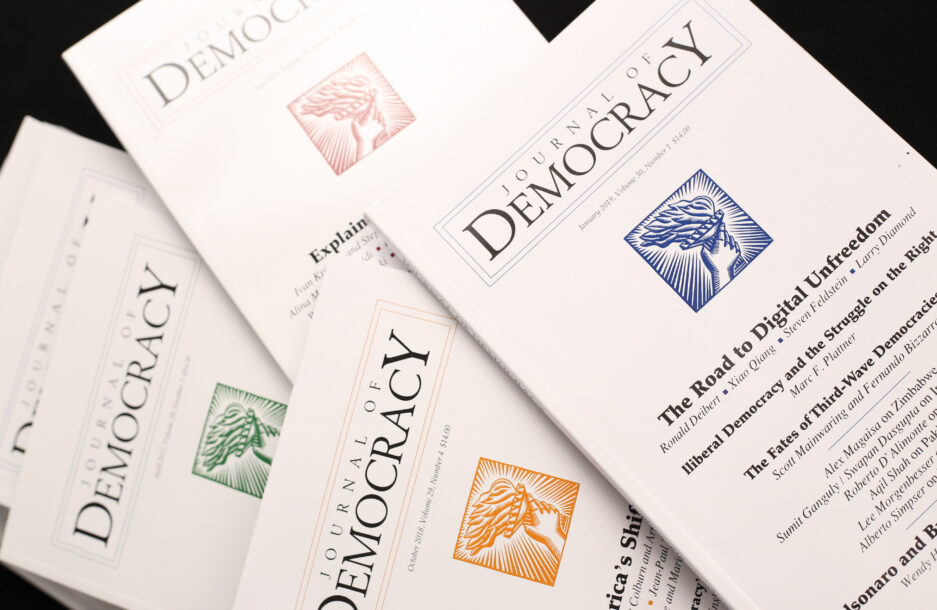
October 2021, Volume 32, Issue 4
Russia’s Road to Autocracy
Thirty years after the Soviet Union collapsed, Russia is firmly in the grip of an autocrat. Where did Russia’s path go wrong?
October 2021, Volume 32, Issue 4
Thirty years after the Soviet Union collapsed, Russia is firmly in the grip of an autocrat. Where did Russia’s path go wrong?
July 2019, Volume 30, Issue 3
A comic actor’s triumph in Ukraine’s free and competitive 2019 presidential race reflects distrust of establishment elites and a deep desire for change.
January 2022, Volume 33, Issue 1
Whether democracy regains its footing will depend on how democratic leaders and citizens respond to emboldened authoritarians and the fissures within their own societies.
January 2020, Volume 31, Issue 1
Lacking any ideas for shoring up Russian society, Putin has settled on picking a fight with Ukraine.
Why Putin’s Days Are Numbered (March 2022)
The system that Russia’s autocrat built wasn’t designed to survive the pressures it is now facing.
By Vladimir Milov
Ukraine’s Information Warriors (March 2022)
Russian rockets are targeting Ukrainian journalists’ ability to report the news, but the country’s media is finding new ways to stay on the air.
By Marta Dyczok
A Dictator’s Day in Court (February 2022)
Tunisia’s president is looking to strengthen his chokehold on the country.
By Nate Grubman
March 2022
The International Forum for Democratic Studies’ Sharp Power Research Portal is a tool for researchers, journalists, policymakers, and activists to recognize patterns of authoritarian influence in several domains. It includes over 750 resources providing research, reporting, and analysis.
March 2022
The Journal of Democracy has been covering the roots of Putin’s obsession with Ukraine for nearly 20 years. Here are 7 essential reads on the origins of the conflict, and what brought us to this dangerous moment.
Thirty years after the Soviet Union collapsed, Russia is firmly in the grip of an autocrat. Where did Russia’s path go wrong?
A review of Competitive Authoritarianism: Hybrid Regimes After the Cold War by Steven Levitsky and Lucan A. Way.
In a deeply polarized United States, ordinary people now consume and espouse once-radical ideas and are primed to commit violence.
By Andrei Illarionov
Who holds political power in Russia? Since Putin’s rise in the late 1990s, it has been the siloviki—veterans of Russia’s “ministries of force” with the skills, motivation, and mental attitude needed to use force against other people. For ordinary Russians, this means an almost total absence of political rights and civil liberties and significant limits to one’s personal security.

EXPANDED EDITION
Larry Diamond
A longer version of his final essay as Journal of Democracy coeditor.
Our January 2021 issue, featuring a cluster on “Mainstream Parties in Crisis,” is now available free of charge.