
April 2015, Volume 26, Issue 2
The Authoritarian Resurgence: Iran’s Paradoxical Regime
Iran’s authoritarianism is more flexible and more durable than its detractors would hope, yet more fragile and endangered than its defenders claim.
2855 Results
April 2015, Volume 26, Issue 2
Iran’s authoritarianism is more flexible and more durable than its detractors would hope, yet more fragile and endangered than its defenders claim.
July 2005, Volume 16, Issue 3
The role of international factors varied greatly across the post-Cold War transitions to democracy, but the intensity and results of external democratizing pressure depended on two variables: linkage to the West and Western leverage.
October 2003, Volume 14, Issue 4
Civic education can enhance democratic values and participation among adults in young democracies, but the training must be frequent and participatory. Otherwise adult civic education may not be worth doing.

July 2007, Volume 18, Issue 3
No one should underrate the will and skill that the ruling Chinese Communist Party will put into keeping its grip on power.

July 2022, Volume 33, Issue 3
Swarms of “nano-influencers,” are rapidly reshaping social-media propaganda campaigns, upending political discourse in democracies around the world.
April 2019, Volume 30, Issue 2
Politicians increasingly are attacking central bankers—once viewed as bland, faceless technocrats—for wielding too much power.
January 2016, Volume 27, Issue 1
Ethiopia’s ruling party has long been tightening its grip, using antiterrorism laws and harsh restrictions on media and civil society to silence voices critical of the regime.
October 2004, Volume 15, Issue 4
Muslim-majority, non-Arab countries are “overachievers” at electoral competitiveness. Arab countries, by contrast, constitute a distinctive political community that at present is inhospitable to competitive elections.

April 2025, Volume 36, Issue 2
Propaganda is autocrats’ weapon of first resort, allowing them to rely on persuasion rather than violence to achieve their ends. But citizens have grown savvy, so autocrats are taking a new tack: spreading their messages via private news outlets indirectly controlled by regime proxies.
July 2017, Volume 28, Issue 3
Reports on elections in Algeria, Armenia, the Bahamas, Bulgaria, the Gambia, Iran, Kosovo, Lesotho, Micronesia, Papua New Guinea, Serbia, South Korea, and Timor-Leste.
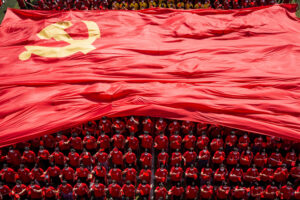
China’s totalitarian regime is built on surveillance, censorship, and repression, with harsh penalties for anyone who dares to defy it. Xi Jinping and the Chinese Communist Party have ambitions that extend beyond China’s borders. The following Journal of Democracy essays explore how China undermines democracy both at home and abroad. Read for free now.
October 2014, Volume 25, Issue 4
The protests that have been erupting around the world may signal the twilight of both the idea of revolution and the notion of political reformism.
January 2009, Volume 20, Issue 1
Democracy-aid providers are moving away from one-size-fits-all strategies and are adapting their programs to diverse political contexts. Two distinct overall approaches to assisting democracy have emerged in response.
July 2022, Volume 33, Issue 3
The more determined democracies are to avoid war, the greater the risk that autocracies will wage it.
January 2020, Volume 31, Issue 1
Why do East and Southeast Asia’s autocracies enjoy more support from their publics than do the region’s democracies?
October 2019, Volume 30, Issue 4
The results of the May 2019 elections to the European Parliament—and particularly the growing influence of the populist radical right—reflect a deep transformation of European politics that can largely be traced to the “refugee crisis” of 2015–16.
April 2018, Volume 29, Issue 2
In 2017, the state of political rights and civil liberties around the world sunk to its lowest point in more than a decade. While the democratic powers grappled with their own internal problems, leading autocrats expanded their global efforts to undermine democratic institutions.
July 2017, Volume 28, Issue 3
Read the full essay here. The relationship between democracy and civil society is not straightforward. Angry crowds can stymie the functioning of the democratic process, institutions, and governance. Drawing on recent Indian examples, this article sets out a typology of civil society movements in order to assess their impact on Indian democracy. It shows how…
April 2017, Volume 28, Issue 2
Populist nationalism is emerging as the main competitor to liberal democracy. But despite its current resurgence, in the long run, like other illiberal paths to modernity, it is likely to prove a dead end.
January 2015, Volume 26, Issue 1
Rather than being in decline, democracy is in crisis due to the gap between the democratic ideal and how democracy is actually being practiced. It will survive by transitioning into a new, as yet unknown, form.