
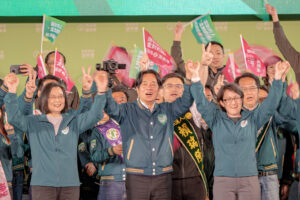
Why Taiwan’s Voters Defied Beijing—Again
Taiwan’s voters rewarded the ruling party with an unprecedented third consecutive term, despite the mainland’s attempts to intimidate. Expect Beijing to find new ways to threaten the democracy off its coast.
3272 Results
Taiwan’s voters rewarded the ruling party with an unprecedented third consecutive term, despite the mainland’s attempts to intimidate. Expect Beijing to find new ways to threaten the democracy off its coast.

July 2020, Volume 31, Issue 3
Liberal democracy has drawn its share of false indictments. But like any form of government, it has genuine weaknesses that can at best be managed. How well liberals navigate these inherent tensions may help determine the future of freedom.

The 2022 World Cup has just kicked off in Qatar. Long before the first match, the small Arab monarchy made a bet that investing billions in the “beautiful game” might do wonders for their reputation, too.

Why Emmanuel Macron’s reelection hangs on him winning support from the very people he has ignored most. April 2022 By Moshik Temkin This month’s French presidential election is giving off a strong sense of déjà vu. As in 2017 and 2002, a center-right presidential candidate (this time, current president Emmanuel Macron) faces off in…
October 2020, Volume 31, Issue 4
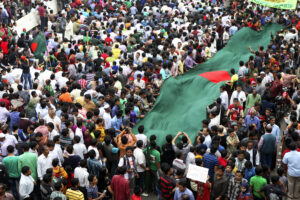
Despite impressive achievements in socioeconomic development, Bangladesh has struggled with establishing democracy and is now effectively under one-party rule.
October 2010, Volume 21, Issue 4
May 2010, Benigno Aquino III bested a crowded field to win the presidency. The election, which was remarkably clean and orderly, gave a clear victory to the reformist narrative that has long vied with populism in the Philippines.
July 2004, Volume 15, Issue 3
President Vladimir Putin's lopsided election victory was assisted by an unlevel electoral playing field, but elections still matter in Russia and they will make more difficult the consolidation of authoritarianism.
October 2024, Volume 35, Issue 4
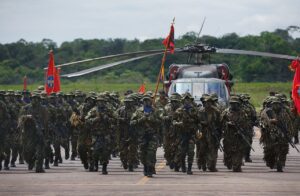
Drug cartels possess the power of militaries, the profits of corporations, and the coercive capacity of a state. They will not be eliminated any time soon. But the region’s democracies can seek to raise their costs, limit their influence, and curb the violence.
July 2012, Volume 23, Issue 3
A review of The Lady and the Peacock: The Life of Aung San Suu Kyi by Peter Popham.

So, why don’t they want to fix it?
July 2020, Volume 31, Issue 3
In Latin America, greater exposure to social media—and the digital misinformation that comes with it—seems to be bolstering prodemocratic attitudes even as it fuels public distrust in democratic institutions.
October 2019, Volume 30, Issue 4
A trio of national ballotings in 2019 tell a tale of waxing authoritarianism in Southeast Asia, but things could have turned out worse.
April 2015, Volume 26, Issue 2
The Iranian regime has sought to recast conventional principles of human rights and political participation by forging alliances with like-minded regimes and by broadcasting its narrative to an international audience.
July 2003, Volume 14, Issue 3
The election cycle concluding in the spring of 2003 was a guarded success. High hurdles to better governance and democratic consolidation remain, but Nigerians can now face them with greater hope.
National politics is increasingly overshadowing everything else, even as local government does more and more. Here’s how to right the balance. | By Eguiar Lizundia and Utpal Misra
July 2015, Volume 26, Issue 3
How are trends in global democratization likely to be shaped by the distribution of such key structural factors as income, ethnic or religious diversity, and the quality of the state?
On May 16, Brazil's Plataforma Democrática (founded by the Centro Edelstein de Pesquisas Sociais and the Instituto Fernando Henrique Cardoso) launched the Journal of Democracy: Edicão em Português.
June 11, 2012
April 2022, Volume 33, Issue 2
In 2021, autocrats’ efforts to reshape the global order enabled heavier repression and brazen power grabs, while democracies faltered. Is this a tipping point?

The military has spent decades trying to impose order on Pakistani politics. It has led to chaos. | By Ahsan I. Butt
April 2001, Volume 12, Issue 2
The Editors’ introduction to “High Anxiety in the Andes.”