
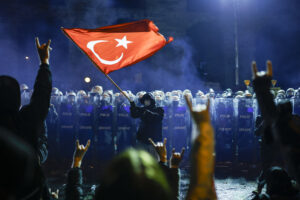
Inside Turkey’s Democratic Crisis
Turkish democracy is at a turning point: Will democratic forces be able to triumph at the ballot box in the next general election, or will the country devolve into full-blown authoritarianism?
1985 Results
Turkish democracy is at a turning point: Will democratic forces be able to triumph at the ballot box in the next general election, or will the country devolve into full-blown authoritarianism?
October 2018, Volume 29, Issue 4
Reports on elections in Cambodia, Maldives, Mali, Mauritania, Mexico, Pakistan, Rwanda, Swaziland, Turkey, and Zimbabwe.
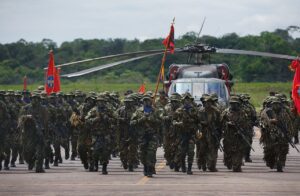
Organized criminal groups in Latin America have money, firepower, and a stranglehold on political life — making them incredibly difficult to defeat. How can countries in the region curb the violence and revive democracy?

Latin American voters are aggrieved, impatient, and eager to elect candidates who offer a break with the past—sometimes whatever that break may be. This factor, combined with high crime and middling economic growth, has led to wild swings and shrinking political rights. But can the region get itself unstuck?
July 2019, Volume 30, Issue 3
Within Ukraine, Russia’s 2014 invasion has generated unprecedented pressures to impose restrictions on speech. While international norms allow some censorship during wartime, some of Ukraine’s new media and cultural policies raise risks not only for its democracy, but for its security as well.
July 2019, Volume 30, Issue 3
The norm of ballot secrecy, although widely accepted in principle, is often downplayed and loosely defined in practice. As policy makers weigh new electoral options such as postal and internet voting, a better understanding is needed of secrecy’s many aspects and requirements.
July 2019, Volume 30, Issue 3
Data from the latest wave of the Afrobarometer survey show that Africans’ demand for liberal democracy remains high. The problem lies in lagging supply.
July 2019, Volume 30, Issue 3
Stymied in his effort to secure a third term, President Joseph Kabila manipulated the electoral process in order to secure a compliant successor.
October 2025, Volume 36, Issue 4
A Togolese activist and writer on oppression; a Chinese human-rights lawyer’s long detention; a reflection on Serbia’s anticorruption protests; Sviatlana Tsikhanouskaya commemorates five years since Belarus’s uprising; a Salvadoran university rejects the constitutional amendment; and Bolivia’s election anthem.

April 2019, Volume 30, Issue 2
Xi reads Tiananmen as a cautionary tale, and he has sought to centralize power and reverse years of ideological atrophy. By controlling the past, he is trying to determine how the Chinese will view their present and future.
October 2019, Volume 30, Issue 4
Reports on elections in Afghanistan, Guatemala, Madagascar, Mauritania, Nauru, Tunisia, Tuvalu, Ukraine.
October 2005, Volume 16, Issue 4
The election results reflect less what voters want than the ideological dynamics that shape the behavior of factions within the regime.

July 2019, Volume 30, Issue 3
A comic actor’s triumph in Ukraine’s free and competitive 2019 presidential race reflects distrust of establishment elites and a deep desire for change.
July 2019, Volume 30, Issue 3
Following the settlement of the revolutionary conflicts that long plagued the region, the left was able to reach power through elections. But the results have been discouraging.
January 2024, Volume 35, Issue 1
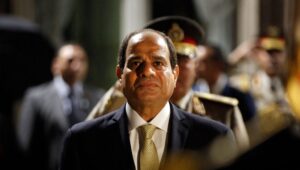
Egypt’s general-turned-president has spent lavishly, cemented the military’s political and economic control, and, afraid of suffering Mubarak’s fate, become increasingly repressive. But with crushing inflation and everyday people suffering, is Sisi losing his grip?
January 2019, Volume 30, Issue 1
A crackdown on the opposition, followed by sham parliamentary elections in July 2018, has deepened and extended the decades-long personalist dictatorship of Hun Sen.
April 2024, Volume 35, Issue 2
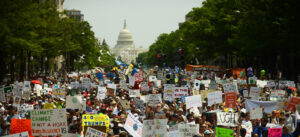
The problem for democracy today is not capitalism; it is a decline in public honesty and civility. But there is an opportunity to revive our sense of national community, if we seize it.
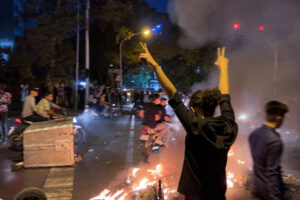
Iran’s women were the Islamic Republic’s first target for repression. This is the newest chapter in their struggle to win back their rights. | Ladan Boroumand