
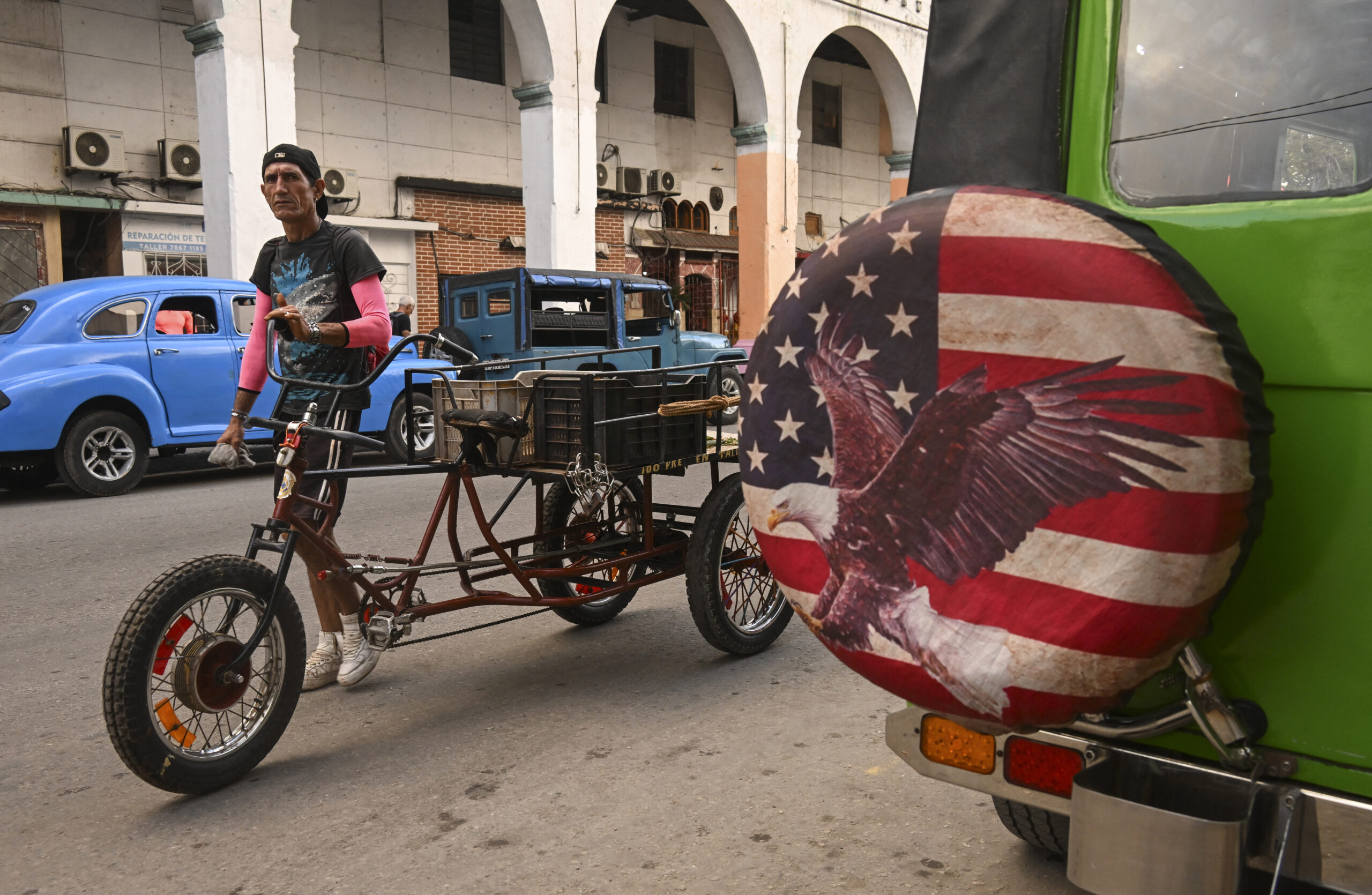
The Trump administration is ratcheting up the pressure, and the island dictatorship is in deep crisis. But what is the plan for picking up the pieces?
February 2026
Leer en español aquí.
A month has passed since the Trump administration’s audacious operation to remove Nicolás Maduro from power in Venezuela. Eyes remain fixed on the breakneck pace of dealmaking between Washington and the interim government of Delcy Rodríguez in Caracas, but attention is also shifting toward Cuba, already in a deep crisis. For the island’s communist leaders, could the loss of oil supplies from their long-time Chavista patrons be the final blow?
Expectation and anticipation have accelerated, egged on by President Donald Trump’s suggestion that Cuba “looks like it’s ready to fall.” Cuban diaspora social-media feeds are full of AI-generated renderings of Havana’s skyline transformed into an imitation of Miami’s luxury condo sprawl. Those who lived through previous predictions that a Cuban paradise was around the corner — after the fall of the Soviet Union, or when illness finally led Fidel Castro to step down — can be forgiven a sense of déjà vu.
Perhaps this time will be different. Cuba is in its most vulnerable economic position in more than thirty years. The Cuban state’s scarce reserves of domestic legitimacy have evaporated in the wake of generational change, bungled economic reforms, the migration of at least 13 percent of the population, and the repression of mass protests on 11 July 2021. With Washington not only able to cut off Venezuelan oil but threatening tariffs on any other country continuing to ship supplies to the island — especially Mexico — the United States wields extraordinary leverage. Cuban diplomats insist the island’s people would rather “sink into the sea” than accept American demands. But such assertions are starkly out of touch with a tired majority that would almost certainly welcome concessions if they improve daily life.
Yet if Cuban authorities’ ability to rally anti-imperialist resistance has diminished, the path from economic immiseration to political transformation remains murky and potentially devastating in humanitarian terms. With Cuban civil society gutted and opposition groups fragmented, outright regime change would likely require forcing the issue from outside. To avoid a protracted long-term commitment, Washington may prefer making a deal with a Cuban government insider. Regardless, any political transition that does not emerge from evolution or negotiation within, or that does not position Cubans as the central actors of national reconstruction, would be born with a massive question mark around its long-term legitimacy.
Weak Hands
Cuba’s acute vulnerability to U.S. pressure since Maduro’s ouster stems from its structural dependence on imported fuel. For years, Venezuelan shipments — 100,000 barrels a day at their peak — covered a substantial share of electricity generation, transportation, and industrial activity. As the flow dwindled alongside Venezuela’s wider collapse, Havana leaned on alternate suppliers, including Mexico and Russia. In 2025, Cuba required about 100,000 barrels of oil a day at diminished consumption levels, 40,000 of which came from domestic production, 35,000 from Venezuela, and 20,000 from Mexico — and this was still not enough to avert several nationwide blackouts.
Losing both Venezuelan and Mexican supplies therefore represents a systemic shock. By choking off or discouraging future shipments, the Trump administration is threatening to cripple the infrastructure of daily life.
Power outages already stretch for twelve to fifteen hours a day in Havana. Further fuel shortages are beginning to paralyze food production, public transit, and hospital operations. Russia has indicated that some of its shipments will continue, and the Chinese are helping the island to expand solar capacity. But there are no obvious alternative suppliers friendly to Havana that can step in at scale, and Cuba cannot afford to replace lost oil at global market prices.
Still, if Cuba’s government faces this crisis from a position of profound vulnerability, so too do its opponents. Frustration and anger are widespread, but years of repression, internal divisions, and mass emigration have hollowed out civil society’s organizational capacity. The most vocal critics now live abroad, while those who remain face constant surveillance or incarceration. Security forces will no doubt retain privileged access to what oil remains.
Exile groups, for their part, are as numerous as they are competitive for influence and attention. With Marco Rubio as secretary of state, Cuban Americans have never held more sway in the U.S. federal government. But unlike during the heyday of the Cuban American National Foundation in the 1990s, there is no single organization or leader who can claim to speak for the entire diaspora community.
In other words, there is no figure like Venezuela’s María Corina Machado, around whom Cubans on and off the island can rally. A political force capable of replacing the Cuban state has not cohered.
The Humanitarian Price of Leverage
Despite this lack of clarity, many U.S. policymakers, diaspora leaders, and opposition figures have embraced humanitarian suffering as a tool of political change.
Alongside the oil pressure campaign, South Florida officials have urged the Trump administration to cut off all flights and remittances from the United States to the island. Others have called on the Treasury Department to suspend licenses that allow U.S. businesses to export food, medicines, and other products under exceptions to the U.S. embargo.
Yet a clear theory for how hardship will accelerate the government’s fall remains missing. Will collective economic pain spark mass unrest? Elite fracture? Outright state collapse? At what human cost? If the goal is to deny resources to the Cuban state, targeting remittances seems an odd fit. These days, most are sent as in-kind gift parcels of food and medicine through the Cuban private sector, with hard currency flows largely staying out of the Cuban financial system through foreign passthroughs and bank accounts. Should the U.S. government dangle potential shipments of the Venezuelan oil it now controls to extract incremental political concessions from Havana? Rather than address how much pain is acceptable, or for how long, public rhetoric in the diaspora tends toward vague assurances: “Change is coming . . . We only have to push a little.”
Not all members of the diaspora, though, embrace a strategy of collective punishment. As much as they deplore the Cuban government, many recoil at plunging families into deeper darkness. In a social-media post, Cuban young professional Jaime Javier Veiga Alonso, who emigrated to Spain several years ago, insisted that cutting oil supplies would affect not those in power but rather mothers unable to cook, elderly people contending with illness, and children growing up in scarcity. “The pain of our people should never be currency,” he pleaded. He is not alone.
The Trouble with “Making a Deal”
Because of these concerns, some in Washington appear to view pressure on its own as an unstable foundation for change. Some diplomats have signaled interest in finding a “Cuban Delcy Rodríguez” — a regime insider with whom to negotiate a controlled transition.
A recent article in Spain’s ABC offered a more unsettling version of the same possibility. The report claims that Raúl Castro’s son, Alejandro Castro Espín, is engaged in exploratory conversations in Mexico with CIA officials about opening the Cuban economy to U.S. capital in exchange, perhaps, for certain Cuban leaders (including Castro Espín’s father) agreeing to head into exile — but allowing, as in Venezuela, the bulk of the Cuban government to remain. The report may prove inaccurate. Though President Trump himself has echoed the idea that talks are underway, other accounts and Cuban officials claim there is no serious dialogue at all. Either way, the prospect has unnerved parts of the diaspora worried that geopolitical pragmatism could lead the United States to prioritize reconfigured authoritarianism over democratic transformation, just as is at risk in the Venezuelan case.
Public messaging reflects this tension. Under Senate questioning, Rubio said the United States “would love to see the regime change [in Cuba],” then immediately added, “That doesn’t mean we’re going to make a change.” This ambiguity was reinforced when Deputy Secretary of State Christopher Landau met with Cuban opposition activist Rosa María Payá. “The U.S. is finally staking a strong leadership role in stabilizing our region,” he tweeted afterward. “Stabilization” suggests that order, containment, and transactional outcomes may be as central to Washington’s calculus as the slower work of democratic reconstruction.
Regardless, political obstacles to duplicating the Venezuela play are formidable. No obvious Cuban regime figure combines real authority within the system with reformist credibility. The Cuban leadership has historically managed internal dissent through punishment, discipline, and rotation rather than cultivating autonomous power centers. The power centers that do exist — namely, the Castro family, or the Cuban military and its vast holding company GAESA, with interests in all key revenue-earning sectors of the Cuban economy — would be unpalatable partners for Cuban Americans given their links to state security, not to mention accusations that they are sitting on billions while most Cubans barely get by. Besides, the Helms-Burton Act of 1996 restricts how much sanctions relief is possible prior to the establishment of a transition government not led by the Communist Party, ostensibly leaving little room for the kind of transactional dealmaking now being floated.
Historical Ghosts
So far, then, the U.S. strategy for Cuba appears caught between maximalist public expectations, dealmaking inclinations among some administration insiders, and limited tools. There is coercion without a viable transition partner, pressure without clear off-ramps. If neither economic collapse nor elite negotiation produces a clear pathway forward, the remaining scenario is even more dangerous: crisis spiraling into unrest that creates a pretext for external intervention.
Washington has shown little appetite for sustained military involvement. Yet amid a true humanitarian catastrophe or leadership vacuum, the pressure to act would be immense. Cuba’s proximity, migration pressures, and the temptation for the administration to take credit for liberating Cuba would make standing on the sidelines unlikely.
This is where history casts a worrisome shadow. In 1898, the United States intervened, uninvited, in Cubans’ ongoing war for their independence again Spain. The outcome saddled the birth of Cuban democracy with foreign military occupation, external economic dependency, and constrained sovereignty written into Cuba’s first constitution. American investors gobbled up war-torn properties for bargain-basement prices. The fragile political and economic order that resulted contributed to instability, deep nationalist resentments, and, ultimately, the grievances that fueled Castro’s revolution.
In fairness, through its direct sanctions and their extraterritorial effects (particularly on financial transactions and banking), Washington exerts considerable control over Cuba’s destiny already. The island is in many ways dependent on the United States today for remittances and critical supplies of food and other goods under embargo exemptions.
Nevertheless, regime change imposed externally risks resetting the historical clock in even more dramatic fashion while reproducing a new version of the legitimacy deficit from 1898: a government born not of negotiated national consensus or internal transformation, but of foreign imposition. Such an outcome might remove or alter what’s left of Cuba’s totalitarian system while planting the seeds of future instability, corruption, or worse.
In Search of Credible Paths
Those predicting imminent transformation are right: The Cuban government has rarely looked so defenseless.
What is missing is a credible architecture for political change, one that centers Cuban actors, rebuilds civil society, and creates institutional legitimacy rather than relying on collapse to do the work of reconstruction. Absent those ingredients, pressure risks humanitarian disaster, unstable elite bargains, or externally imposed outcomes that address one crisis while sowing another.
Efforts to engineer transformation in Cuba are also unfolding as the United States faces unprecedented questions about the resilience of its own democratic norms. Washington has shown willingness to accommodate illiberal actors at home and abroad (including in Latin America) when politically expedient. That credibility gap matters. It shapes how U.S. pressure is perceived, the legitimacy of any transition it sponsors, and the durability of the political order that follows.
The fantasy of effortless regime implosion — complete with glossy visions of a reborn Havana — obscures the far harder reality of postauthoritarian rebuilding. It treats economic pain as a catalyst while ignoring the social foundations necessary for political order. Cuba may indeed be at its most consequential turning point in decades. But history suggests that how change comes matters as much as that it comes at all.
Michael J. Bustamante is the Emilio Bacardí Moreau Chair for Cuban and Cuban-American Studies at the University of Miami.
Copyright © 2026 National Endowment for Democracy
Image credit: YAMIL LAGE / AFP via Getty Images
|
FURTHER READING |
||
Cuba’s Mafia State |
The Cuban Embargo Does Not ExistThe Cuban regime has created a narrative of victimhood as a smoke screen for its gross incompetence and corruption. I should know. I once believed it, too. |
|