
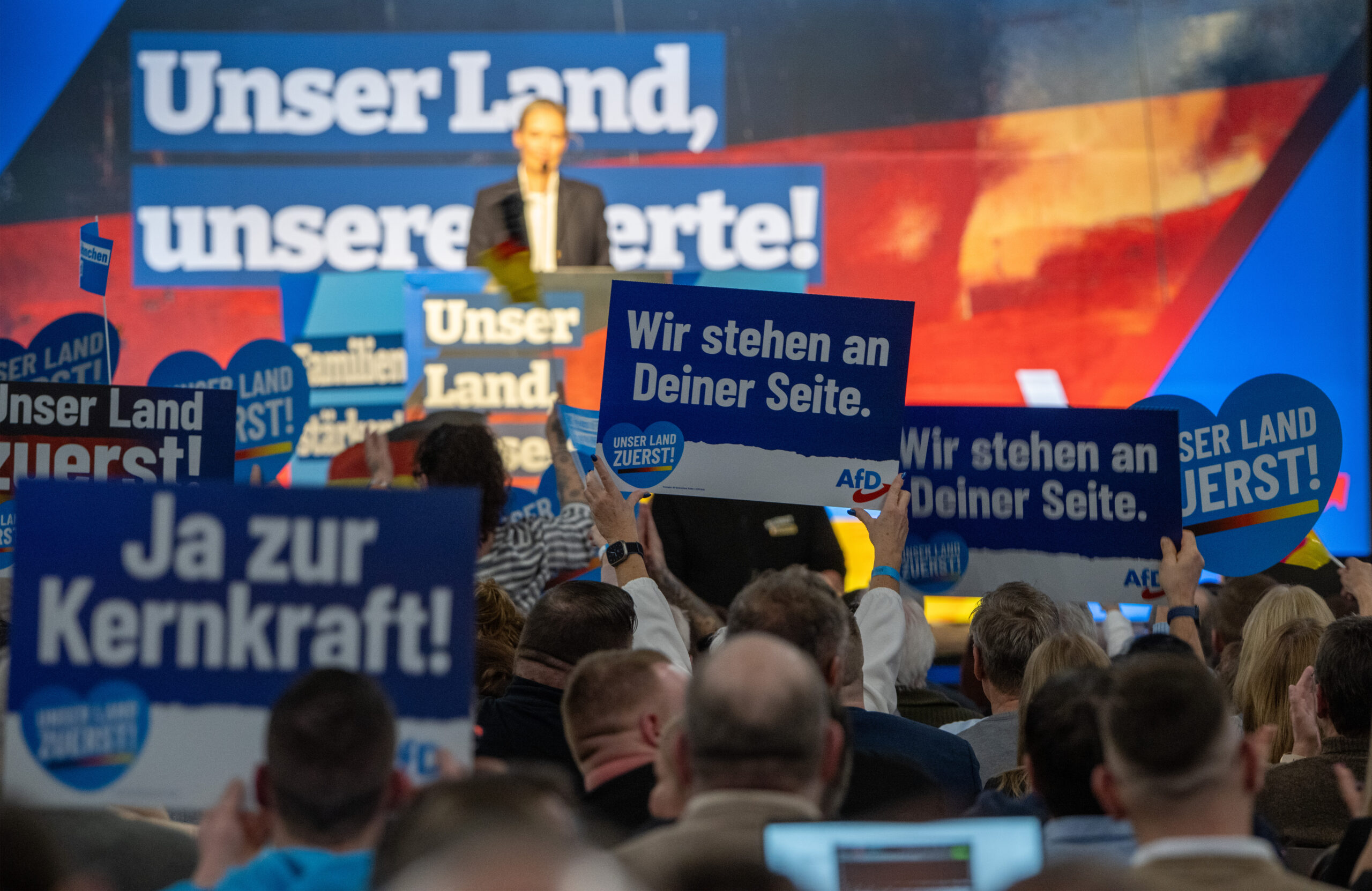
In the first contests of Germany’s “super election year,” the radical-right AfD performed well far from its strongholds. The country may soon decide it’s time to cooperate with the party rather than try to contain it.
March 2026
Germany is in the midst of another Superwahljahr — a super election year — with a total of five regional elections scheduled by the end of 2026. Against the backdrop of stagnating growth, rising energy prices, and mounting concerns about immigration, this series of elections is testing the post-2025 federal landscape under German chancellor Friedrich Merz, whose Christian Democratic Union (CDU) is currently governing in a grand coalition with the Social Democrats (SPD).
With results now in from the first two elections — held in the economically strong southwestern states of Baden-Württemberg on March 8 and Rhineland-Palatinate on March 22 — the outcomes point to substantial electoral shifts with repercussions far beyond the regional level.
In Rhineland-Palatinate, the CDU prevailed with 31 percent of the vote. After ten failed attempts to unseat the Social Democratic state premier, the CDU increased its vote share by more than 3 percentage points, relegating the previously governing SPD to second place with around 26 percent. This result not only signals the end of the last remaining traffic-light coalition (SPD–Greens–Free Democratic Party [FDP]) at the state level but also marks a further historic low for the Social Democrats, who had governed the state for more than 35 years. The most likely outcome — following a campaign dominated by economic concerns — is another grand coalition between the CDU and SPD, which could lend momentum to Merz’s struggling coalition in Berlin.
The Greens, Liberals, Free Voters (a center-right party that blends regionalism with conservatism), and the Left all lost support and — except for the Greens — failed to enter the state parliament. The Greens narrowly made it in with just under 8 percent. Notably, the far-right Alternative for Germany (AfD) delivered a strong performance, more than doubling its vote share to around 20 percent and achieving its best-ever result in a western German state.
This result echoes the outcome in Baden-Württemberg two weeks earlier, where the Greens narrowly retained first place at about 30 percent and defended their sole state premiership. The next premier is likely to be Green leader Cem Özdemir, a German of Turkish descent known for his pro-business stance and opposition to open-border policies — positions so controversial within his party that members of its youth wing insulted him at his victory event.
In Baden-Württemberg, the CDU surged to a close second (29.7 percent) with significant gains, while the AfD again nearly doubled its share to 18.8 percent. Meanwhile, the SPD collapsed to its worst-ever postwar result, and both far-left Die Linke and the pro-business FDP failed to clear the 5 percent threshold.
What emerges is an ambivalent picture shaped by regional specifics and personal popularity, yet defined by broader trends: the strong performance of the Christian Democrats, the continued rise of the far right, the ongoing collapse of Germany’s center left, and setbacks for the radical left.
A key takeaway from these first two elections is the deep entrenchment of the AfD in western Germany. The party’s strongholds were long confined to the east, but that is no longer the case. In both Baden-Württemberg and Rhineland-Palatinate, the AfD doubled its representation in state parliaments and made further gains by winning several direct-constituency mandates.
Postelection analysis indicates that the party is increasingly attractive to younger and blue-collar voters. In Rhineland-Palatinate, the AfD emerged as the strongest party among voters under 24; in Baden-Württemberg, it placed second in this demographic. In both elections, support among blue-collar workers reached nearly 40 percent, positioning the AfD as the de facto new workers’ party.
As in previous elections, the AfD continues to benefit from perceived competence on issues such as asylum, refugees, and crime. In Rhineland-Palatinate, a quarter of voters consider the AFD the most competent party on security, and 27 percent on asylum and refugees.
Now, however, the AfD’s perceived competence is notably expanding into economic issues. While only 4 percent of voters in Rhineland-Palatinate viewed the party as economically competent in 2021, that figure has risen to 17 percent. A similar trend is visible in Baden-Württemberg, where the AfD has seen double-digit increases in perceived competence on social-justice and economic matters — indicating a broader diversification of issue ownership.
The party also remains effective in mobilizing former nonvoters. Its success appears largely unaffected by corruption allegations (including cases involving the hiring of relatives by AfD officeholders) or geopolitical factors, such as widespread public rejection of U.S. president Donald Trump’s policies. So far, the AfD has managed these accountability challenges effectively.
The rise of the AfD mirrors the sharp decline of Germany’s center left. Just two weeks ago, the SPD recorded the worst result in its more than 150-year history, barely surpassing the 5 percent threshold in Baden-Württemberg with only 5.5 percent of the vote. This weekend, it lost another traditional stronghold, reducing the number of Social Democratic state premiers to just five. These results are widely expected to trigger political fallout in Berlin. Party leaders have announced an emergency meeting for Friday involving the parliamentary group, minister-presidents, SPD ministers, and leading municipal representatives to discuss possible leadership changes.
The results were particularly damaging for Germany’s smaller parties. Die Linke, which saw a temporary resurgence after the last federal election, failed to build on its momentum. While this may be partly explained by the socially conservative and economically affluent nature of these regions, the same cannot be said for the FDP. Having now failed to enter a state parliament for the second consecutive time — and after being voted out of the federal parliament — the Liberals appear to be in terminal decline. They are currently represented in only six of Germany’s sixteen state parliaments, prompting Chancellor Merz to recently declare the party essentially “dead.”
From a broader perspective, a more optimistic interpretation would see these results as evidence of democratic resilience, despite a clear rightward trend. In both elections, parties of the democratic center secured governing majorities. Germany’s liberal flagship newspaper Die Zeit has argued that in many Western democracies, a 50 percent vote share for centrist parties would be considered exceptional in today’s fermented political climate. Yet only a few years ago, Germany’s centrist parties commanded around 80 percent.
Looking ahead to the remainder of this Superwahljahr, key questions remain: Will these trends persist? Can newly elected state governments — and the federal grand coalition — restore effective governance, implement meaningful reforms, and revive economic growth? While both Social Democrats and Christian Democrats signal readiness for reforms, it remains uncertain whether the SPD has the political strength to sustain such efforts amid declining support.
At a systemic level, the central question is how — or whether — established parties can halt the AfD’s accelerating rise. Debates on this issue are ongoing and often touch on fundamental aspects of Germany’s antifascist postwar identity. Recent court rulings preventing the AfD from being classified as extremist in its entirety have made an outright party ban increasingly unlikely.
With upcoming elections in Berlin, Mecklenburg-Vorpommern, and Saxony-Anhalt — where the AfD is already the strongest force in polls — the issue of governability is likely to become more urgent.
For Germany’s conservatives, the dilemma is acute: How can center-right majorities in public opinion be translated into policy when doing so requires cooperation with the political left? One potential answer would be to reconsider the Brandmauer (firewall), under which all parties have refused to cooperate with the AfD. Increasingly, conservative voices are asking when this “straitjacket” will cease to contain the far right and instead begin to fuel its rise. Recent polling suggests that public support for isolating the AfD is weakening, with nearly half of voters in southwestern Germany now open to cooperation.
Given that the AfD currently leads in polls in two of the three remaining state elections this year, it remains to be seen what German voters — and the governing coalition — will do next, and if the Superwahljahr 2026 could spell the beginning of the end of the Brandmauer.
Michael Bröning is a political scientist and a member of the basic-value commission of the German Social Democratic Party. His most recent book is Die Hetzer sind immer die Anderen (2024).
Copyright © 2026 National Endowment for Democracy
Image credit: Harald Tittel/picture alliance via Getty Images
|
FURTHER READING |
||
Is Germany Headed to a Political Crisis? |
Why Germany’s Far Right Is Winning Big |
Why Germans Are Rallying Against the Far RightHundreds of thousands of Germans are taking to the streets in protest against the country’s far-right parties. Will it shift the tide or leave Germany further divided? |