
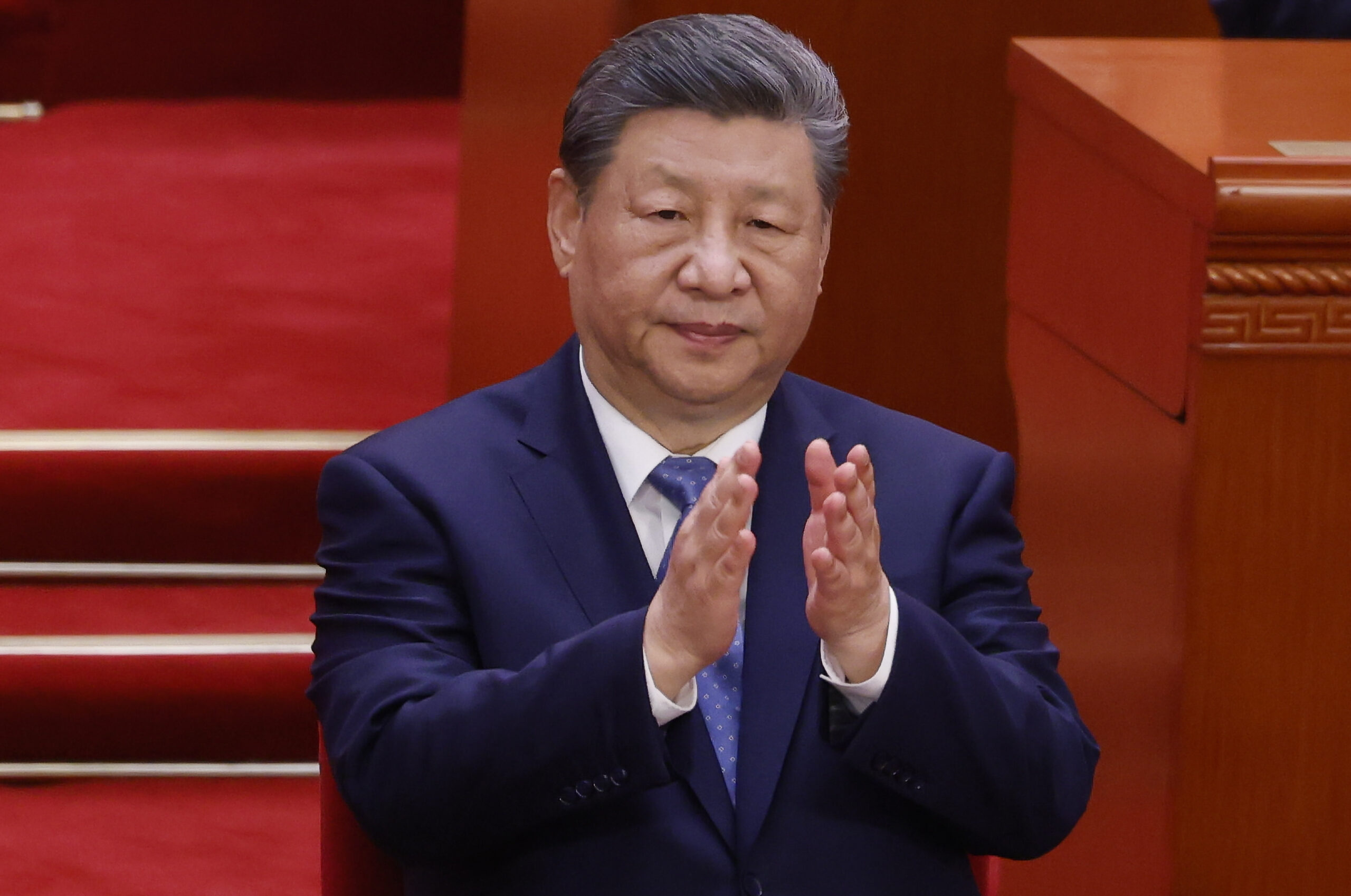
Xi’s ongoing purge of China’s leaders — including his political allies — marks a return to Mao-style court politics. He is cementing his absolute control — and laying the groundwork for a major succession crisis.
March 2026
In the final days of 2025, the demise of Ma Xingrui, the former Xinjiang party secretary, was confirmed when his name conspicuously vanished from a ceremonial wreath. While the chattering class waited for the official word, a greater shockwave struck: A terse communiqué abruptly announced that Zhang Youxia, the first vice-chairman of the Central Military Commission (CMC), had been placed under investigation. From CMC Second Vice-Chairman He Weidong to Ma, and now Zhang, the targets are growing more politically significant. The purge of three incumbent Politburo members within a single term marks the most extensive high-level political shake-up since the 1970s.
Years from now, when historians look at this moment, they will realize that the true era of ruthless turbulence in Beijing had only just begun.
In the early stages of this wave of purges, external observers largely misread the tremors. As Xi Jinping’s loyalists were ousted one by one, conventional wisdom held that the supreme leader was struggling to maintain his grip, perhaps even facing resurgent opposition. This narrative evoked images of “dynastic decline,” suggesting a fatal fracturing of his power base. Many even projected Zhang Youxia as the ultimate challenger — a formidable counterweight capable of holding the line. It was not until Zhang himself was abruptly purged that this illusion was shattered, waking analysts from their wishful thinking.
Far from signaling weakness, this “Great Purge” is a defining feature of Xi’s drive toward personalist dictatorship. We are witnessing a paradigm shift away from the post-Mao era’s oligarchic equilibrium toward a system of absolute obedience. Xi does not purge out of fear of opposition. The purge is the point — a naked display of the sovereign’s unbridled capacity to dispose of any official, regardless of past loyalty, bloodline, or competence.
For decades, the primary lens for understanding Beijing’s machinations was the interplay between competing factions. During the Jiang Zemin and Hu Jintao eras, purges often adhered to an unwritten code, primarily targeting rivals while generally respecting the tacit immunity of top elites to maintain a delicate balance of power. That was an age of oligarchy, where political control relied on private compromise and backroom negotiation.
That old paradigm is now dead. The “Shanghai Gang” is a memory, the Communist Youth League faction has been decimated, and the “Princelings” have withered away. The Chinese Communist Party’s (CCP) senior ranks are now overwhelmingly dominated by “Xi’s Army.” Today’s purges are no longer about merely eliminating opponents; they are about a show of power.
This transformation reveals the core logic of the new court: Under absolute rule, there are no allies, only servants. It is an axiom of authoritarian politics that once a dictator eliminates external rivals, the gravest danger invariably emerges from the inner circle. For Xi, any subordinate commanding an independent power base or wielding extensive local resources — even if outwardly loyal — represents an intolerable threat. By purging seemingly unassailable lieutenants, Xi broadcasts a chilling ultimatum: No one is beyond his reach.
By deliberately fostering internal discord and atomizing his subordinates, Xi engineers unpredictability to cement his status as the sole arbiter of power, trapping every official in a state of existential dread and absolute obeisance. Hardly a modern invention, such a ruling strategy represents a chilling return to the machinations of dynastic court politics — one that draws directly from the Maoist playbook.
In the early years of the People’s Republic, Mao Zedong famously used Gao Gang, an early leader of the CCP, to curb chairman Liu Shaoqi’s rising influence, allowing Gao — who imagined himself the Chairman’s favored blade — to aggressively target Liu’s factional network. Yet, when Liu mounted a counteroffensive exposing Gao’s political ambitions, Mao unhesitatingly discarded his instrument as the head of an “anti-Party clique.” The victor’s reprieve, however, was merely a stay of execution: Liu would eventually be consumed by the same machinery of the purge once Mao decided that Liu, too, represented an intolerable threat.
A modern reprise of this cycle has just unfolded. Xi likely permitted his handpicked protégés, He Weidong and Miao Hua, to target the entrenched network of Zhang Youxia. However, when Zhang counterattacked, reportedly presenting evidence of their crimes, Xi replicated the Maoist pivot. He jettisoned his loyalists. But once the rival faction was eliminated, it was Zhang’s turn to be discarded — not the victor, but merely the last one eaten. In the court, a vassal who possesses the power to destroy another vassal is, by definition, a threat to the sovereign.
Unlike the Mao era, where “counterrevolution” was the weapon of choice, today’s purge is cloaked in “anticorruption.” Yet the core remains identical: The decision of when and who is purged is entirely a function of the leader’s own political necessity. Whether to quell intraparty discord or simply to reinforce the sovereign’s power, any official, regardless of rank, becomes an expendable pawn. This has terrorized the bureaucracy, compelling officials to prioritize self-preservation over sound policy, obsessed with avoiding the fate of becoming the next “example.”
A telling anecdote from Mao’s twilight years vividly illuminates the psyche of China’s highest-ranking officials today, such as Premier Li Qiang or Chief of Staff Cai Qi. It is recorded that early one morning, Zhou was informed that Mao had collapsed. Zhou rushed to the chairman’s bedside, where the sight of the unconscious Mao caused him to lose control of his bowels and bladder. Minutes later, when Mao came to, Zhou’s immediate instinct was to cry out: “Chairman, the power is still in your full command!”
This single sentence encapsulates the survival instinct of the inner court: The apparatus does not fear Xi losing power; it fears Xi suspecting that he is losing power. Should the leader harbor such insecurity, a fresh wave of frenzied purges becomes the only inevitable response. For lieutenants like Li and Cai, daily politics has devolved into a permanent performance — a feverish, nonstop reassurance that “the power is still in your full command.” Any lapse in this theater is to invite the next sacrifice.
Yet, while Xi’s power remains unassailable, his prestige is inexorably drawing closer to a “Lin Biao moment.” It is crucial to distinguish between the capacity to instill fear and the legitimacy derived from widespread conviction. Xi undoubtedly possesses the former, but is rapidly forfeiting the latter. Lin Biao’s death in 1971 marked the ideological watershed of the Mao era; the sudden downfall of a political successor formally enshrined in the Party Charter shattered the myth of the leader’s infallibility and exposed the sheer absurdity of the political struggle.
Today, Xi finds himself in a parallel predicament. The political myth of the leader’s “sage wisdom” and “astute appointments” is crumbling. Qin Gang, Li Shangfu, Wei Fenghe, Miao Hua, He Weidong, Ma Xingrui — and now Zhang Youxia and Liu Zhenli — were not holdovers, but all leaders handpicked by Xi. Their purge creates an insoluble paradox: Either Xi possesses profoundly flawed judgment, consistently picking “bad apples,” or the system itself has become a relentless meat grinder where no status guarantees safety. Regardless of the answer, it inflicts a crushing blow to his political prestige.
The political endgame is stark. As Xi enters his later years, the high-pressure campaign of purges will not cease; instead, it is bound to intensify, fueled by increasing fears of aging and betrayal. By systematically purging all capable and prestigious potential heirs, Xi is engineering a monumental succession crisis. His eventual departure will leave a profound power vacuum, triggering a fierce struggle for survival among those who remain. Given the progressive erosion of his moral authority, any victor emerging from this struggle will inevitably seek legitimacy by systematically repudiating Xi’s legacy — a pattern of posthumous reckoning seen after both Stalin and Mao. The purge is the point — but a dynasty of one condemned to endless purges will not have a second opportunity, destined only to consume everything the purger sought to build.
Christopher Nye is a Non-Resident Fellow at The Jamestown Foundation. He previously served as a professor and directed a university think tank in China. He specializes in China’s elite politics, local governance, legal institutions, and U.S.-China technology competition.
Copyright © 2026 National Endowment for Democracy
Image credit: Lintao Zhang/Getty Images
|
FURTHER READING |
||
China’s Age of Counterreform |
The CCP After the Zero-Covid FailThe regime’s ill-fated policy to eliminate covid from China spurred the largest protests in a generation. It also made Xi Jinping’s challenge of maintaining authoritarian control over Chinese society even harder. |
China’s Threat to Global DemocracyMichael Beckley and Hal Brands The Chinese Communist Party is deadly serious about its authoritarian designs, and it is bent on promoting them. It is time for the world’s democracies to get serious, too. |