
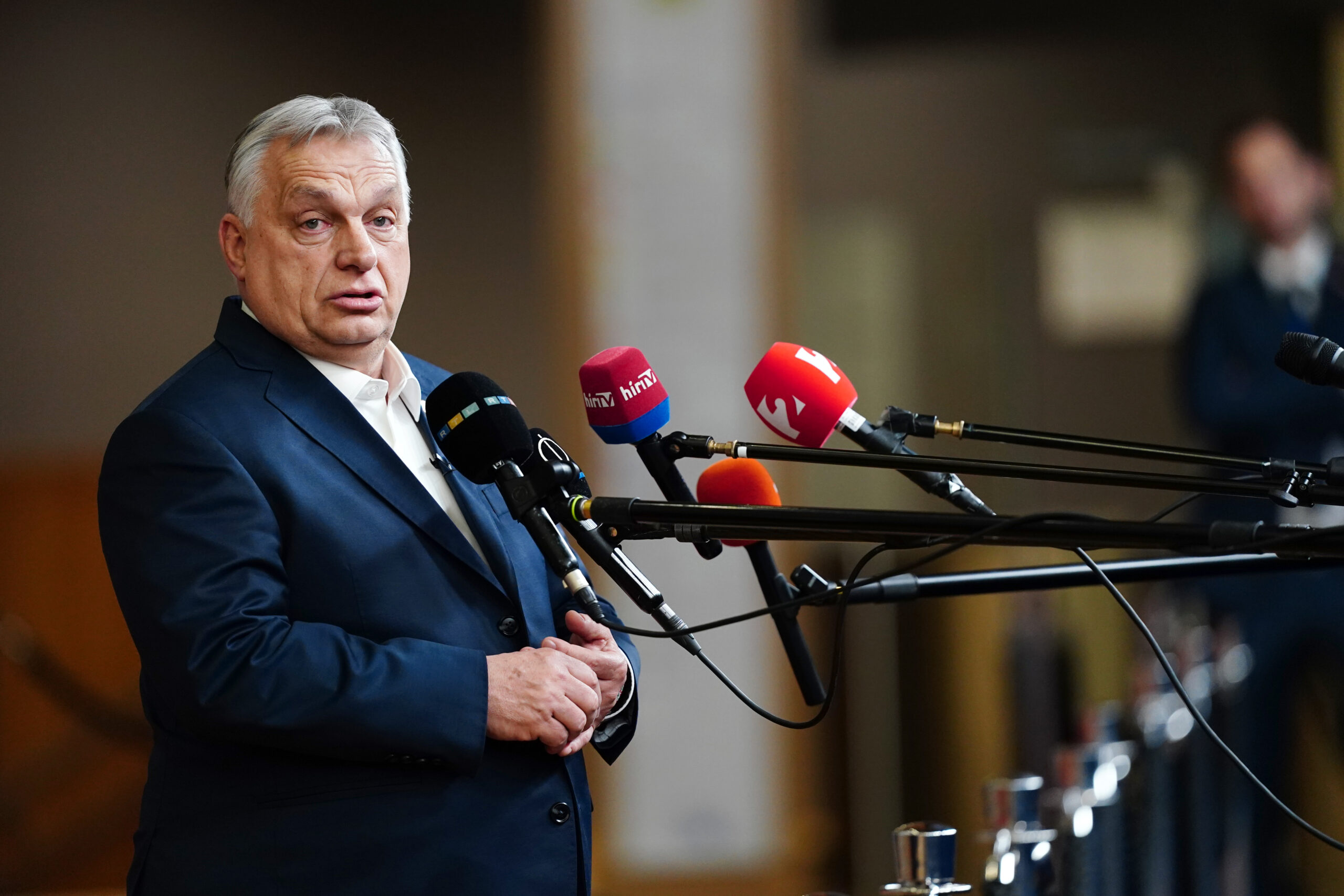
A series of unforced errors, poor results, and a worthy opponent are part of the explanation. But there are wider lessons that may explain how Orbán and other illiberal leaders can be defeated.
By Ferenc Laczó
April 2026
On 12 April 2026, Hungarians will go to the polls to cast their ballots in what is widely seen as this year’s most consequential European election. The vote will amount to a referendum on Prime Minister Viktor Orbán’s supermajoritarian and increasingly centralized rule. Sixteen years in power, he has been responsible for the sharp decline of democratic standards and the establishment of the first illiberal state within the enlarged West, making Hungary the forerunner of what is now seen as a much wider anti-democratic trend. The run-up to election day has brought a flurry of unexpected and sometimes disturbing turns, from a flood of online fakes to high-profile diplomatic leaks to even a faux sex scandal.
Following Romania’s controversial nullified-and-rerun 2024–25 presidential election, the Hungarian parliamentary election may be the most geopolitically significant one in EU history. Held in a country that has repeatedly been a site for political experimentation, it will pit pro-European and broadly liberal forces against a seemingly entrenched regime that is intent on furthering an illiberal revolution within a liberal Union. The EU’s contested neighborhood has seen such fraught elections, and now the EU itself is seeing them too.
What may be more surprising is that there are several hopeful lessons to report.
Orbán’s grip on Hungary’s state institutions and political resources has become so tight that many thought it virtually impossible for his party, Fidesz, to lose any of the free but notoriously unfair elections it prefers to hold. Yet after four straight terms, Orbán’s regime finds itself struggling to frame an effective response to the recently founded Tisza party’s meteoric rise. Over the last two years, the fear that once dominated the country has largely dissipated. Under former Fidesz insider turned opposition firebrand Péter Magyar, Tisza (whose name is a portmanteau for “Respect and Freedom” and a play on the name of a major Hungarian river) appears to be doing well in the run-up, even if the result that truly matters — the number of seats in the 199-member, unicameral parliament — may turn out to be tight.
What explains this unexpected turn? How has Tisza been able to run against Fidesz with what seems to be (if surveys are accurate) so much success?
Crumbling Illiberal Hegemony
It is ironic that just when the illiberal revolt appears to have gone nearly global, the regime built by a pioneer of this revolt within a newly vulnerable EU began making unforced errors. Trying to leverage EU membership in ever more controversial ways, Orbán’s regime has marginalized the country within a Union on which Hungary continues to depend despite Orbán’s posturings.
More damagingly still to his party’s political prospects, Orbán has neglected the core tasks of governing Hungary effectively and holding on to popular legitimacy by meeting new challenges. He has let public services visibly deteriorate even as the cost of living keeps rising. Dissatisfaction is now widespread. The unfolding political turn, however, has deeper causes — and analyzing them may yield lessons regarding how seemingly entrenched illiberal hegemony might come undone elsewhere too.
While Orbán’s regime has been centralizing power methodically, it has continued to deploy a populist-moralizing discourse against liberal international elites, promising to protect the Hungarian populace against the most varied threats, real or imaginary. His regime has even painted a conservative utopia: Hungary was supposed to have become a bastion of traditional values. Being in the EU has had a constraining effect to some extent, not least as it implied a need to maintain certain appearances. It meant that Orbán’s regime, its gradual hardening across the years notwithstanding, continued to exhibit a relatively soft version of authoritarianism.
If such a combination of populism, conservatism, and soft authoritarianism looked like a winning formula on the EU’s disadvantaged periphery, the tensions inherent in such a project have recently become glaring. The building of a new oligarchic elite raised the odds of populist rhetoric being turned against it. The starker the colors in which a conservative utopia was painted, the more apparent grew the gap between supposedly dominant values and actual social realities in a system without proper checks and balances. The more the regime talked about protecting society and nation, the more socioeconomic crises hurt its popularity. Nonetheless, Tisza’s ascent over the past two years took everyone by surprise.
Key factors behind it can be identified, however. Autocratizing regimes may be most effectively challenged by elite defection, especially if defectors can turn the regime’s own political tactics against it and thereby unite the bloc of opposition voters with former loyalists. That indeed seems to be the formula that Péter Magyar has applied so successfully: To delegitimize an illiberal state, he often presents liberal demands in a national-populist key.
Magyar’s confrontational style and recurrent grandstanding may not always be the most appealing, but a dynamic and power-savvy opportunist dedicated to core values might indeed be most capable of catalyzing positive change under illiberal rule. While Magyar shares the incumbent’s rhetorical skills and charismatic appeal, he is also significantly younger (45 to Orbán’s 62), more polished, and — crucially — less cynical.
If this is a moment of rising hopes in a badly mismanaged and indignant country, it should also be a moment of grave concern. When challenged, corrupt authoritarian regimes can become less inhibited and more dangerous. Orbán’s electoral strategy has revolved around heightening conflicts, the row with Ukraine most prominent and controversial among them. Mass disinformation campaigns are an inherent part of this strategy. We cannot know in advance how far the regime’s defenders might go to keep power, or what they might do to block a new majority from exercising its democratic prerogatives. Illiberal hegemony may have crumbled, but we should not expect defeat to be conceded without a fierce rearguard fight.
In the days ahead, Tisza’s leaders will need to stay calm. They will also need a long-term strategy that can balance the redemocratizing of institutions with the deescalation of political contention. Even in the sunniest scenarios, the legacy of Fidesz’s methodical sixteen-year power grab will haunt the country for years to come.
European Lessons
Orbán’s longstanding centralized rule holds urgent lessons for the European project as a whole. The current crucial moment in Hungarian history also previews the kinds of issues (illiberal subversion, geopolitical realignment, mass mobilization to oppose such changes) that Europeans are likely to face repeatedly in coming years.
Through extensive subsidies and symbolic legitimation, the EU spent the 2010s unwittingly nurturing an avowedly illiberal state in its midst. The Union refuses to take responsibility for this, pleading ignorance, but the truth is that it should have known. Orbán made no secret of his intentions, speaking proudly in public as early as 2014 of the “illiberal state” that he was creating.
The unfolding of Orbán’s illiberal project also laid bare how limited and ineffective the EU’s commitment is to defending liberal democracy in its member states. As is widely recognized today, the EU loses much of the leverage it has on a country as soon as that country becomes a full member. Part of the irony is that the EU has remained more popular in Hungary than it has been ready to acknowledge. This underestimation of one’s own strength has led the Union to prefer soft tools in its treatment of the Hungarian regime – even though a clearer confrontation between Brussels and Budapest might well have generated wider resistance to Orbán’s illiberal turn in Hungarian society.
In recent years, the Fidesz regime has openly placed the priorities of external actors above those of its European allies. In the process, Orbán’s ever bolder foreign-policy choices have exposed another major vulnerability of European integration: Member states can easily leverage their broad veto powers over Union policy. As the EU becomes an object of global contestation, such leveraging will only become more common. The foreign-policy ideologues of Fidesz like to boast that Hungary maintains good relations with all world power centers except Brussels — an attitude which, given the country’s position and environment, amounts to the opposite of Realpolitik.
The obliviousness, meekness, and weakness that have marked the EU’s dealings with Orbán over the past sixteen years point to a painful conclusion: The Union has disappointed and largely failed Hungarian citizens who favor liberal democracy and transnational integration. Their experience points to urgent needs for the EU to streamline and bolster its fragile structures, to reexamine its apolitical conception of democracy, and to learn more effective ways of doing transnational politics.
Whether the April 12 election goes poorly for Fidesz or they emerge victorious, their eagerness to keep up democratic appearances might give way to their will to preserve power. This would set Hungary on an even starker collision course with the EU, and could require the Union to develop an expulsion mechanism. Under such a ruinous scenario, protecting the rights of Hungarian citizens would become both more urgent and more difficult.
If Tisza wins and is able to take power, its twin challenges will be to restore Hungary’s credibility among its allies while taking apart the complex and methodically constructed edifice of illiberalism that Orbán built. Unfortunately, no matter how well planned, strategies to undo illiberal inheritances may themselves result in frustrating backsliding. As Tisza tries to govern, the EU would need to strike a balance between strong support and enough strictness to make sure liberal-democratic boundaries are not being crossed. In other words, it would finally need to develop an ambitious democracy agenda that will make compromises only when those are principled.
Either of the two likeliest outcomes of April 12 — an even harsher authoritarian turn or an ambitious attempt to unmake an illiberal state — will force the EU to face unprecedented challenges and foreshadow issues that it will have to confront more often in coming years. All this said, that voters in the EU’s most controversial member state seem ready to deliver an unexpected verdict against illiberalism in this year’s most consequential European election remains cause for cautious optimism.
Ferenc Laczó is assistant professor of history at Maastricht University and author of Hungarian Jews in the Age of Genocide: An Intellectual History, 1929–1948 (2016).
Copyright © 2026 National Endowment for Democracy
Image credit: Pier Marco Tacca/Getty Images
|
FURTHER READING |
||
Inside Orbán’s Plan to Occupy Europe |

The Viktor Orbán Show |
How Viktor Orbán WinsThe case of Hungary shows how autocrats can rig elections legally, using legislative majorities to change the law and neutralize the opposition at every turn, no matter what strategy they adopt. |