
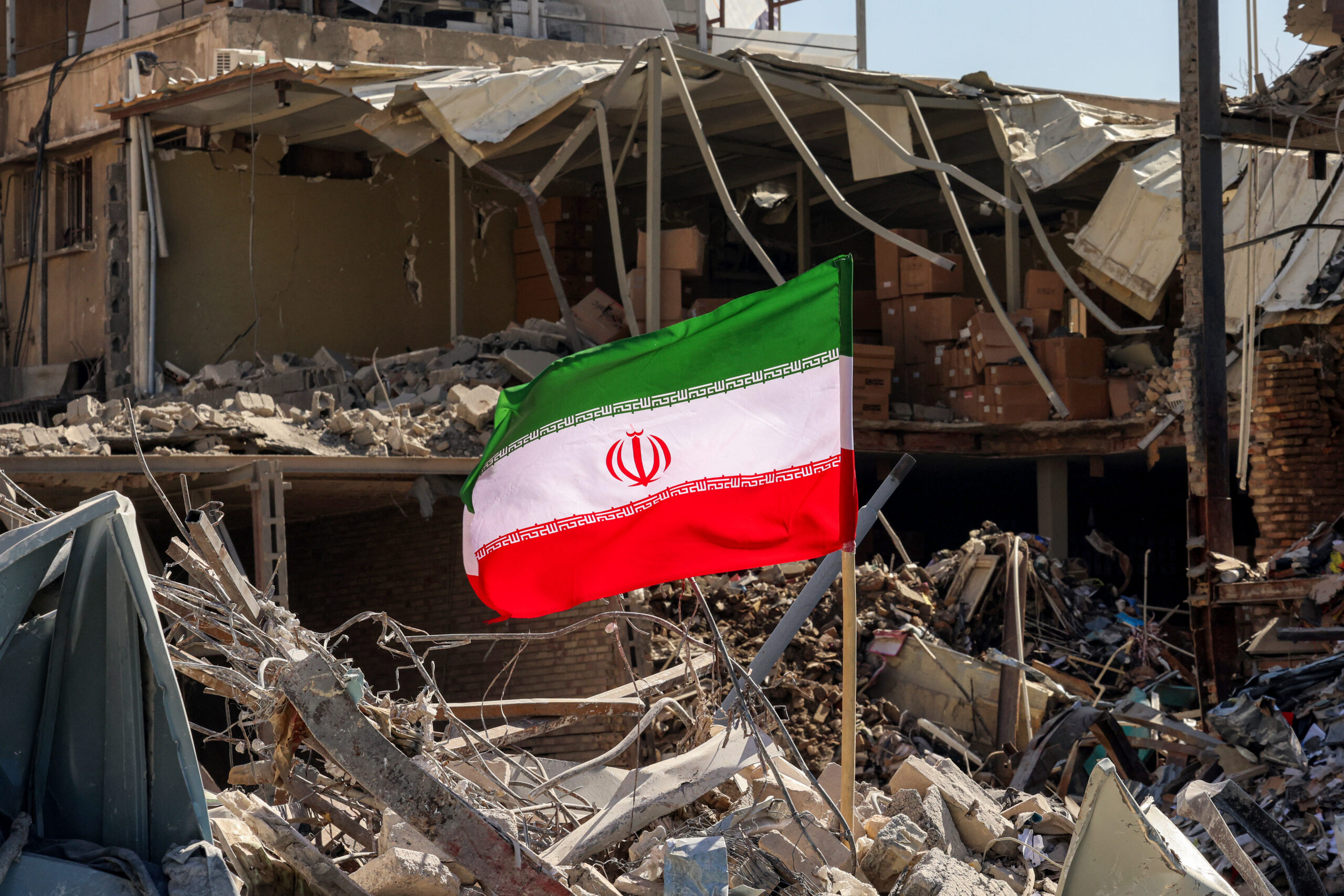
After January’s mass protests, Iran seemed on the verge of revolutionary upheaval. How is it weathering the U.S.-Israeli assault?
March 2026
On February 28, a few hours after the joint U.S.-Israeli strikes on Iran, U.S. president Donald Trump delivered a brief address in which he called on members of the Islamic Revolutionary Guard Corps to “lay down your weapons” and told the Iranian people, “the hour of your freedom is at hand,” encouraging them to “take over your government” once the military campaign was complete. Israeli prime minister Benjamin Netanyahu conveyed a similar message, stating that the “joint action will create the conditions for the brave Iranian people to take their destiny into their own hands.”
U.S. and Israeli officials were not the only voices speaking the language of regime change. In fact, the strikes unfolded against the backdrop of a broader pro-attack campaign among analysts, activists, and segments of the Iranian diaspora who had urged military action precisely for that purpose. One analyst advised the U.S. military to “go big—and then let Iranians do the rest,” confident that destroying government institutions would “inspire the masses of Iranians who took to the streets in December and January to do so again.” The Wall Street Journal quoted a text message from an Iranian woman that captured this same sentiment: “We’re all staring at the sky, hoping Trump will bomb us, just to destroy Khamenei and his regime.” Iranian diaspora rallied in several Western cities chanting “Trump, act now,” urging the United States to strike the Islamic Republic.
Underlying many of these calls was a widely shared belief that Iran stood on the verge of revolutionary upheaval. The January protests, met with harsh repression, were widely interpreted by supporters of military action as evidence of deep revolutionary potential within Iranian society. Military strikes, in this view, would weaken the government’s coercive apparatus and provide the final spark for a popular uprising. The pattern of U.S.-Israeli strikes also appeared consistent with this logic. Targets included facilities associated with the Revolutionary Guards, their paramilitary affiliate, the Basij, and police forces — institutions that form the backbone of the Islamic Republic’s coercive apparatus.
Yet there is little indication that the strikes have produced revolutionary momentum inside Iran. If anything, the political signals emerging from the country suggest the opposite dynamic may be unfolding. There have been no significant reports of antigovernment demonstrations or mass mobilization following the attacks. Instead, public attention has shifted toward the immediate realities of war. Three dynamics, in particular, help to explain why.
Institutional Resilience
First, the premise that military strikes would quickly cripple the Islamic Republic underestimates the government’s institutional depth and organizational capacity. Unlike many personalist authoritarian systems — historically common in the Middle East, such as Saddam Hussein’s Iraq, Muammar Qaddafi’s Libya, or even the Assad regime in Syria — the Islamic Republic is not built around the authority of a single ruler. Instead, it operates through a dense network of institutions that distribute power across the Revolutionary Guards, the Basij, clerical establishments, the judiciary, and a wide range of state-linked religious and social organizations. This institutional architecture allows the system to absorb shocks that might destabilize more personalized regimes.
In the immediate aftermath of the strikes and the death of the supreme leader, Ayatollah Ali Khamenei, these networks moved quickly to mobilize supporters and assert control in the public space. One Revolutionary Guard commander urged citizens to “go to [their] mosques right now and control their neighborhoods.” Other organizations issued nationwide appeals for gatherings in mosques, religious centers, and public squares “to preserve national unity.”
Since the first day of the attack, progovernment rallies have taken place daily across the country, a sustained presence in public space that opposition movements inside Iran cannot remotely match. At the same time, Basij networks were simultaneously activated across cities to maintain order and monitor neighborhoods in the wake of the leadership shock. Equally telling is what has not occurred: There have been no credible reports of significant defections from the Revolutionary Guards or the military leadership, another indicator of elite cohesion.
Security Before Revolution
Second, the conduct of the military campaign has forced many Iranians to confront the realities of war. Strikes that hit civilian areas, including schools, hospitals, historical sites, and energy infrastructure, have shifted public attention away from political grievances and toward the immediate human costs of conflict. For some Iranians who had imagined that external pressure might somehow produce a relatively orderly political transition, the destruction associated with the strikes has served as a sobering reminder of what regime-change wars often entail. Rather than creating revolutionary momentum, the attacks have pushed many citizens to prioritize security.
In this sense, the war has altered political calculations inside Iran. The choice no longer appears simply to be change versus the status quo, but increasingly stability versus chaos. As the Financial Times reported from Tehran, scenes of devastation have shocked many residents. “If they wanted to assassinate the supreme leader, why are they waging full-scale war?” one woman asked. Before the conflict, she had viewed military pressure more favorably. Another woman, addressing Reza Pahlavi, the exiled son of the late shah, said: “Come now with your three daughters and see how it feels to be bombarded.” Similar expressions of fear and insecurity have circulated widely on social media among Iranians able to bypass the country’s internet restrictions.
A Growing Sense of Nationalism
Finally, the impact of civilian casualties has been compounded by a strategic messaging failure from Washington that has tapped into Iran’s deepest existential anxieties. President Trump’s suggestion that Iran’s map might not look the same following the conflict, coupled with reports of U.S. coordination with armed Kurdish opposition groups, further reinforced fears that ethnic divisions could be exploited to destabilize the country.
Such rhetoric resonates strongly in Iran because collective memory remains deeply shaped by the territorial losses of the nineteenth century, when wars with imperial Russia forced the Qajar state to cede large parts of the Caucasus under the Treaties of Gulistan (1813) and Turkmenchay (1828). British and Russian interference throughout the nineteenth and early twentieth centuries further reinforced a widespread perception that foreign powers historically sought to weaken and partition Iran. As a result, questions of territorial integrity occupy a uniquely sensitive place in Iranian political culture, cutting across ideological and political divides. In this context, the combination of civilian destruction and rhetoric about redrawing borders has triggered nationalist sentiment, or at least political caution among citizens who might otherwise support political change.
Even critics of the Islamic Republic have echoed elements of this nationalist sentiment. Abdolkarim Soroush, a prominent Iranian intellectual who has lived in exile for more than two decades, released a video expressing support for Iran’s military and urging citizens to remain vigilant against foreign threats. A sociologist in Tehran who has been critical of the government reported anecdotal evidence of a growing “sense of nationalism emerging from the conflict.”
Progovernment rallies have also included participants who would not normally be associated with the Islamic Republic’s core supporters. Women with loose or no hijabs have appeared at demonstrations. One young woman without a hijab, who said she had previously participated in protest movements and had been beaten by security forces during earlier demonstrations, explained her presence at a progovernment rally in stark terms: “If the Islamic Republic were to tell me that tomorrow, after we win [in the war], we will execute you right here in this square, I would still feel it is my duty to come here today. Because after victory we can continue our struggle. But if Iran is occupied or partitioned, there will be nothing left on which we could build a civil movement.” Another young woman without a hijab, who had been active in the “Woman, Life, Freedom” movement, said that she once disliked the Basij but no longer felt the same way.
Possible Political Paths Ahead
The absence of immediate protest mobilization does not necessarily mean that political opposition inside Iran has disappeared. At least one party involved in the conflict appears to be operating on the assumption that domestic unrest could still emerge as the war unfolds. Israel’s recent targeting of Iranian security personnel at neighborhood checkpoints, for example, is aimed at weakening the state’s local-enforcement capacity and creating openings for protest activity.
Israeli leaders have also continued to signal that they expect internal mobilization to follow military pressure. Addressing Iranians directly on March 10, Benjamin Netanyahu declared: “In the coming days we will create the conditions for you to grasp your destiny,” and that “when the time is right, and that time is fast approaching, we will pass the torch to you. Be ready to seize the moment.” Opposition figures abroad have echoed similar expectations. Reza Pahlavi, for example, has likewise urged Iranians to remain prepared for possible calls to mobilize, suggesting that a moment for collective action may yet arrive.
Such expectations are not entirely implausible. Wars can produce sudden political openings, particularly if military setbacks weaken the ruling coalition or create perceptions that the state has lost control. If the conflict were to end with severe strategic failures, leadership fragmentation, or widespread perceptions of state vulnerability, opposition leaders might well view the moment as an opportunity to revive protest mobilization.
For now, however, the available signals point in the opposite direction. Rather than generating revolutionary momentum, the war has thus far reinforced elite cohesion, strengthened nationalist sentiment, and redirected public attention toward security and survival. If the Islamic Republic manages to navigate the conflict without catastrophic military defeat, and in a way that the outcome could be framed as a strategic success, the political effects could further consolidate the system’s core supporters while demoralizing opposition forces.
The longer-term trajectory of domestic politics will ultimately depend not only on the military outcome of the war but also on its economic consequences. Iran’s economy has already endured years of sanctions, inflation, and declining living standards. If the conflict deepens these pressures, the grievances that fueled earlier waves of protest could reemerge once the immediate pressures of war recede. This helps explain why Iranian officials have repeatedly emphasized war reparations and sanctions relief as essential components of any durable ceasefire. Stabilizing the domestic economic environment after the conflict may prove just as important as the battlefield outcome itself.
Peyman Asadzade is a research fellow at the Harvard Kennedy School’s Middle East Initiative. His research focuses on public opinion, state–society relations, and conflict in Iran and the Middle East.
Copyright © 2026 National Endowment for Democracy
Image credit: ATTA KENARE / AFP via Getty Images
|
FURTHER READING |
||
Iran’s Massacres Will Haunt the Regime |
The Islamic Republic’s War on IraniansLadan Boroumand Iran’s theocracy has waged a brutal campaign against its own citizens for years. The Woman, Life, Freedom movement has stripped the regime of any legitimacy. |
Why Iran Is Entering a Dangerous MomentMohammad Ayatollahi Tabaar Many fear that coups are making a comeback. While this is not true, one thing is alarming: Anti-coup norms are starting to erode. |