
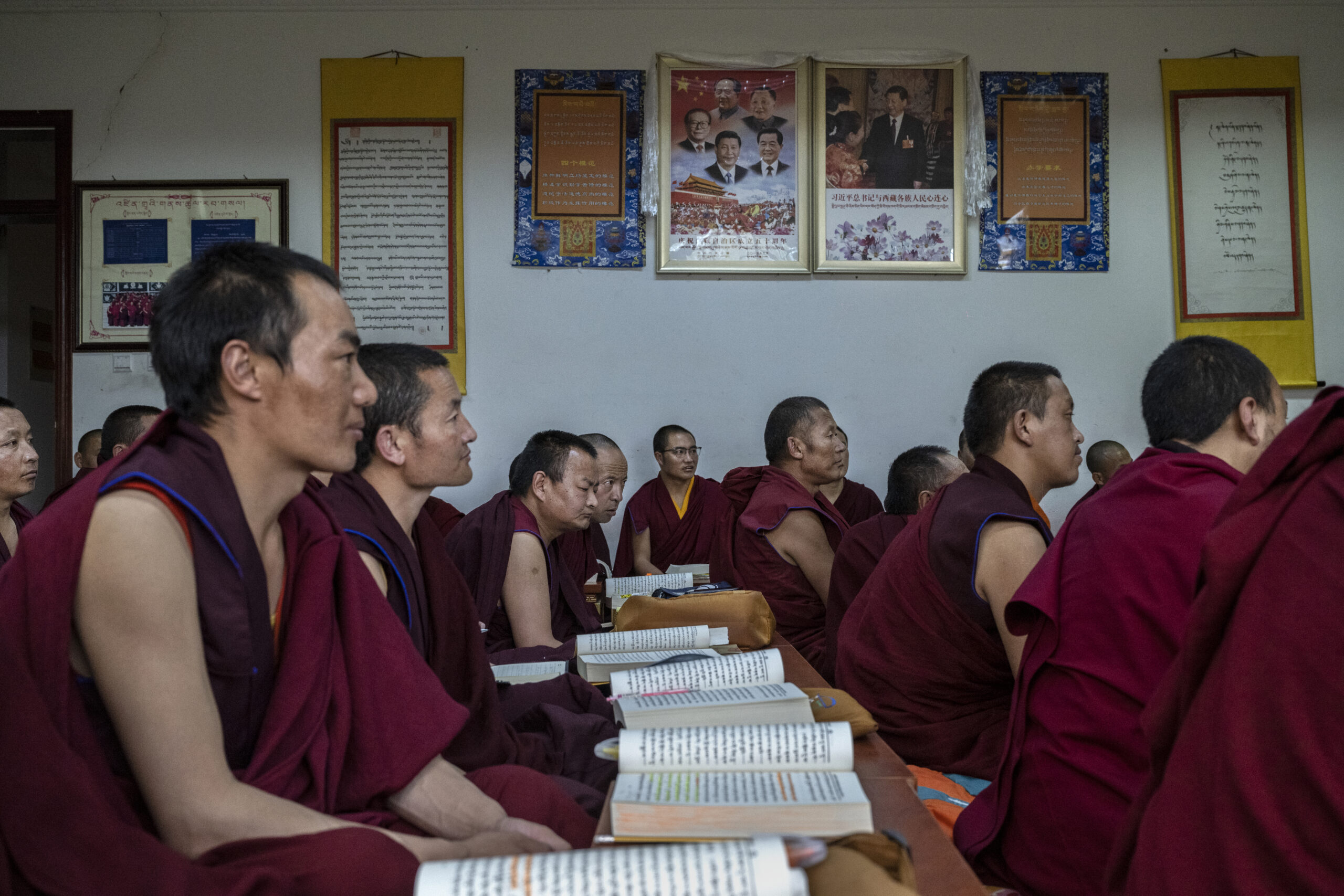
Tibet is one of the most heavily policed regions in the world. Beijing has spent seven decades trying to assimilate the Tibetan people through force. It will never succeed.
March 2026
China’s leaders often speak as though Tibet is a solved problem—an ancient territory “returned” to the motherland, pacified through development, secured through military presence, and integrated through a sweeping architecture of surveillance and political control. Yet the intensity of Beijing’s efforts tells a different story. Few regions under Chinese rule require such constant ideological policing, such heavy securitization, or such elaborate campaigns to reshape identity. The Party’s own internal documents, leaked over the years, concede that Tibetans remain “ideologically resistant” and “politically unreliable.”
The contradiction at the heart of China’s Tibet policy is stark: Beijing is attempting to manufacture national belonging through coercion, but the very need for coercion reveals the absence of genuine legitimacy. The state can suppress Tibetan expression, but it cannot transform Tibetan identity. And because identity—not infrastructure, not GDP, not propaganda—is the core of the conflict, China’s Tibet problem is not a temporary challenge. It is structural, enduring, and ultimately unsolvable on the terms Beijing has set.
A Political Problem Miscast as a Security Threat
From the Chinese Communist Party’s perspective, Tibet is a frontier whose loyalty must be guaranteed at all costs. The Party’s narrative frames Tibetans as a “backward minority” uplifted by liberation in 1951, whose resistance is the product of foreign manipulation or religious “superstition.” This framing allows Beijing to treat Tibetan dissent as a security threat rather than a political grievance.
But Tibet’s resistance is not the product of misunderstanding or foreign interference. It is the expression of a national identity that predates the People’s Republic by centuries. Tibetans do not see themselves as Chinese, and no amount of political education can convince them otherwise.
The Party’s response has been to double down on securitization. Tibet today is one of the most heavily policed regions in the world. Grid-style neighborhood surveillance, informant networks, facial-recognition cameras, and police stations embedded in monasteries form a system designed to detect and deter even the smallest expression of dissent.
Yet this vast security apparatus has not produced loyalty. It has produced silence—and silence is not consent.
The Limits of Assimilation
Beijing’s strategy in Tibet rests on a core assumption: that identity is malleable, and that with enough pressure, Tibetans can be remade into Chinese citizens who think, speak, and feel as the Party desires. This assumption underlies the three pillars of China’s assimilation project: language replacement, religious control, and demographic engineering.
Language is not merely a tool of communication; it shapes one’s worldview. Beijing’s push to replace Tibetan with Mandarin in schools—especially through the vast boarding-school system that now houses nearly a million Tibetan children—aims to reshape how Tibetans think, dream, and relate to the world.
But language suppression has not erased Tibetan identity. Families continue to teach prayers, stories, and songs at home. Monasteries, though tightly controlled, remain centers of cultural preservation. Even in exile, Tibetan communities maintain linguistic continuity. The Party can mandate the language of instruction, but it cannot extinguish the emotional and spiritual resonance of Tibetan speech.
Similarly, Tibetan Buddhism is not simply a faith; it is the foundation of Tibetan civilization. The Dalai Lama is not merely a religious figure; he is the embodiment of national identity.
Beijing’s attempts to control Tibetan Buddhism—by appointing reincarnate lamas, rewriting monastic curricula, and criminalizing loyalty to the Dalai Lama—misunderstand the nature of spiritual authority. Legitimacy in Tibetan Buddhism does not flow from political committees. It flows from lineage, practice, and the recognition of the faithful. The more the state interferes, the more Tibetans cling to their traditions. Beijing can regulate monasteries, but it cannot command belief.
Nor is demographics destiny. China has encouraged large-scale migration of Han settlers into Tibetan areas, transforming the urban landscape and shifting economic power. Yet demographic change has not dissolved Tibetan identity. Instead, it has deepened the sense of being colonized in one’s own homeland.
Belonging is not determined by census figures. It is determined by history, memory, and cultural continuity—none of which Beijing can erase.
Why the Problem Persists
China’s Tibet dilemma persists because the Party’s approach is built on three flawed assumptions:
That economic development can buy loyalty. Beijing has invested heavily in infrastructure, mining, and urbanization in Tibet. But development without political agency is experienced not as empowerment but as extraction. Roads and railways facilitate resource removal and troop movement as much as they improve local life. Tibetans understand this. Economic growth has not translated into political acceptance.
That repression can extinguish identity. The Party believes that with enough surveillance, enough arrests, and enough ideological training, Tibetans will eventually internalize Chinese identity. But repression does not erase identity; it hardens it. Cultures under pressure do not dissolve—they become more self-conscious, more deliberate, more resilient.
That time is on Beijing’s side. Chinese officials often suggest that assimilation is inevitable—that younger Tibetans, educated in Mandarin and raised under Party rule, will eventually see themselves as Chinese. Yet the evidence points in the opposite direction. Young Tibetans, both inside Tibet and in exile, are among the most committed to cultural preservation. They are digitally connected, politically aware, and deeply conscious of their heritage. Time is not eroding Tibetan identity. It is renewing it.
The International Dimension Beijing Cannot Escape
Tibet is not merely a domestic issue. It is a global one, shaped by international law, geopolitics, and the moral authority of the Dalai Lama.
For Beijing, the Dalai Lama is a political obstacle. For Tibetans, he is the embodiment of their nation. His global stature ensures that Tibet remains on the international agenda, despite China’s efforts to isolate the issue. Beijing’s plan to appoint its own Dalai Lama after the current one passes is likely to deepen, not resolve, the conflict. Tibetans will not accept a state-appointed spiritual leader. The result will be two Dalai Lamas—one legitimate, one political—ensuring decades of further tension.
China insists that Tibet is an internal matter. But the principles of self-determination and cultural rights are embedded in international law. Tibet’s historical status, while contested, is not irrelevant. The fact that Tibet functioned as a de facto independent state for long periods complicates Beijing’s narrative of “liberation.”
As global attention to human rights grows—especially in the wake of China’s actions in Xinjiang—Tibet’s situation is increasingly viewed through the lens of international norms, not Chinese sovereignty claims.
Tibet’s strategic location—bordering India, Nepal, Bhutan, and Myanmar—ensures that it remains geopolitically significant. China’s militarization of the Tibetan plateau has reshaped the security landscape of the Himalayas, contributing to tensions with India and complicating regional stability. Tibet is not merely a cultural frontier. It is a strategic one, and its instability has implications far beyond China’s borders.
The Future Beijing Cannot Control
China’s Tibet problem is not a policy failure. It is a structural contradiction between an authoritarian state that demands uniformity and a civilization that insists on being itself.
China’s leaders often speak as though history bends inevitably toward assimilation. But history suggests the opposite. Nations denied self-expression do not fade; they deepen their sense of purpose. Cultures under pressure do not disappear; they endure.
Tibetans have survived exile, occupation, and cultural assault. They have preserved their language, their faith, and their dignity. They have raised new generations who know exactly who they are.
China’s problem with Tibet is not that Tibetans resist. It is that Tibetans endure—and will continue to endure long after the current policies, and perhaps even the current political system, have passed.
Khedroob Thondup is the nephew of the Dalai Lama.
Copyright © 2026 National Endowment for Democracy
Image credit: Kevin Frayer/Getty Images
|
FURTHER READING |
||
Beijing Wants to Erase Tibet’s Name. Don’t Let Them.The Chinese Communist Party is attempting to rename the Tibetan people’s homeland, part of a wider effort to eradicate Tibet’s cultural identity. For Tibet, it’s more than just a name. |
Breaking Han Silence |
China at the UN: Choking Civil SocietyBeijing is using red tape, procedural rules, and a little help from its authoritarian allies to strangle NGOs seeking to participate in the world body. |