
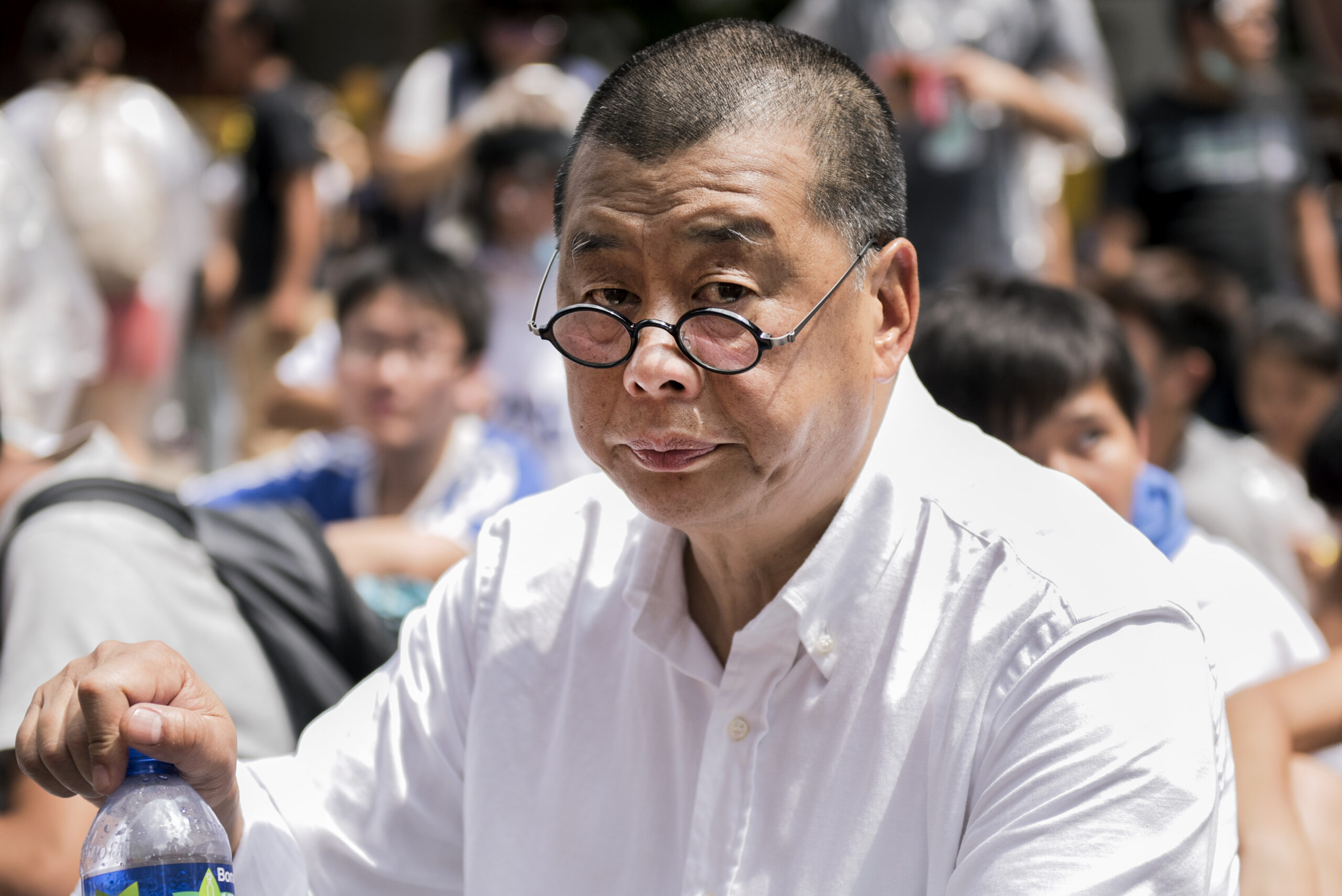
Newspaper publisher Jimmy Lai was just sentenced to twenty years in prison. His persecution offers a window into how freedom has been undone in Hong Kong. It should be a warning to us all.
February 2026
The world stood in shock on February 9, 2026, when 78-year-old newspaper publisher Jimmy Lai was sentenced to twenty years in prison, virtually a life sentence, for his efforts to promote democracy and human rights in Hong Kong. The Beijing and Hong Kong governments have branded Lai a dangerous criminal who deserves severe punishment. The persecution of Lai amounts to an autopsy of how freedom has been undone in Hong Kong through the degrading of liberal safeguards under what Beijing officials promote as “executive-led government,” essentially jargon for an illiberal system. In an age when political leaders in many democracies are promoting a similar illiberal agenda, it raises questions about the survival of basic freedoms and the consequences that follow when they fail.
How was freedom undone in Hong Kong? How was one of the most vibrant cities in the world silenced? It is useful to understand this process through the lens of one individual targeted by Hong Kong’s newly repressive regime. At the same time, the impact on Jimmy Lai, as horrible as it is, extends well beyond one man himself, as it underscores the costs of speaking out in the face of an illiberal authoritarian order. A clear message compelling silence has been sent.
A Promised Liberal Constitutional Order
Is Jimmy Lai a dangerous criminal? If so, then millions of Hong Kong people who joined a long string of weekly protests in 2019 are similarly guilty. The 1984 Sino-British Joint Declaration, the treaty for Hong Kong’s return from Britain to China, promised the territory the elements of a liberal open society. It guaranteed sixteen human rights, half of which related to free speech in one form or another. It further guaranteed maintenance of the rule of law, along with judicial independence. The continuing application of the International Covenant on Civil and Political Rights—as existed in the city’s colonial constitution and almost verbatim in a local Bill of Rights ordinance—was also assured. Such liberal guarantees were in fact included in the Basic Law, the post-handover constitution.
After the 1997 handover, and for roughly the next twenty years, these human-rights and rule-of-law guarantees were largely adhered to. In the face of grousing by mainland officials, the courts exercised constitutional judicial review to uphold basic freedoms under the Basic Law. Various human-rights rating services typically rated Hong Kong among the most-free places in the world, with its rule of law likewise rated highly. A liberal order existed, despite a limited democracy.
The Joint Declaration likewise committed to elections for both the chief executive and the Legislative Council. The Basic Law makes this even more explicitly democratic, promising the “ultimate aim” of “universal suffrage” in selecting both the chief executive and the Legislative Council. Such guarantees were considered essential to confidence in such an arrangement in a society where about half the population, in one generation or another, had fled the mainland’s Communist repression and where international investors were skeptical of Beijing rule. Progress in realizing this “ultimate aim” was slow and ultimately obstructed.
Despite the Basic Law’s clear language, Beijing has taken a different view. As articulated in a recent speech by Xia Baolong, the Director of the Hong Kong and Macao Affairs Office of the State Council, Beijing officials have promoted a notion of “executive-led government,” which is understood to preclude checks and balances. In his speech, Xia referred disparagingly to the “so-called separation of powers” and highlighted the need “for all three branches to work in concert” under the “leadership of the executive.” He also passionately defended the “patriots only” elections, imposed by Beijing in 2021, that have effectively barred opposition candidates, many of whom now have been jailed.
Lai was long a human rights defender and an active supporter of legal prodemocracy protests at home and similarly legal lobbying efforts abroad. Prior to Beijing’s imposition of the National Security Law (NSL), his efforts, like that of many human-rights advocates and NGOs he supported, included calls for foreign governments to speak out against the failure to carry out Beijing’s democratic commitments under the Joint Declaration and the Basic Law. He also lent financial and media support to NGOs calling for sanctions to pressure officials on these commitments. The mantra of all the protests Lai supported was nonviolence, and the lobbying abroad likewise posed no violent threat to China or Hong Kong.
Deploying the National Security Law
Prodemocracy protests in Hong Kong had previously drawn heavy-handed police tactics and arrests, especially the Umbrella Movement in 2014 and during the many weeks of protests in 2019. Still, they were not met with a wholesale crackdown and suspension of rights until Beijing imposed the NSL in late June 2020. The NSL effectively branded human-rights and democracy advocacy as subversion and collusion with foreign forces. In an additional charge, Lai’s critical writing and speaking about government failures were cast as sedition under the preexisting colonial statute, allegedly for causing “disaffection, hatred or contempt” toward the government. But such sedition charge accounts for only a small portion of his twenty-year sentence, as sedition at that time carried a maximum sentence of two years.
After the imposition of the NSL, as noted in the court judgment, Lai openly called on his media staff to temper their demands to stay within the requirements of the NSL. Advocacy then shifted to a more limited criticism of government policy and calls for outsiders and the media to speak up. Several of those staff members would later receive lengthy sentences of up to ten years in the same prosecution.
Unfortunately, the Beijing and Hong Kong governments had long viewed Lai’s opposition newspaper, Apple Daily, with contempt and quickly moved, beginning in August 2020, to arrest him and eventually to shut down his newspaper.
Lai’s shift in tone after the imposition of the NSL posed a dilemma for the prosecution and the court. While his advocacy efforts before the NSL, which were not covered by the statute, likely violated the draconian provisions of this new law, the case against him for his behavior after the law’s imposition didn’t appear sufficient. There was a need to somehow bootstrap his long years of advocacy to the case.
In the NSL, Beijing had anticipated the difficulty of enforcing its illiberal agenda in erstwhile liberal Hong Kong by taming its courts. They accomplished this by including provisions in the NSL that a presumption against bail would effectively apply, that a three-judge panel of specially selected “national security judges” could replace the right to a jury, and that access to a lawyer of choice could be truncated. Each of these measures was applied to Lai, denying him bail, a trial by jury, and his lawyer of choice. Like Lai, most defendants now facing national-security charges in Hong Kong spend years in jail before their cases are even called.
The Judgment and Sentence
In its conviction of Lai, the three-judge panel fully embraced the prosecution’s case, using his advocacy before the NSL to brand him as a subversive with long-held contempt for the Chinese Communist Party. They condemned his promotion of “Western values” and concluded that it was “implicit” that he still had these aims in his brief advocacy after the imposition of the NSL. By this magic, his human-rights advocacy before the NSL became the primary proof of a dangerous crime under the new law. Further, his prior human-rights advocacy and support for human-rights NGOs to lobby foreign governments became collusion with foreign forces, the target of two of the three charges against him.
On a separate charge, under the still applicable colonial sedition ordinance, some 161 of his newspaper articles were deemed seditious for “inciting disaffection” and engendering “hatred or contempt” of the government. This ignored the reality that policy arguments about extreme government policies may by their nature breed contempt. To find otherwise is to ban criticism of extreme government policies, as has been done under the NSL. Press freedom and free expression more generally were given little thought.
Lai’s conviction and twenty-year sentence not only deprives a respected newspaper publisher and democracy defender of his freedom, likely for the remainder of his life, but it destroys press freedom more broadly. It also serves as a warning of the likely consequences of the illiberal trends we are seeing unfold across the globe.
Rather than two decades in prison, Jimmy Lai deserves to be lauded and celebrated for his years of support for the solemn human rights commitments made in the Joint Declaration and the Basic Law, and for his willingness to remain in Hong Kong despite the dangers he faced. His immediate release from prison should be a central demand of liberal democracies everywhere.
Michael C. Davis, formerly a law professor at the University of Hong Kong, is a professor of law and international affairs at O.P. Jindal Global University in India. He is author of Freedom Undone: The Assault on Liberal Values and Institutions in Hong Kong.
Copyright © 2026 National Endowment for Democracy
Image credit: ALEX OGLE/AFP via Getty Images
|
FURTHER READING |
||
Fighting for Democracy Is a Crime in Hong Kong
|
Hong Kong: How Beijing Perfected RepressionWith the new National Security Law, the Chinese Communist Party has honed its more sophisticated tool for hollowing out the city, whose rights and freedoms Beijing had once promised to respect. |
Crackdown: Hong Kong Faces Tiananmen 2.0Liberty flourished in Hong Kong, but the Chinese Communist Party has crushed it. Beijing wants “capitalism without freedom” in the city, but can there be one without the other? |