
Africans don’t want military rule. They want generals to rid them of bad leaders, and then return to the barracks. But once in power, military leaders often have other ideas.
By Michael Yekple and Zlatin Mitkov
March 2026
Since 2020, a wave of coups has overthrown governments in Mali, Guinea, Burkina Faso, Niger, Gabon, Madagascar, and, most recently, Guinea-Bissau, often amid popular support from citizens in the streets. In total, there were eleven coups in Africa between 2020 and 2025, bringing the total count in Africa since 1950 to 112 coup attempts and 111 successful coups, according to data compiled by Jonathan Powell and Clayton Thyne.
This is happening at a time when most citizens of African countries still say they prefer democracy to nondemocratic alternatives, including military rule. Afrobarometer’s latest round of surveys finds that about two-thirds of Africans (66 percent) prefer democracy to any other political system; as many outright reject military rule (66 percent), while even larger majorities reject one-man (80 percent) and one-party (78 percent) rule. Nevertheless, a majority (54 percent) would support a military takeover in response to elected leaders abusing their power; the share is even higher among young people between the ages of 18 and 25 (58 percent). Yet according to our analysis of a more recent round of Afrobarometer data, a large majority of those who support military intervention to oust bad leaders also want the military then to hand power back to another elected civilian administration and return to the barracks.
While this combination of strong support for democracy and rising preference for military coups may seem contradictory, it is better understood as an emerging pattern in which many African publics are asking their militaries to intervene in politics to restore order in their dysfunctional democracies.
But the militaries that African publics are inviting to do this “resetting” of democracy rarely share that short-term vision of a temporary foray into politics. The conduct of recent coup leaders instead exhibits a pattern of permanent entrenchment. Thus the gap between what citizens and their armed forces want is quickly becoming a major threat to democracy in Africa.
A Last Resort, Not Nostalgia
Afrobarometer’s Round 9 (2021–23) survey asked respondents across 39 African countries for the first time to choose between one option stating that the country’s “armed forces should never intervene in the country’s political process” and another stating that “it is legitimate for the armed force to take control of the government when elected leaders abuse power for their own ends.”
Across these countries, the pattern is consistent. About two-thirds of Africans prefer democracy over any other form of government and oppose military rule as a permanent regime. However, a majority are willing to accept military intervention if leaders abuse their power. Abuse of power in this context usually means rigging elections, undermining constitutional rules, violating human rights, and suppressing dissent.
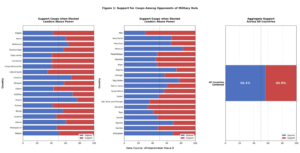
As Figure 1 shows, across 39 African countries, 56 percent of the public who oppose military rule as a form of government support military coups when elected leaders abuse their power. In fourteen countries — including Guinea and Mali, which have recently experienced coups, as well as Togo, Tanzania, and Côte D’Ivoire — more than 50 percent of the populace supports military coups in response to elected leaders abusing their power. Not so coincidentally, these countries with high numbers of coups are also where incumbents have engaged in constitutional manipulations to aggrandize political power.
In other words, support for coups is far from an ideological commitment to military rule. It is instrumental and conditional, a last-resort accountability strategy when elections, courts, and legislatures seem incapable of disciplining wayward elected leaders.
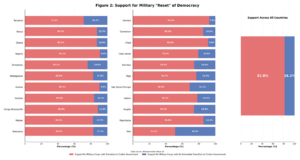
The most recent Afrobarometer wave (2024–25) added a new question that further explores this disposition by linking military intervention to the restoration of civilian rule. Our analysis of this question for 22 African countries for which data are available shows that the majority of African publics see the military as a temporary means to reset democracy (Figure 2). They expect the armed forces to intervene when civilian leaders manipulate the system and then exit once the situation is corrected. Citizens do not endorse prolonged military control, but many do support a brief corrective reset.
Bad Democrats, not Bad Democracy
Public support for coups stems from genuine grievances. Across the continent, elected leaders have increasingly engaged in undemocratic practices. They have evaded term limits, altered constitutions, politicized courts and the rule of law, unleashed their security forces against citizens, abused human rights, and cracked down on dissent.
Take Guinea. Alpha Condé became the country’s first democratically elected president in 2010, but over a decade, his government came to symbolize corruption and repression. In 2019, Condé pushed through a controversial constitutional referendum that reset term limits and allowed him to run for a third term in 2020, amid protests and lethal crackdowns. Many Guineans saw this as a constitutional coup. When Colonel Mamady Doumbouya’s Special Forces ousted Condé in 2021, they justified the takeover by citing corruption and poverty, but many believe that the constitutional manipulation garnered support for the coup.
In Mali, President Ibrahim Boubacar Keïta entered office in 2013 promising reform, but by 2020 he faced mass protests over corruption, an electoral crisis, and the state’s failure to contain jihadist violence. Soldiers who overthrew him in August 2020 claimed they were acting in response to popular demands to end misrule and insecurity. In Côte D’Ivoire, Alassane Ouattara manipulated the constitution to allow him a third and fourth presidential term while also instigating the disqualification of electoral rivals in the 2025 election. And in Uganda, Yoweri Museveni, president since 1986, pursued constitutional amendments to remove both term and age limits in order to stay in power. Similar manipulations of democratic institutions took place in where incumbents have also cracked down on citizens protesting these moves.
These cases are part of a larger trend. Survey data across the continent reveal increasing dissatisfaction with democracy and a growing disconnect between citizens’ demand for democratic norms and leaders’ ability or inclination to meet those expectations.
When elected leaders manipulate democratic constitutions to stay in power, coopt electoral commissions, harass opposition parties, and pack courts, many citizens stop believing that elections can remove abusive leaders. Put differently, the problem is that elected leaders have become very bad democrats, not that democracy itself is bad. In such contexts, the military starts to look — wrongly but understandably — like the only institution that can impose real consequences on incumbents.
The Reset That Never Ends
Citizens may imagine a brief interlude to reset democracy, but there is no guarantee that will happen.
The debate about whether coups are good or bad for democratic transitions has been going on for years. A recent study by Marianne Dahl and Kristian Skrede Gleditsch attempts to settle that question, finding that coups do not necessarily lead to democratic transitions. Whether they do or not depends largely on one key factor: popular mobilization accompanying coups. According to Dahl and Gleditsch, when a popular mobilization occurs alongside coups, it empowers civil society to demand a postcoup democratic transition and can make coup leaders feel vulnerable enough to have to grant such a concession.
In West Africa, where armed forces have recently seized power, the civil society space has been hollowed out. In Mali, opposition protests are banned, and journalists, activists, and civil society groups suffer harassment and intimidation, making coordinated pressure for a democratic transition extremely risky. In Burkina Faso, the military junta has abducted and detained opposition figures, forcibly conscripted critics, and cracked down on critical media, deterring civil society and citizens from openly challenging the junta administration or demanding a return to civilian government. And in Guinea and Niger there has been a widespread crackdown on dissent and on prodemocracy activism, making it virtually impossible for civil society to organize the large, sustained mobilizations necessary to push for a democratic transition. In Gabon, the junta promised to transfer power to a civilian government, while the junta leader appointed himself as the transition president. After appointing loyalists to key offices overseeing the drafting of a new constitution, thereby marginalizing opposition voices from the transition process,, the junta leader resigned from the military to put himself up as candidate in a rushed election in which he won more than 90 percent of the vote. In Guinea-Bissau, following the country’s coup in late 2025, the military has announced a one-year transition period. However, a democratic transition is hardly assured, as the military disrupted an ongoing election to advance its coup.
During the recent wave of coups, we have not seen the kind of popular mobilization that empowers civil society, and coup leaders have not made the type of concessions — such as establishing credible transition timetables for elections, permitting opposition activity, conceding to demands from popular protests, or making institutional reforms that broaden political participation — that allow coups to lead to democratic transitions.
From 1950 to 2010, Africa experienced more coups than any other world region according to Powell and Thyne. Yet in the post–Cold War years, many of those coups eventually led to elections. A later study updating that finding takes into account the recent takeovers on the continent and identifies a broader emerging trend that departs from the previous pattern of postcoup democratic transition.
According to Powell and Hammou, from 2002 to 2020, the median period that coup leaders held on to power before transferring it was 22 days. Since 2020, however, we have been seeing something different. Political transitions are taking longer — and, more concerning, military coupmakers no longer bother to promise that they will return power to elected governments, let alone communicate a timeline for doing so.
Leaders of the recent coups have found reasons to extend democratic transitions, delay election timelines, disband political parties and electoral commissions, and relax or remove restrictions on junta members running for office. Specifically, coup leaders in Chad and Gabon held elections solely to formalize and entrench their own positions in politics, and none of the remaining 2020–25 coups have resulted in a return to civilian rule.
When we analyze armed forces’ postcoup legal and institutional choices — prolonged transitions, no pledges to relinquish power, drafting constitutions that entrench coup leaders in politics — they are best understood as the revealed preferences of those leaders. Whatever promises they may have made initially, or whatever the public expects of them, their actions show a clear preference not to transfer power quickly to a civilian government.
The result is a divergence between public expectations of a short intervention to restore democracy and the reality of armed forces’ desire to hold on to power. Why do the preferences of citizens and soldiers deviate so sharply?
For many citizens, supporting a coup is a targeted and time-bound decision. They are punishing a specific leader or regime they see as having broken the democratic contract — by rigging elections, changing term limits, or presiding over rampant corruption. People expect that once the immediate problem is removed and the rules are reset, politics will return to something closer to normal.
For militaries, by contrast, seizing power is an opportunity to restructure the entire political order around their own corporate interests. Once in charge, they can expand defense budgets, place loyal officers in key economic and administrative posts, shield themselves from scrutiny and prosecution for past and present abuses, and reorient foreign and security partnerships to maximize regime survival.
Research on civilian praetorianism shows that coup leaders are acutely aware of public opinion and international perceptions. Today’s juntas portray themselves as saviors of their countries and their people, and claim that their aim is to eliminate corruption and restore stability and sovereignty. What they deliver, however, are indefinite timelines, restrictions on civil society space, and aggrandizement of their power. In short, citizens’ willingness to tolerate coups is conditional and finite, while soldiers’ incentives to stay are structural and persistent.
Escaping the Military Reset Trap
What can African democrats — including elected leaders, civil society organizations, and prodemocracy movements — and their regional and international partners — do to avoid this trap?
First, they should view support for military intervention as a warning signal, not a solution. When half or more of a country’s citizens say they could accept a coup if elected leaders are abusing their power, it is a measure of how badly democratic institutions have failed, not evidence that people have turned their backs on democracy. Afrobarometer data show resilient demand for democratic norms even where tolerance of coups has risen.
Second, African democrats and their allies should help rebuild nonmilitary accountability mechanisms. When parliaments, courts, audit agencies, and electoral commissions are captured, citizens turn to soldiers. Strengthening these institutions — legally, financially, and in terms of public credibility — will make the army seem less like the only remaining check on executive abuse. Specific measures include designing truly independent electoral commissions, protecting judicial tenure and funding, and resourcing anticorruption bodies that can investigate those in power.
Finally, regional bodies that engage in democracy promotion must close the gap between how they treat “constitutional coups” and how they treat military ones. It’s time organizations like the African Union and ECOWAS sanctioned elected leaders who extend their terms and manipulate constitutions just as they do armed forces’ overt seizure of power. The failure of regional organizations to enforce democracy and good-governance norms against the illiberalism of elected leaders has reinforced grievances that fuel support for military coups.
Asking for One Thing but Getting Another
Across the continent, Africans are sending a clear message. Most still want competitive elections and civilian government. But they are increasingly willing to call in the military when civilian leaders abuse their power and rig the rules.
These citizens are not longing nostalgically for generals in sunglasses. What they want is to restore basic democratic accountability when democratic institutions seem captured. Citizens are asking the military to act as a temporary reset button — to remove the worst offenders, level the playing field, and then leave. Yet the behavior of recent coup leaders who have taken control suggests that citizens are likely to face something different. Militaries are staying in power indefinitely and writing new constitutions that, rather than renewing democracy, are enabling juntas to entrench themselves.
Unless African democrats can rebuild credible civilian mechanisms for disciplining power, the temptation to press the military reset button will remain. And with each new reset, the risk grows that the very armed forces called in to save democracy will instead become the main obstacle to its return.
Michael Yekple is visiting assistant professor of government at Bowdoin College. His research focuses on African peace and security; international relations of Africa and the Global South; and governance and democratization in Africa. Zlatin Mitkov is assistant teaching professor in the School of Public and International Affairs at North Carolina State University. His work focuses on political psychology and public opinion and disinformation.
Copyright © 2026 National Endowment for Democracy
Image credit: PATRICK MEINHARDT / AFP via Getty Images)
|
FURTHER READING |
||
African Coups and the Elite-Forces Trap |
The Truth About Africa’s CoupsPraetorian politics are not making a comeback. Africa’s recent putsches have more to do with democracy’s failure to deliver than any fondness for military rule. |
The Myth of the Coup ContagionMany fear that coups are making a comeback. While this is not true, one thing is alarming: Anti-coup norms are starting to erode. |