
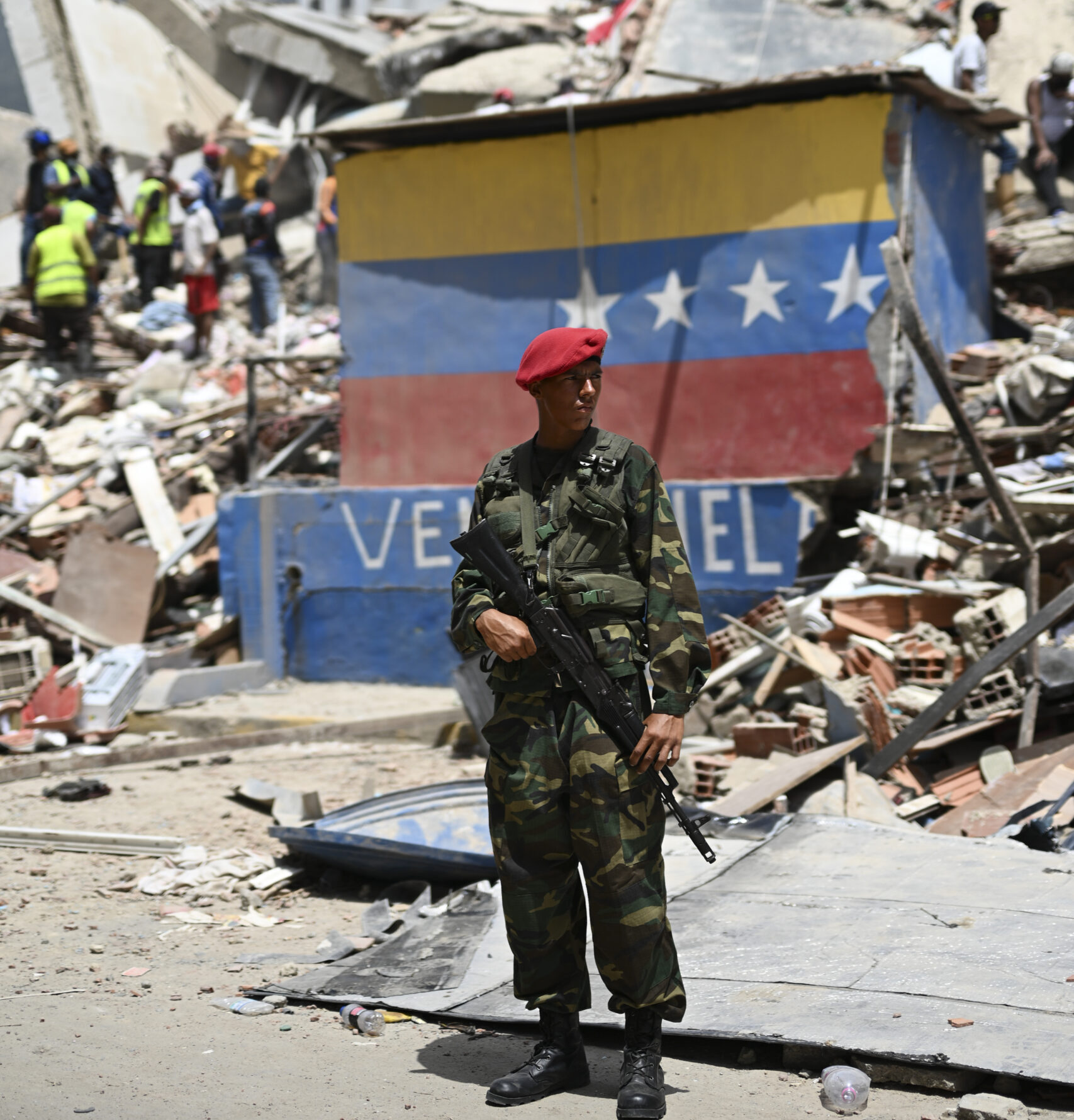
From state officials taking selfies amid the rubble to soldiers looting, Venezuela’s earthquake response reveals why corrupt authoritarian governments fail so badly when disasters strike.
By Maryhen Jiménez, Rebecca Hanson, Benedicte Bull, and Verónica Zubillaga
July 2026
Disasters expose governments. Not because they are exceptional events, but because they are revealing ones. When the ground shakes, the state either functions or is seen not to. When tragedy leaves people with no recourse other than to turn to the government, it soon becomes clear whether that government is poised to actually serve.
On June 24, two massive, back-to-back earthquakes struck northwestern Venezuela — the first a 7.2 magnitude, and the second a 7.5. The death toll has now surpassed 3,800, with thousands more injured.
Research on disaster mortality has established that what determines how many people die is not primarily the disaster itself but the institutional environment surrounding it, including the capacity of the state to coordinate a response, the existence of functional emergency services, and the quality of building regulation. Research focused specifically on earthquakes shows that higher levels of public-sector corruption are associated with higher death tolls. Corrupt and incompetent states fail before the shaking starts, leaving buildings uninspected and codes unenforced. Then they fail again afterward, unable to mount a coherent response.
What the cameras have been capturing since June 24 in the badly damaged Venezuelan port city of La Guaira outside Caracas fits this pattern with a precision that researchers rarely get to observe in real time. Security forces were not only slow to respond, but reportedly stood at collapse sites without assisting in rescue efforts. Others restricted access along roads into the affected areas, delaying or turning back volunteer rescue and aid teams. Uniformed security personnel were also seen clustering at the edge of rubble fields, seemingly without orders, without equipment, and without any evident understanding of what they were supposed to do.
While some civil protection services and fire brigades were present — though critically underresourced — in certain communities, it was ordinary citizens and international rescue teams from Europe, Latin America, and the United States who were doing the heavy work of pulling people from concrete. What the cameras have been recording is not a state overwhelmed by an exceptional disaster. It is a state exposed for what it is: a machine built to extract resources and perform loyalty, not to govern or to serve its citizens.
A Legitimacy Long Exhausted
Videos circulating on social media show military men standing idle by the wreckage while residents dig with their hands, shouting at soldiers to help. In one widely shared clip, a citizen berates a group of soldiers and challenges them to show the same force in La Guaira with a pickaxe and shovel that they use to crack down on protesters. Police and National Guard officials were also seen posing for photographs at a collapsed building in Los Corales, with five bodies wrapped in blankets a few feet away, before leaving without doing any work.
But Venezuelan officials have done worse than simply not helping. In one instance, military personnel took the phone of a Chilean rescue worker they suspected of espionage as he tried to consult with medical experts via video call about how to remove a teenager from the rubble without causing further injury. In another, a group of officers were caught looting a hotel. Police and military personnel have been accused of stealing from homes and from the dead. And in yet another, a Caracas construction-company owner who drove a jackhammer to La Guaira — just 14 kilometers away — to help clear the rubble spent two days navigating police demands for permits and receipts before he could reach his destination.
At the Vallarta building in Playa Grande, Catia La Mar, a group of women confronted a Scientific, Penal, and Criminal Investigations Corps officer who reportedly tried to remove a box of dollars from the rubble, snatched it away from him, and tore up the bills. Rage like this has erupted across affected sites. But it is not spontaneous; it is accumulated — years of built up anger and resentment at a state that has been largely absent and, when present, has inflicted harm.
Scholarship on authoritarian legitimation strategies argues that nondemocratic regimes survive through three overlapping claims: identity, procedure, and performance. Chavismo exemplifies this: The Bolivarian Revolution supplied the identity. Elections, increasingly manipulated and unfree, supplied procedural cover. And social spending during the oil boom supplied performance legitimacy.
In 2013, Nicolás Maduro inherited a regime whose identity component largely faded with Hugo Chávez’s death, whose procedural claims collapsed with the stolen 2024 election, and whose performance has evaporated with declining public services, economic vulnerability, and rampant corruption. At the core of these transformations lies the packing of state institutions with loyal officials, not necessarily trained ones.
Moreover, in most poor Venezuelan neighborhoods, the government has deployed lethal militarized policing instead of providing public security and outsourced control to armed progovernment groups known as colectivos and criminal groups operating with state tolerance. Scholarship on violence under Chavismo has traced how failed police reform, militarized security policy, and the politicization of law enforcement produced an apparatus often oriented less toward public safety than toward spectacular performances of violence in popular sectors and territorial and political control. Between 2016 and 2019, state-security forces killed around five-thousand people a year, accounting for anywhere between 21 to 44 percent of all violent deaths in the country depending on the year. These figures describe a state that has deployed its institutions, including the security forces, against its own population.
What we are seeing in La Guaria and other affected areas is a population turning against precisely these institutions — the ones that showed up too late and, when they finally did, either stood to the side or looted what they could from the rubble. The security forces that arrived in La Guaira are not viewed as a protective institution. Across the country, their presence has long been associated with predation, surveillance, intimidation, extortion, and violence. This is partly because the Venezuelan state, rather than building genuine public-safety institutions, has empowered corrupt and violent security forces and granted them impunity, even as they have increasingly engaged in their own forms of extraction, including bribery, coerced payments, and extortion.
What arrived in La Guaira was the residue of these choices. When people screamed at uniformed officers standing idle at the rubble, they were not simply expressing frustration at an inadequate disaster response. They were delivering a verdict on institutions that have forfeited any claim to public authority. This is what decades of authoritarian predation produce, a population that has lost faith in the very institutions from which it must still demand a response.
A State Built to Extract, not to Serve
A predatory state can be identified by its emphasis on extraction over service provision and regulation, its personalistic rather than institutionalized nature, and its lack of accountability. These characteristics together yield a state structure that essentially aims to funnel resources toward those who control it — to reward loyalty, to survive as a ruling cohort. A predatory state can, for a long time, look like a “developmental state,” especially when resources are flowing.
Under Chávez and Maduro, Venezuela’s state was systematically redesigned toward predation. The national oil company, PDVSA, provides the clearest evidence. Once among the world’s great energy companies, PDVSA was looted from within over two decades. Technical staff were replaced with loyalists. Resources were extracted and not reinvested. Production fell from more than three-million barrels per day in 1998 to just around 900,000 by 2025.
There is a long history behind this predatory, extractive state. Like other countries in the region, the foundations of the Venezuelan state were laid by colonialists whose institutions were oriented toward one goal: the extraction of resources. The discovery of oil in Venezuela in the early twentieth century further exacerbated extractive behavior. Rather than building sustainable fiscal and administrative institutions that emerge from taxing a productive economy, Venezuela became a petrostate — that is, an apparatus whose legitimacy rested on its capacity to distribute resource wealth. Citizens have largely related to the state as recipients, not as rights-bearing taxpayers. Ever since, Venezuelans have expected the state to use oil rents to improve infrastructure, quality of life, and public services.
Meeting this expectation as well as developmental aspirations has meant doubling down on extraction. Chavismo further exacerbated this pattern. The Venezuelan economy became even more dependent on oil while Chávez was in office as the government invested in “revolutionizing” state and society. Under Maduro, the extractive logic continued without the corresponding services and goods associated with his predecessor. What remains is a state not accountable to the population but to the demands of extraction. The missing machinery, the uniformed men standing at the edge of rubble fields without orders, the foreign rescue teams doing the work the state could not: None of it is surprising once we understand what the state was actually built for and who it is meant to serve.
The Transition Discourse and Its Blind Spot
The question that Venezuela is facing now is how the earthquake will impact its political future. Will it be the beginning of a transition toward a different regime or will it provide an excuse for continued authoritarianism? Washington has outlined a three-phase approach to a political transition in Venezuela encompassing stabilization, economic recovery, and eventual political transition, without specifying clear timelines for any of them. Policy analysts have called for merit-based civil-service recruitment and the rebuilding of technical capacity. Diaspora-engagement initiatives treat the millions of people who have left Venezuela as a reserve of human capital awaiting mobilization. Each of these proposals addresses a real dimension of Venezuela’s crisis. None of them adequately engages the problem of political legitimacy.
Venezuela is not a developmental state in need of repair. It is a predatory state whose internal architecture, built around loyalty, extraction, and the systematic replacement of professional capacity with political compliance, is not simply amenable to technocratic fixes. Recruitment, reform, and institutional redesign are necessary but insufficient conditions for recovery. The organizational culture, informal incentive structures, and rules of accountability that define how a state actually functions cannot be replaced through administrative procedures alone. They require open conversations and a new social contract about how the state and society will relate to one another.
Humanitarian emergencies have historically provided governments with a justification to militarize or to postpone openings, and the current situation is no different. The two key players governing Venezuela since the U.S. intervention on 3 January 2026 — the Delcy Rrodríguez government and the Trump administration — are, for different reasons, served by delay. The disaster provides one more reason to counsel patience to the opposition and the population while reconstruction arrangements with current authorities move forward. However, construction investments channeled through authorities and institutions that lack popular legitimacy and accountability risk replicating the patterns of state capture that produced the crisis in the first place. Scholarship on post-authoritarian transitions is consistent on this point: Institutional reconstruction that is not anchored in credible democratic legitimacy tends not to hold.
The earthquakes have further exposed the illegitimacy, fragility, indifference, and incapacity of the Venezuelan state. The disconnect between the population and state authorities will not be resolved by disaster relief, however generously provided, nor by reconstruction financing, however well-intentioned. What Venezuela requires, alongside the material work of rebuilding, is the political work of rebuilding a state that citizens are willing to inhabit, fund, and hold accountable. That is work that cannot be performed from the outside. It belongs to Venezuelans themselves.
The question facing those who hold influence, over Venezuela’s potential transition, especially the United States, is whether they will create the conditions for that work to begin, or whether the opportunity — which will not remain open indefinitely — will be lost to the calculations of those who confuse stability with legitimacy.
Maryhen Jiménez is assistant professor of politics at the National University of Ireland, Maynooth; Rebecca Hanson is associate professor in the Department of Sociology and Criminology and Law and the Center for Latin American Studies at the University of Florida; Benedicte Bull is professor of political science at the Center for Global Sustainability, University of Oslo; and Verónica Zubillaga is Greenleaf Scholar-in-Residence in the Stone Center for Latin American Studies at Tulane University.
Copyright © 2026 JoD Productions
Image credit: Rafael Hernández/picture alliance via Getty Images
|
FURTHER READING |
||
How Machado Can Steer Venezuela Toward DemocracyWhether the capture of Nicolás Maduro leads to democracy depends on Donald Trump — and María Corina Machado’s ability to make a democratic future the only attractive choice. |
Why the United States Shouldn’t Run Venezuela |
How Venezuela Became a Gangster StateNicolás Maduro is a mafia boss, not a president, and the Venezuelan government is now a criminal enterprise with the power of a state. It poses a threat to democracies everywhere. |