
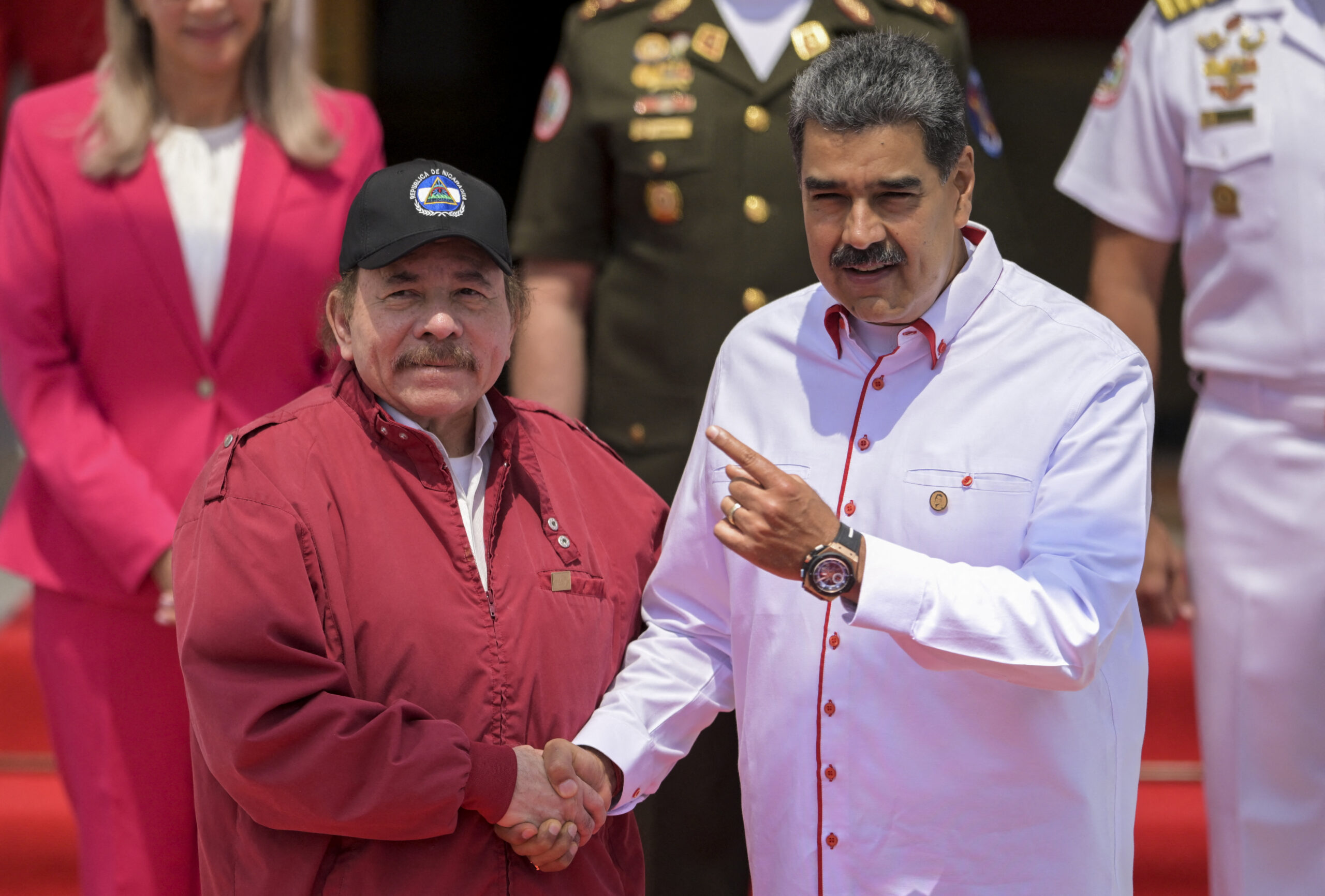
Nicaragua is a corrupt, dictatorial outpost. But it didn’t have to be the case. And its path offers valuable lessons for how to achieve a successful democratic transition in Venezuela today.
By Luis Rivas and Benjamin N. Gedan
February 2026
In his January Senate testimony, U.S. secretary of state Marco Rubio cited Spain and Paraguay as examples of democratic transitions that offer lessons for Venezuela. Not surprisingly, he did not mention Nicaragua, a police state ruled by the Ortega family. Yet Nicaragua offers important lessons for what the United States should and should not do in promoting a political transition in Venezuela following its removal of strongman Nicolás Maduro.
The U.S. intervention in Venezuela marks a historic opportunity for the South American country. For now, President Donald Trump seems most interested in the country’s oil fields and reviving its economy, and he appears satisfied leaving Delcy Rodríguez, Maduro’s former lieutenant, in charge. But Rubio has consistently promised an eventual political transition, following the country’s “stabilization” and “recovery.”
How best to bring about a transition, the third and most complicated phase in that strategy, remains an open question. Success will depend on the right sequencing of political reform after a long period of authoritarian rule, economic collapse, and mass migration.
Latin America’s history of democratic collapse and recovery offers plenty of models to choose from, including Argentina, Brazil, Chile, and Uruguay, all democracies that descended into dictatorship during the Cold War. But in many ways, Nicaragua’s 1990 transition is the most relevant example, despite that story’s unhappy end. Nicaragua’s experience teaches both the path to national reconciliation and the high risk of backsliding absent wholesale structural reform.
Like Venezuela, Nicaragua endured a long period of dictatorship, including 43 years under the Somoza family and a decade under the socialist Sandinistas. Like Venezuela, its illegitimate leaders faced U.S. economic coercion and security threats.
Unlike Venezuela, the United States did not use force to remove the Sandinista dictator, Daniel Ortega, and replace him with his number two. After the U.S.-backed Contra insurgency failed to dislodge the Sandinistas, Washington pressed for negotiations between the regime and its opponents. The United States also reconsidered its unilateral approach and came to coordinate closely with the governments of Costa Rica, El Salvador, Honduras, and Guatemala.
That strategy worked, and it offers best practices for Venezuela’s potential return to democracy. Ortega agreed to an election he thought he’d win, and fourteen opposition parties agreed to back a single candidate, Violeta Chamorro, the wife of a prominent journalist and newspaper publisher assassinated in 1978. In 1990, she defeated Ortega, and with the support of former U.S. president Jimmy Carter, the Organization of American States, and the United Nations, negotiated the Sandinistas’ orderly exit from power.
Had Nicaragua’s story ended there, Rubio might be drawing parallels between Chamorro and María Corina Machado, the Nobel laureate and Venezuelan opposition leader, who stands ready to compete against Hugo Chávez’s heirs should the United States eventually help Venezuelans engineer a free and fair election.
Sadly, the collapse of Nicaragua’s democracy into an even more repressive system has overshadowed Chamorro’s triumph. That collapse, however, makes the Nicaraguan case even more important to study as Rubio plots Venezuela’s political future. Nicaragua’s return to dictatorship makes clear that free and fair elections alone are not enough to consolidate a democracy if underlying political and economic power structures remain intact.
As in Rubio’s three-phase strategy for Venezuela, Nicaragua’s post-1990 leadership prioritized stability and recovery over political and institutional reforms. That seemed reasonable at the time in a country exhausted by war and economic depression. Chamorro and her democratic successors — at the mercy of the Sandinista opposition — chose accommodation over confrontation and coexistence over institutional rupture. Postdictatorship leaders in Argentina, Brazil, and Chile made similar choices in order to reassure military officers suspicious about the civilians atop their chain of command.
As a result, the Sandinistas retained influence over Nicaragua’s military, police, and courts. Daniel Ortega’s brother, Humberto, remained as army commander. Human-rights abuses committed during the dictatorship went largely unpunished.
Those choices reduced short-term risk but created long-term vulnerabilities. Sandinistas had accumulated great wealth and power by plundering the state, both before transferring control and later by taking advantage of hasty privatizations. Its cadres remained intact, protected by a general amnesty that allowed Ortega to rebuild the party machinery.
There were other factors. Chamorro’s uninspiring successor, Arnoldo Alemán, squandered trust and goodwill, including through a notorious pact with Ortega that reduced the threshold to win the presidency in exchange for legal protection against corruption charges and continued political influence. In the 2006 presidential election, the opposition coalition fragmented, allowing Ortega to return to power with just 38 percent of the vote in a three-way contest.
But the absence of structural political reform best explains Nicaragua’s latest chapter, including the massacre of protesters in 2018 and widespread arrests of opposition candidates, priests, and business leaders, including one of these authors. Today, Nicaragua is a brutal, patrimonial state, more despotic than the Somoza dynasty Ortega once fought against.
Worryingly, Venezuela could fall into a similar trap should the United States pressure Rodríguez to hold elections but leave her regime allies in control of the armed forces, the country’s multiple security agencies, progovernment militias, courts, and National Assembly. Just as the post-1990 Sandinistas operated a state within a state, Chavismo will remain immensely powerful if its leaders escape accountability. The state also needs to recover the riches stolen by the “Boligarchs” — the elites enriched by their relationships to Hugo Chávez and his “Bolivarian Revolution.” Legal and illegal Chavista businesses must submit to public scrutiny.
At minimum, to avoid Nicaragua’s fate, the United States should insist upon the professionalization and de-ideologization of Venezuela’s military and other armed state actors, as well as civilian oversight, merit-based promotion, and systematic accountability.
For the same reason, the United States should not blindly prioritize a superficial reconciliation, though that approach might offer short-term stability. To do so would fail the victims of government-directed human-rights abuses, breed cynicism about democracy, and leave the ugliest elements of the regime poised to return to power.
Instead, the United States should work with Venezuelans to design a gradual, but credible, transitional-justice process. That means independent investigations and documentation of abuses, followed by a strategic mix of amnesty and punishment that rebuilds the rule of law without derailing the transition to democracy.
Lastly, Venezuela should rebuild its institutions before the United States declares its mission accomplished. In Nicaragua, the international community celebrated the 1990 election, but neglected to fix politicized courts and regulatory institutions, strengthen political parties, and build robust civil society institutions. That left Nicaragua unprepared to repel Ortega’s efforts to undermine Chamorro and her two democratic successors, divide the opposition, retake power, and dismantle democracy from within.
Venezuela will require soup-to-nuts government reform to repair the wreckage and make sure Chavistas cannot follow the post–Cold War Sandinista playbook. In particular, a transitional government will need to prevent attempts to manipulate the redistribution of state assets, debt restructuring, and any surge in foreign investment. Otherwise, the country will see the emergence of an oligarchy of former socialists that distorts the post-Maduro Venezuelan economy and political system.
All this sounds like nation building because it is. But Rubio rightly dismisses overly pessimistic comparisons to Iraq and Afghanistan. The United States has a chance to help Venezuela avoid the mistakes of post-1990 Nicaragua, when donors and diplomats declared victory prematurely. If the United States builds a strong international coalition to patiently midwife reform, it could help Venezuelans rebuild their democracy and give the United States a stable and prosperous neighbor.
Luis Rivas is a Senior Partner at Varyag Consulting Group and a member of the Advisory Board of the Stimson Center’s Latin America Program. Benjamin N. Gedan is a Senior Fellow and Director of the Latin America Program at the Stimson Center and a fellow in the Latin America Studies Initiative at the Johns Hopkins University School of Advanced International Studies.
Copyright © 2026 National Endowment for Democracy
Image credit: JUAN BARRETO/AFP via Getty Images
|
FURTHER READING |
||
Why Dictators Fear Universal Jurisdiction |
The Threat to Latin American Term LimitsBenjamin N. Gedan and Elias French Latin America remains haunted by the specter of “strongman” rule. Term limits have been a way of guarding against this threat, but aspiring autocrats have now found a new avenue to bypass this barrier to power: courts of law. |
How Venezuela Actually Becomes a DemocracyThe South American country may be on the verge of real change. But it isn’t going to descend into civil-war chaos like Libya. It will be difficult, imperfect, and far better than what Venezuelans have had to endure. |